@MattHennessey@WSJFreeEx Smug. Arrogant. Grandmothers are a force more powerful than you. We were activists in our youth and we know how to change things. I know you're trying to be cute, makes it even worse.
The Texas A&M University Department of Economics is hiring for a macroeconomics position! Please consider applying, and feel free to share this opportunity with others who may be interested in joining our department.
https://t.co/6QPOSpJmV3
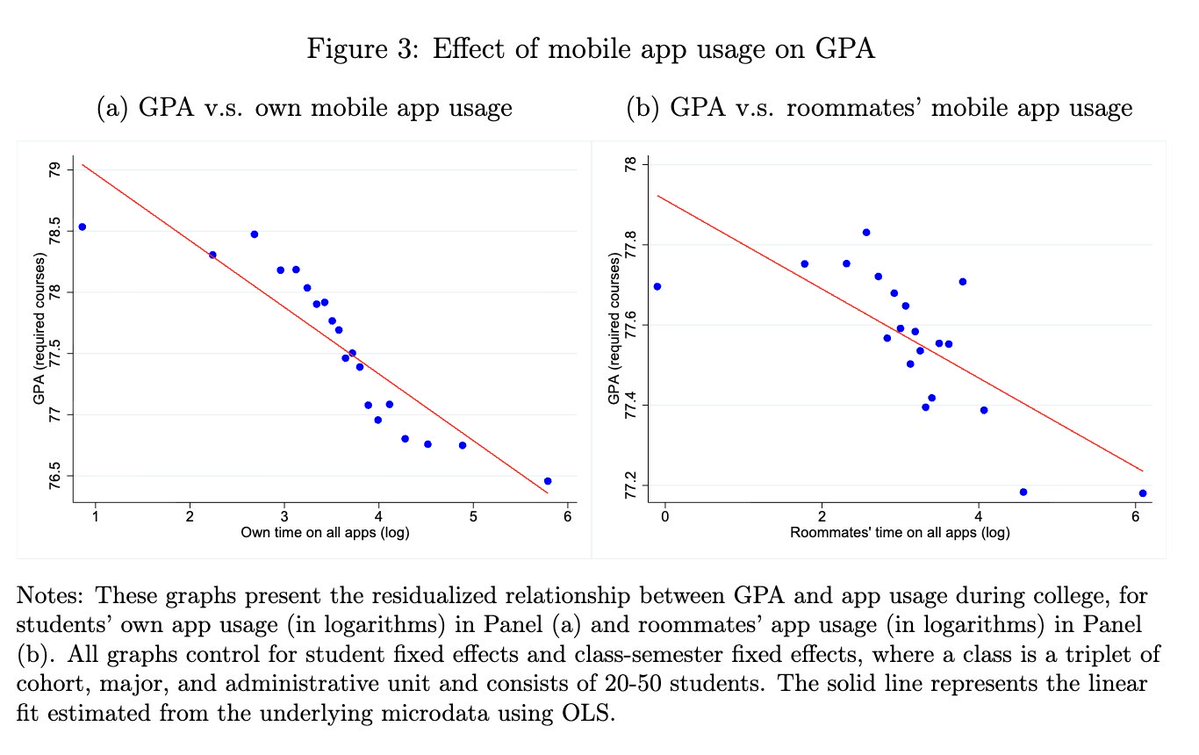
New evidence from over 6,000 college students finds that digital devices are bad for academic performance and even effect peers in negative ways!
Mobile app use reduces grades, increases stress, and lowers class attendance, job applications, and wages coming out of school.
It also impacts the academic performance of roommates (who were randomly assigned). https://t.co/eAtk0WQUsP
Econ 43 (Introduction to Financial Decision-Making) is one of the most popular undergraduate courses at @Stanford . The popularity speaks of the need for personal financial education, including across generations, as we've found students bring knowledge back to their families. This winter, I'm excited to teach a personal finance course open to the public: BUS 09 — Mastering Financial Decision-Making.
Developed by the Stanford Initiative for Financial Decision-Making (IFDM) team, the course draws on two decades of research on financial literacy and financial decision-making and offers evidence-based strategies for navigating today’s financial choices.
I hope you’ll join me. You can attend the course in person (if you live in the Bay Area) or online. Below are the links to register:
- On-campus: https://t.co/xUcdW3CfHQ
- Online: https://t.co/FF3IUHojuU
📲✖️Should phones be banned in classrooms?
Our study with 17,000 students finds:
Removing phones improves grades, especially for struggling students!
🧵
https://t.co/t2caQ388Lj (with @andbjn and P. Choudhury)
Half of global education systems have phone bans in classrooms, particularly in K-12 settings, BUT these policies are exercised with an absence of a large-scale controlled study. Little is known about whether or how they work (https://t.co/pyiJUgLL1f).
This is where our research comes into play. We partnered with 10 higher education institutions. Half of the students had to put their phones in a box during lectures throughout a semester.
💡Findings:
1. Better grades: Mandatory phone deposition boosted grades by 0.078 standard deviations, about the same effect as the gap between having a very good or a mediocre teacher for a year. First-year, lower-performing, and non-STEM students benefited the most.
2. Students liked it: Students experiencing the ban became significantly more supportive of phone ban policies. Many policymakers worry as ban policies appear restrictive. Increased support after first-hand experience is an important indicator for phone bans being a realistic, non-invasive policy.
3. No major side effects: there was a mild uptick in FOMO, but no adverse effects on student distraction, well-being, academic motivation, digital use, or online harassment.
🎯 We also did spot checks!
4. A healthier classroom environment: study coordinators randomly visited thousands of lectures to take a peek into the classroom dynamics. Students were observed as less chit-chatting and disrupting the lecture, along with reduced phone usage(!) and increased engagement by teachers.
In a new @IFP policy brief, @pierre_azoulay, @daniel_p_gross, and Bhaven Sampat analyze new data from NIH-funded institutions to clarify what is happening with indirect cost rates.
https://t.co/nOp4QeHrPT
Some key charts:
@aboutJoy@BrianCAlbrecht I found some of mine were just using google notebook to summarize the podcasts.... Then they used ChatGPT to write the essay. Even though I told them not to do that.
Related: men underrate how much cognitive labor goes into skincare and how sophisticated women are about it.
Getting into skincare (identifying unwanted skin conditions and fixing them) is one of the best ways to train empirical science skills. It's a practical science.
Requires:
* keen observational skills (figuring out exactly what's wrong, where it's happening)
* planning experiments (you often don't know how long to run an experiment for, or what variables you need to keep track of at the beginning; lots of suggested interventions in the literature don't work or are harmful)
* literature review (reading both scientific papers and what other people have tried)
Somebody who went on a "skincare journey" is better at running experiments than a median CS grad.
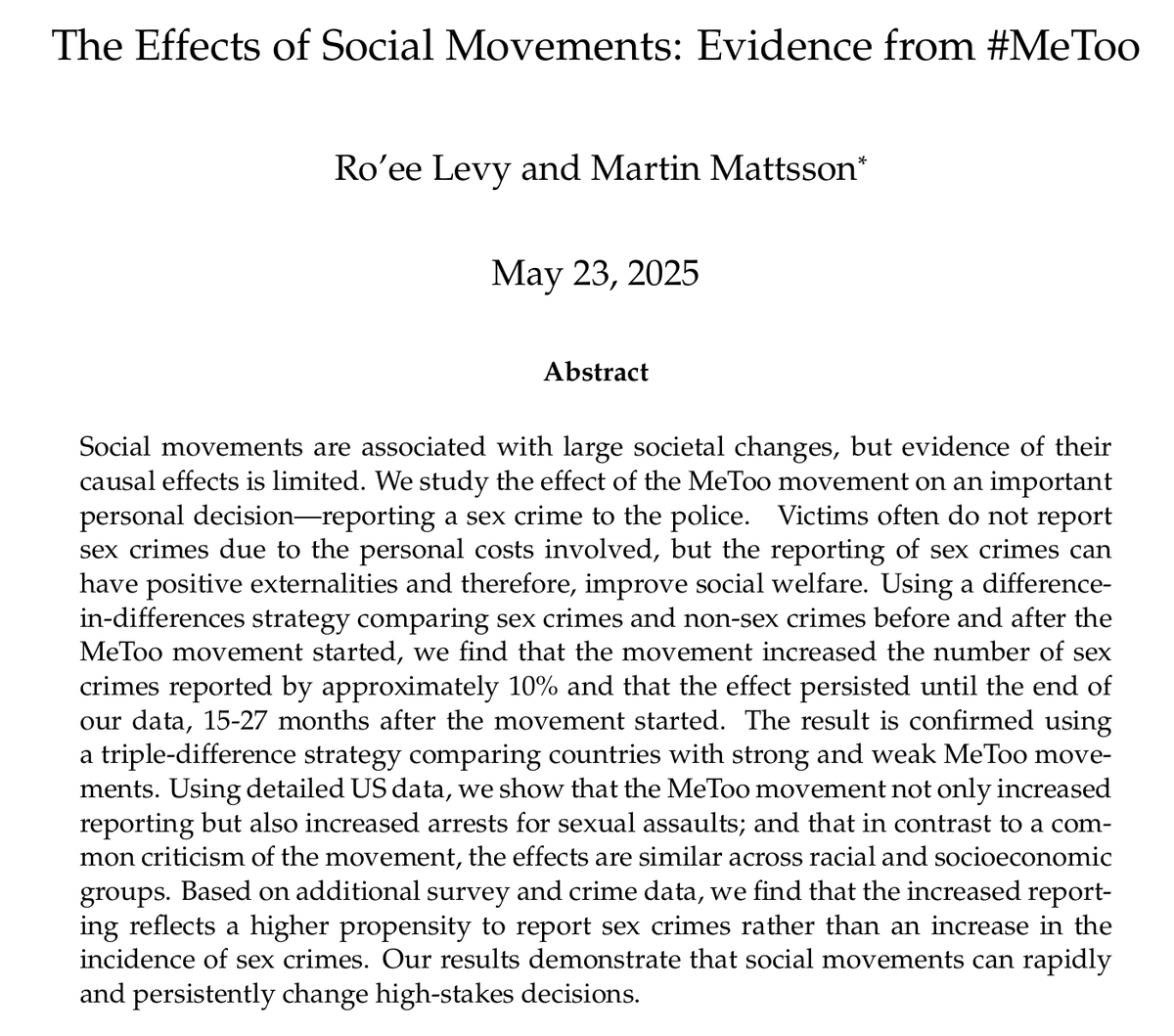
The #MeToo movement led to a 10% jump in sex crime reports and the effect lasted over 2 years.
✅ More reporting
✅ More arrests
❌ Not just more crimes
✅ Impact across race & income
Social movements can change high-stakes behavior.
Does poverty lead to risk taking or risk avoidance? Turns out, to both. Our new paper (with D. Nettle & W. Frankenhuis) in Proc B explains why, and conducts preregistered tests of our ‘desperation threshold’ model.
https://t.co/i6vNwY1yOx
A 🧵