One of the best gifts you can give your kids is real-world skills.
Nothing builds confidence in children like knowing how to navigate the world.
This comes in many forms… doing an oil change, cooking a meal from scratch, playing an instrument, speaking a different language, learning to negotiate, etc.
The more diversity in your teachings, the better, since more skills allows you to navigate through different areas seamlessly.
Yet, one thing almost no one teaches their children is how to navigate the markets… how to create and manage a portfolio, how to trade, and how to THINK like a trader.
Knowing how to operate in the markets is literally one of the most valuable skills you can learn. It’s also a skill that, if you lack it, can cost you big time.
Many think they know what they’re doing financially, but if a few X accounts stopped posting they’d be lost. Not necessarily a strategy you can pass down to your children, either.
What you need is to develop a skillset that travels with you wherever you go. That you can use in any market to take advantage of the opportunities in front of you.
That you can pass down through the generations.
Many think that if they cannot be a full-time trader or investor then this isn’t possible.
But that’s just not true.
In Trade Flow Lab, the majority of our members are part-time traders and have fulltime jobs.
Many have 7-8 figure portfolios and are consistently profitable.
(In fact, we just had a member post that he took his Roth from 30k to 900k recently).
Our traders are able to do this not by copy-trading, but because they have a specific skillset they’ve developed over years in the market.
Our goal is to help support you to develop those skills… and to make a bunch of money in the process.
Having traded in the markets for the better part of 4 decades, working with many of the biggest institutions in the world, we know what it takes to be a successful trader.
And we’re here to show you the way.
If you're trading options into this Friday's expiration on 6/12, you need to understand this week's market mechanics given the $SPCX IPO…
And it's bigger and more nuanced than most people realize.
SpaceX is going public Friday with $75 billion raised on a $1.77 trillion valuation.
It’s BY FAR the largest IPO in history.
And the demand? $150 billion, double what's available.
That means $75 billion worth of institutions, such as sovereign wealth funds, pension funds, large asset managers, didn't get the shares they wanted at the IPO price.
You better bet they’ll show up Friday and buy on the open market.
And to do that, they have to sell something else first.
That's where it gets interesting for the rest of the market this week.
The smarter money isn't waiting until Friday to raise that cash.
They've been quietly selling large-cap liquid positions, such as big tech to pre-position. That's part of what you've been seeing in the market this past week. It's not random selling.
Now add the concentration problem on the other side (the sell side).
Funds that already held SpaceX privately are sitting on enormous gains.
Fidelity Contrafund ($FCNTX) is at 5.1%, right at the legal limit for diversified funds. If SPCX pops at the open, they become mandated sellers by law.
Baron Partners Fund ($BPTRX) has 33% of their entire fund in SpaceX, if SPCX opens at the current valuation, that will rise to over 41%. They're not forced to sell by a rule, but at that concentration they'll be trimming.
So you have massive buy pressure from unallocated institutions colliding with forced and motivated selling from funds that are suddenly overweight.
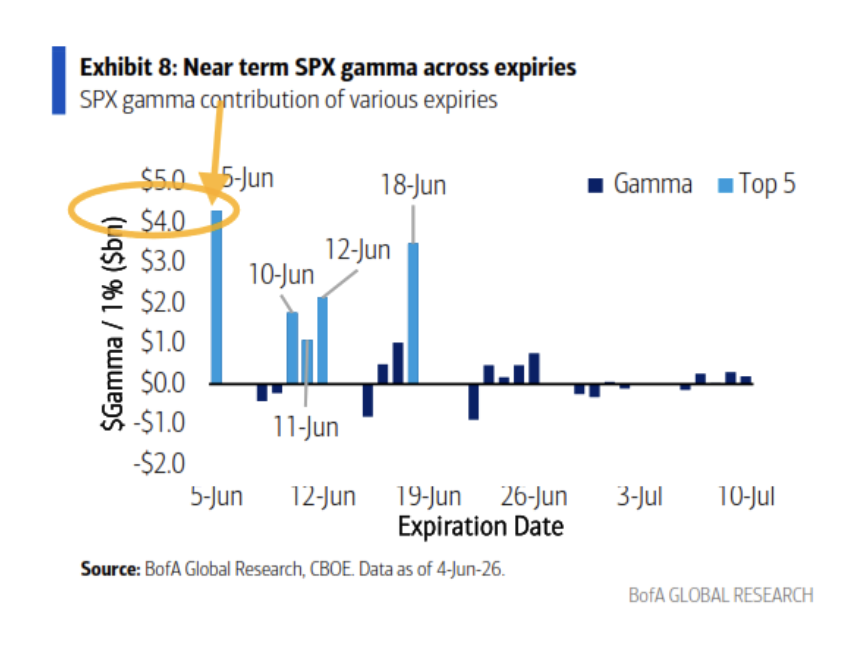
And on top of all of this, gamma has dropped off significantly since last week (see chart).
Without the stabilizing force of large positive gamma, moves in both directions accelerate.
And with a wildly uncertain new stock dominating the day's volume, you won't see new gamma get built in to replace it.
Volatile moves in individual names, accelerated by the gamma cliff, fueled by billions rotating in and out of positions in real time.
This is not a normal Friday. Prepare accordingly.
This week's market action is exactly why we have a rule that most traders ignore.
And that’s you should always take a decent portion of the profits in your options account and move them to a separate portfolio and buy common stock.
If you kept on rolling your calls this week, you got destroyed by the VOL crush Wednesday and Thursday, and then there was the large pullback Friday.
However, if you had been taking those profits and buying stock, you’re down a decent bit, but you have protected a significant amount of your capital.
Remember, your number one goal as a trader is to minimize substantial drawdowns.
And you are most susceptible to large drawdowns after making large gains and getting too loose with your rules.
Think of how many times your options account has been up big only for you to lose the majority of those gains…
Without exception, the best traders in our group all maintain a relatively small options account and funnel profits into equity purchases.
While this caps your upside short term, it protects your capital while building positions in stocks you believe in so your capital can compound over time.
There are two big account killers...
1. Overtrading.
2. Oversizing.
Remember, trades are like trains... there is always another one right around the corner.
Nice continuation in $PURR.
Remember, this has a possibility to gamma squeeze unlike a $HYPE ETF.
$PURR is unique in that...
- The company buys more HYPE when the MNAV drops below 1 and issues more shares when it goes beyond. So they are in the business of accumulating more HYPE when it's warranted.
- They can take out credit, unlike ETF's.
- The MNAV can go up and they don't have to sell to balance their holdings like HYPE ETF's do.
All this to say, the upside is much higher for PURR than HYPE ETF's and it's why it's such an attractive play.
If you look at crypto overall, it looks awful. Yet HYPE is making all time highs.
If crypto turns around at any point, this thing can really move.
We love weekends in the group as it gives us time to go through the institutional research and plan for the week ahead.
(This is how you save yourself a lot of time, since the group collects and condenses the most important items to watch each week ahead).
@redbadbear was breaking down how CTA flow models can help predict where larger moves can occur, as CTA's are systematic funds that buy/sell algorithmically at certain ranges.
So if you see $SPX go down into the 7310 level, the chances of a larger sell off increase as CTA's will begin selling automatically.
This isn’t just for Covid shots but nearly all potential vaccine injuries are not reported because doctors believe they don’t happen.
It’s not their job to determine causality, it’s to be cautious and report if there is a temporal tie between a vaccine and an adverse event.
🚨We have found 1575 patients at HoustonMethodist who were admitted to the hospital shortly after receiving a Covid shot and not reported to VAERS.
“Stacy”, a 27 year old female, got her first COVID-19 shot 1/7/2022 and was admitted to HoustonMethodist 12 days later on 1/19/2022. Her primary diagnosis was “Cardiomegaly” and her secondary diagnosis was “Hyperkalemia”. She died on 1/19/2022, just 12 days after the vaccine.
We are gathering more…. Please share with your Houston friends. Legal action forthcoming.
One of the quickest ways to improve your trading is to know where the gamma exposure levels are each week.
(As seen in this gamma chart we share weekly in the group)
Why is having updated gamma levels every week so important to a trader?
It tells you how much the market will swing at specific price points.
The more positive gamma is, the slower the market moves in each direction.
As gamma becomes more negative, you see accelerated moves in each direction (higher volatility).
Knowing this is key for positioning, whether you’re buying or selling options.
You need to know how likely it is that a big move will happen AND where it’s going to happen.
Gamma tells you this so you can position your trades accordingly.
Think about it…
If you know SPX is heading into a high volatility area, you’re going to want to be careful selling options that can swing significantly.
On the other hand, your further out the money options can be more likely to hit in a large negative gamma zone.
So why does no one on X talk about this?
One, because the math behind it is rather technical (you really don’t need to know all of the nuances to use the chart).
And two, because you can’t just buy access to this data.
Which is a shame since it’s such a huge edge to have as a trader every week.
If you’re considering becoming a full-time trader…
We interviewed the most profitable traders in our group (7–8 figures) and found some surprising commonalities.
Here’s what actually helps you become and remain a profitable trader:
1 - Most still have a full-time job.
Many said this helps them trade calmly and to avoid oversizing and overtrading.
The income they made outside of trading MADE them better traders.
So if you just lost your job and you’re considering trading full-time, also consider SOME sort of side income to take the pressure off.
2 - Psychology is just as important as intelligence.
Impatience, over-sizing, revenge trading, over-trading, FOMO are a result of psychology/emotions and have very little to do with intellect.
That’s precisely how many intelligent people blow up their accounts.
If you’re going full-time, mastering your psychology is your job.
3 - Know your edge and stick to it.
Our best traders all said they take fewer, more concentrated trades. Very rarely do they play 0DTE contracts.
They’re not chasing every move. They’re selective and disciplined.
4 - Don’t do it alone.
It’s impossible to keep up with the market today (according to Paul Tudor Jones).
So if it’s too fast for him and his team, it’s certainly too fast for you.
Trying to do this on your own will burn you out.
This is especially true if you have a family.
Which is why we created our trading group TFL.
Because we know that a hive mind of experienced traders is going to raise the level of everyone in the group.
This is especially true considering we have members who have been traders for several decades, have worked at the most well-known institutions running teams, and understand how the market works intimately.
It’s an insane edge to have, not just for your trading, but so that you can have a life outside of trading.
That said, we’re not for everyone.
We’re not a call service for novice traders.
We’re for those who have at least a few years under their belt, love to learn, and take this seriously.
You see this as a skill to master that will help you make and protect your capital.
If that sounds like you and you’d like to try us out, we have a 2-week trial period so you can do so nearly risk-free.
Send us a DM for more info.
Two things that will get you hurt as a trader:
1. Focusing too much on Macro (most macro guys don't ever make money, despite being informed).
2. Being a permabear.
If you hit a short perfectly the gains are insane, but the odds are very low and you lose more than you win over time.
It pays to be a bull in our economy.