It's funny how AI has made white collar work 10x faster already but there's been basically no economic impact from it.
The reason is quite simple:
1. Most white collar work is bullshit, so speeding it up by 10x still equals a pile of bullshit at the end
2. Most white collar employees are using AI to do all their work for the week in 4 hours instead of 40, whilst telling their manager the deadline is still 40 hours away
We have been living in a fake economy for the better part of two decades. It is all a fugazi.
People who do real jobs in the real world get paid comparatively crap, and people who do fake jobs in the fiat Ponzi world get paid just enough fiat currency to pretend they are important. None of it amounts to anything productive nor valuable for the world though.
An entire generation doing fake email jobs, slide decks and excel sheets for corporations who ultimately produce nothing.
They can only raise prices so much. Instead, the food will shrink. Lies will be told about quality (think olive oil). Costs will be cut. Wait times will increase. Workers will be asked to “be more productive.” Management stress will elevate. And the stores will start looking more and more like the worst parts of SF on a more consistent basis.
Automation the kicker. The bigger players can buy time. The little guy will struggle.
All within the rhelm #QualityOfLife
An entire generation under the age of 30 is coming to realization that having a family and home will never be within the grasp of reality for them
Society is not ready for the consequences of this. A generation with no stake in the system would rather watch it burn
Since tariffs are a consumption tax, if you fully replace income taxes with tariffs, it is functionally similar to imposing a flat income tax. A hugely regressive move that would penalize lower incomes heavily. To say nothing about whether it would even be feasible.
NO problems would be solved if we stopped "printing money"
The dollar has been losing purchasing power well before the Fed, the Gold Standard, Government Spending or any of the narratives people float today. This is how the system is SUPPOSED to operate
There is no rule that says dollars need to be a store of value.
See the thread below
Millennials living through 2 economic recessions, 9/11, a global pandemic, 8 stock market crashes, jobs replaced by AI, and possibly WW3 before hitting 42
Minimum wage skyrocketed.
Money printer went full force.
The people will never win without a far deeper understanding of how the system works. Solutions MUST be compatible with nature. PERIOD! There is no exception.
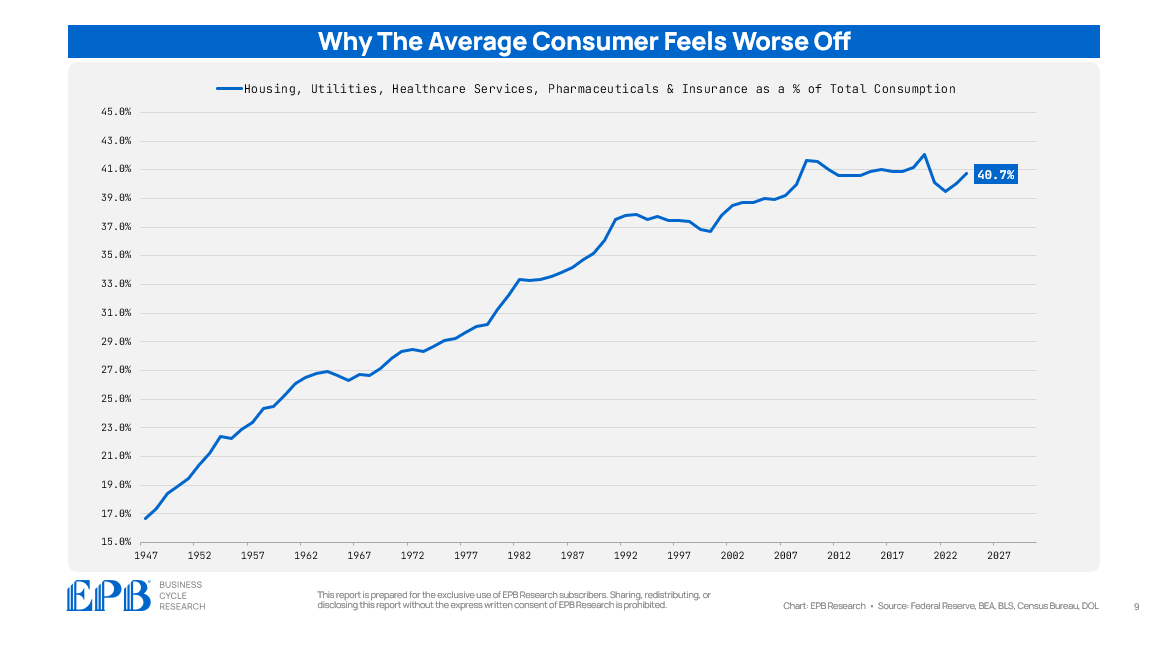
Why does the average consumer feel worse off?
Because 41% of consumer spending goes to: housing, utilities, healthcare, medications, and insurance.
This was 16% in 1947, 30% in 1980, and 35% in 1990.
Fewer consumer dollars are left for true discretionary spending.
Charlie Munger:
“The secret to life is easy because it's so simple:
You don’t have a lot of envy or resentment. You don’t overspend your income. You stay cheerful in spite of your troubles. You deal with reliable people and you do what you’re supposed to do.”
They can only raise prices so much. Instead, the food will shrink. Lies will be told about quality (think olive oil). Costs will be cut. Wait times will increase. Workers will be asked to “be more productive.” Management stress will elevate. And the stores will start looking more and more like the worst parts of SF on a more consistent basis.
Automation the kicker. The bigger players can buy time. The little guy will struggle.
All within the rhelm #QualityOfLife
Economics is a science of social behavior.
It's grounded in empirical facts (like supply and demand) and operational constraints (such as scarcity), but subject to the evolving social behavior of the participants who influence how the underlying principles operate in reality. 🤔🤔🤔
Just one lifetime ago in the United States, our grandfathers were able to buy a home, buy a car, have 3-4 children, keep their wife at home, take annual vacations, and then retire… all on one middle-class salary.
“You show me an incentive, I’ll show you an outcome” -Munger
For the entire adult lives of Gen X & some younger Boomers, post-1971 USD reserve status structure has incentivized Americans away fr engineering/trades towards finance
That’s the “culture” element that needs changing