OUSD and USDC now exchange at par on Catena.
Starting today, businesses and their authorized agents can move between these stables one for one, across any supported chain, under the authority the business has already set and within Catena's exchange limits.
https://t.co/EeN7j3ZGPo
The first AI Assistant Commerce Report is live!
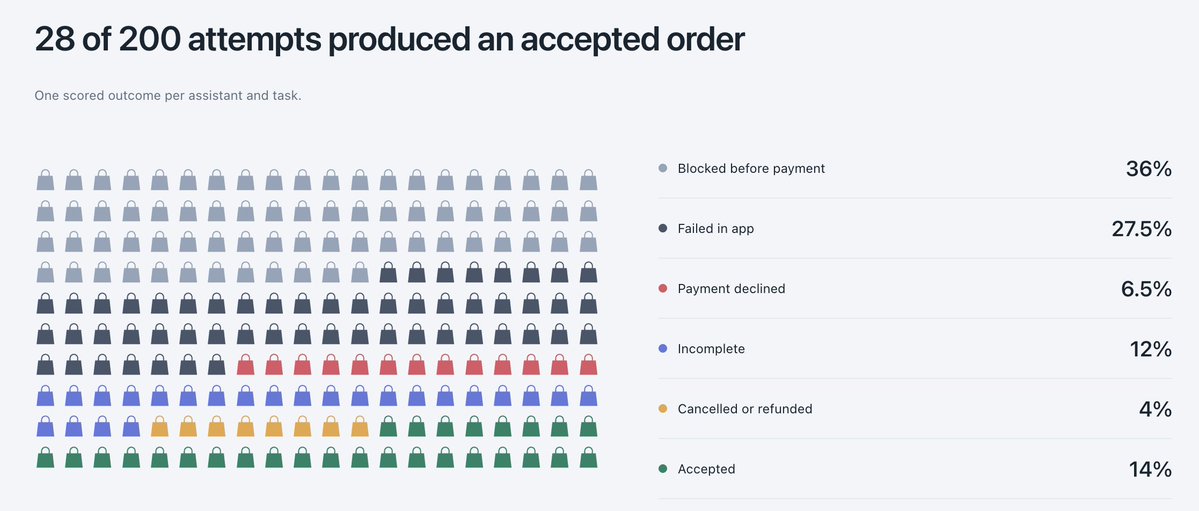
We tested 25 AI assistants on whether they can actually buy things online. Out of 200 attempts, only 28 ended in an accepted order (14%)
Each assistant was given the same 8 tasks:
1-5. White Nike socks at Target, Nike, Dick's, Kohl's & Macy's
6. A Logitech mouse on Amazon
7. Flowers, store of its choice
8. A USB-C cable, store of its choice
No single assistant cracked them all, in fact the best one got only got 5 of 8 orders through
The report outlines where agentic shopping breaks today:
> The web is the biggest blocker.
36% of attempts were stopped before payment by bot walls, sign-in pages and checkout flows
Agents can find the product, the store just won't let them buy it
Dick's had the most successful orders placed (16%)
Amazon failed to allow a single order to be placed (0%)
> "Order confirmed" doesn't mean the order went through.
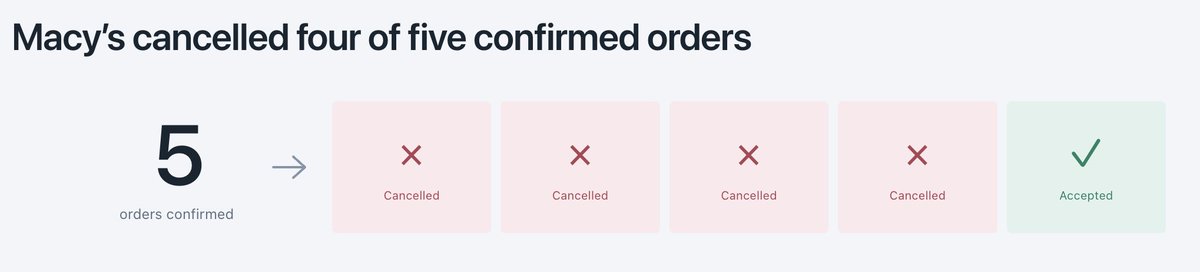
Macy's confirmed 5 orders, then cancelled 4
Fraud systems are canceling the order after checkout, and the agent never finds out because it already assumed it was done
> Agents guessed at billing address.
With a new card, agents copied the shipping address into the billing address without checking multiple times
Dick's cancelled both orders because it didn't match the card
> Purchased items sometimes differ from request.
Two accepted sock orders showed up wrong
Nike socks from Target arrived as Champion and white Nike socks from Dick's arrived as a multi-color pack
> Flexibility helps more than raw capability.
Letting the assistant pick the store produced 18 of the 28 accepted orders, but for flowers, 20 of 25 still needed me to step in and direct the agent to a different store after the initial checkout got blocked
The agents seem to still struggle with knowing which stores provide the most successful pathway to purchasing
> So which agents performed the best?
@ZapiaAI, @hark_labs and @bot led the charge on acceptance rate
@tomo, Sones, and @heyrobynai led the charge on speed
So what does this all mean about agentic commerce today?
First off, we are very very early. This doesn't mean that agentic commerce is a mirage, it means that we are early and the internet is still not aligned on how it should function
Agentic commerce is a merchant problem, a fraud problem and a post-checkout problem
TLDR: I think we need an agentic retailer to solve all of these problems in one go 👀
Want new stores or tasks tested for the next report?
Looking at some fun collaborations for a more in-depth report.
Let me know!
Open standards that enable interoperability gave us the internet and the web. Avoiding centralization and the concentration of power in a few vendors for the agentic internet is critical.
https://t.co/gKYJ4cV2Jw
Very cool that while we were digging into safety, liability, and agent identity for agentic commerce @FintechNerdCon, the Singapore government was pushing ahead with a know-your-agent protocol. The problems are global.
https://t.co/k7j4ca9dHD
Just caught up with @edavidpeterson ‘s great piece on the impact of AI on the software industry. So let’s take it forward to fintech/finance/banking.
* new models of the firm are predicated on new and different financial relationships. We need to push past merely making banking and payments safe for agent interactions, and start inventing new financial products that serve and enable agentic businesses.
* Speed in money movement (USDC and RTP) coupled with speed in decision making (AI) should unlock new ways to price, manage supply chain disruption, structure deal terms, and finance trade.
* Be afraid for VCs and a big chunk for PE. Those asset classes today were built on the software industry. As it changes the need for them, their funds, their brands, and their networks are at risk. Not to mention big portfolios that may need some serious mark to market adjustments.
https://t.co/QKFT0oI2RO
The complexity of B2B pricing should result in agentic systems ultimately unlocking more value than buying from simple price lists. Initially, agentic buying decisions will be within pre-contracted boundaries that still require judgement about tradeoffs for any one order: price, quantity, delivery timing, vendor SLA tradeoffs, financing options, etc.
@ernietedeschi@stripe Two notes: (1) We are at the very beginning of agentic commerce. A lot more to come. (2) B2B is ~80% of ecommerce. Agentic commerce in B2B will vastly exceed consumer. The purchasing problems are harder, so the opportunity for agents to have impact is larger.
Had a blast at @FintechNerdCon. @sytaylor crushed it. All the talk was about agentic commerce from the builders who will actually create all the infra needed to make this real. Plenty of hard problems yet to be solved to unlock this market.
We're releasing new @Stripe agentic commerce data today, telling the story so far as we look ahead to the kickoff of the holiday season next week. https://t.co/hasxiBHoSU
Ep. 3 of @moneymachines_ is live!
@chuk_xyz and @rparekh are joined by @psneville, Co-founder & CEO of @catena_labs.
Sean co-founded @circle in 2013 and architected USDC. He believes most financial transactions will soon be handled by AI agents.
Giving an agent access to money is easy. Making it safe is the hard part.
That's what Catena is building for. It's a bank where businesses link their AI agents to make payments, manage treasury, and earn on idle cash safely. The safety rules sit in the money movement itself, outside the AI. So even if an agent hallucinates or gets attacked, the payment still follows the rules.
He walks through the four layers behind it, from AI guardrails and a policy engine to cryptographic signing and smart contracts.
We cover:
(2:21) Programmable dollars for AI
(04:28) One agent, many payment rails
(08:48) Lessons from building Circle
(11:57) USDC was not meant to be Circle Coin
(16:30) Treasury is the first use case
(19:12) A new banking platform for agents
(22:32) The four layers of safety
(25:12) Why Catena pursued an OCC charter
(28:40) What the charter process involves
(32:43) Why Catena isn't a USDC-only bank.
(38:14) New kinds of money for AI
(42:43) Why competitors must set standards
(48:30) Takeaways from the conversation
Powered by @raincards
Find the links in the comments or search “Money Machines” on your favourite platform
Agentic commerce is not a good experience today.
However, people seem to mistake the early days of agentic commerce for the failure of the industry as a whole.
In reality, things are moving in the right direction.
@ForterGlobal published some incredible data that highlights where agentic commerce stands today:
1/ There is clear demand
Agentic orders are up 7.2x since the first week of August, and Muse placed more than half of all agentic orders in its first week.
Even before Muse, agentic orders grew 24% from August to September, or 48% once you count Instinct & Grok Bot, which first showed up Sept 1.
If users are naturally pushing agentic orders in the first week of Muse's launch, before any of Muse's widespread ads, then you know it's an inherent behavior that users are interested in.
2/ Muse's growth was net-additive to the industry
Muse didn't steal orders from other agents. After it launched, orders from OpenAI, Google and ChatGPT kept growing, up 4% month over month.
Muse brought in net-new demand.
3/ Browser automation drove the explosion
Browser automation, especially before companies started cracking down on bot detection, allowed these agents to shop freely.
Muse alone bought at 74% of all stores that got any agentic orders. Instinct followed behind at 50% coverage.
Many sites are blocking agents, so I am putting together my own report that tests 20+ agents on sites like Macy's, Target, Nike, Dick's and Amazon. I'll release that report soon 🙂
4/ Protocol agents reach minimal stores
OpenAI's checkout protocol reached only 24% of stores, and Google just 5%.
The issue with protocols is that they are bound to the merchants that have implemented said protocol. Relying on the store to integrate is a proven friction point for scaling agentic commerce.
5/ Agentic commerce is built for multi-item checkout
The average agentic order is $227 and reflects a lean towards multi-item checkouts.
Muse had an average order size of $213 and Instinct hit $239. Google averages only $100, since it only supports single-item checkout.
Of all agentic orders, only 27% are under $50, again pointing towards multi-item carts as the dominant use case.
6/ Travel still dominates
Travel hit $536 per order, over 2x the next category, which is physical goods at $235.
We're still early, and I question whether the average American will use agents for travel like the early adopters do, but for now, the data holds true.
7/ North America is 86% of agentic orders
Agentic commerce volume is almost all North America so far, which leaves a massive opportunity for all other geographic markets.
Agentic commerce is just getting started, and given some of this early traction in just the first few months, it feels like we're positioned for a wild ride.
Source: https://t.co/A4lBJkUhlM
@sytaylor ~80% of e-commerce is B2B. Businesses may adopt agentic commerce faster than consumers, especially where agents make a real difference. For many consumers, shopping isn't a chore to delegate; it's an activity to enjoy.
Read to the end and this point jumps off the page:
"Migrating to the cloud meant rearchitecting technology systems, which was relatively simple. AI is rearchitecting the economy."
After 30 years in the software industry, having worked with a wide range of brilliant programmers, this rings true. It's also true in a different way for those of us who built our careers creating software businesses. The software business model has forever changed. Some of the old sources of Power, both static and dynamic, that we took for granted are gone. It was a dynamic and exciting industry to build in for decades. Now new opportunities are opening for those ready to seize them.
DHH is probably one of the top software artisans of the past decade. Hearing him speak with this much conviction and transparency about one of the most polarizing topics in software right now, writing code by hand vs. with AI, is something pretty much every software engineer should hear a few times.
Especially those still on the wrong side of history.