Sustainability at scale is a capital allocation problem. Abu Dhabi's Global Water Platform restructures unbankable water projects into investable transactions through layered concessional capital. That's how you actually move the date.
⏱️Time is running.
🌍The world keeps spinning.
⌛Nature’s resources are being consumed faster than the Earth can regenerate them.
UNIDO works with partners around the world to help #MoveTheDate of #EarthOvershootDay & build a more sustainable future. ♻️💚
SDG 6's real gap isn't capital, it's bankability. ADFD's Abu Dhabi Global Water Platform ($1B, Jan 2026) takes unbankable water projects and restructures them into investable transactions through concessional anchors, equity in water tech, and export guarantees.
💧 Water is a superconnector — linking people, planet and prosperity.
Better health. Stronger economies. Healthier ecosystems. More resilience.
Investing in water means investing across sustainable development.
#SDG6 https://t.co/tcaMuzOOlb
@Sorenthek Warsh wanting markets to set rates is fine in theory but gold rallying alongside yields shows the market is already pricing something the Fed isn't acknowledging. That's a confidence problem, not a rate discovery problem.
@Dovydas44444 Yields at 19-year highs and Warsh is already queuing another hike for late 2026. The curve is pricing a credibility problem, not a timing problem.
Framework is the problem, not the person. 15 years of forward guidance created expectations that were never sustainable. Unwinding was always going to be ugly.
Everybody loves shitting on the fed chair. Why? He can’t fight back and it makes you feel good having a scapegoat for your own poor investment decisions.
So far warsh is walking his talk. Less hand holding, less single point data dependence, more like Greenspan.
Dial up the hate.
I mean I hate the Fed too but it’s already starting (he screwed up!!) and he’s done nothing either way.
Meh
@LawrenceLepard The bond market has humbled every Fed chair who mistook confidence for foresight. Volcker worked because he understood the job was discipline, not cleverness.
The gap between development need and investable transactions is a structuring problem, not a capital problem. ADFD's water platform shows the fix: concessional anchor capital, equity, export guarantees, co-financing.
How do Concessional Partner Loans help IDA deliver impact?
CPLs give countries long-term, low- or zero-interest financing that’s repaid to donors, helping IDA do more for countries in need.
IDA Senior Advisor Trichur Sundararaman explains: https://t.co/0qJmO5IXiP #IDAworks
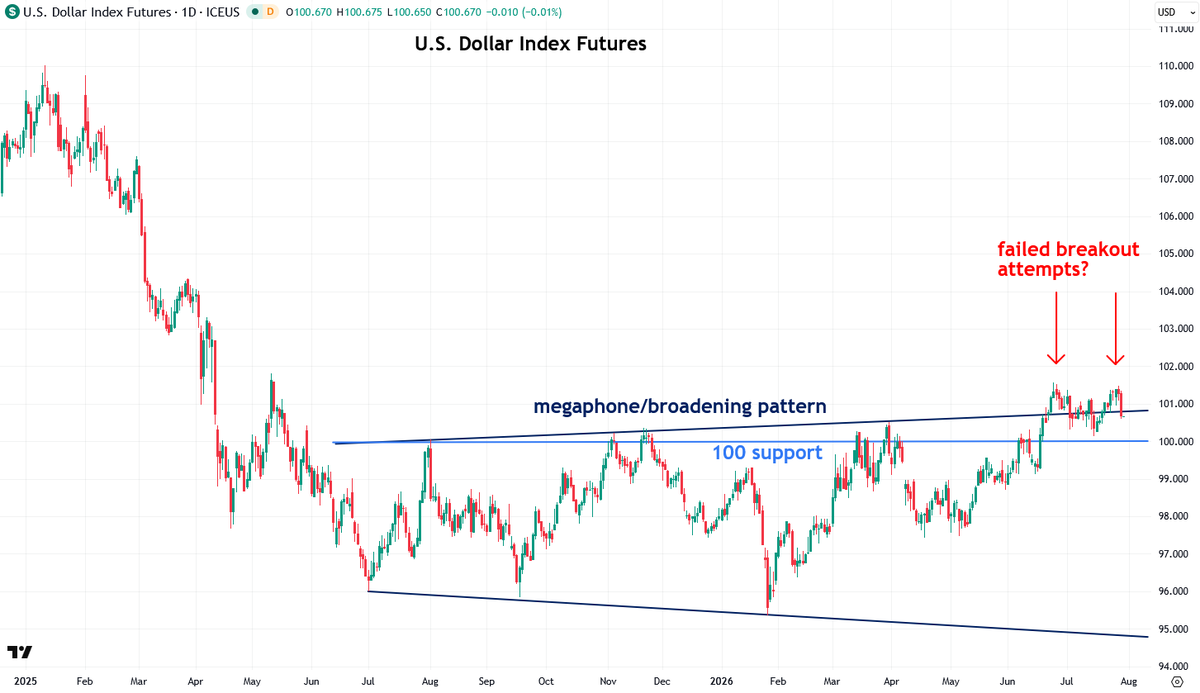
The U.S. Dollar Index has now failed for a second time to break out, which raises the odds of a sharp pullback, especially given how crowded the long-dollar trade is.
If so, that would be bullish for precious metals.
I discussed this in my update:
https://t.co/D9fJ5nHqgL
@keoneHD Digital assets already ran this experiment. Permissionless chains captured retail mindshare. Regulated venues captured institutional AUM. I'd back whoever controls custody and settlement.
Gold continues to demonstrate resilience, holding above US$4,000/oz as investors await the U.S. Federal Reserve's latest policy decision.
📊 While uncertainty surrounding interest rates has kept traders cautious, #gold's ability to maintain this key psychological level underscores its role as a preferred safe-haven asset during periods of economic and geopolitical uncertainty.
🔎 As markets look for clues on the path of monetary policy, all eyes remain on the Fed—and on gold.
Read the full Kitco report:
https://t.co/xdW2JeXRVA
#Mining
@fiscal_ai EWY is basically a semiconductor sector fund with a KRW overlay. 45% in Samsung and SK Hynix means you're trading DRAM pricing, not Korean equities.
Gold isn't pricing a trapped Fed. It's pricing fiscal dominance. Treasury issuance sets the effective term structure, not FOMC decisions. Different mechanism, different thesis.
Gold fell 47 percent in the middle of the 1970s bull market. Most investors sold.
The financial press called it over. Time magazine ran a cover story: "The Great Gold Bust."
Then gold ran nearly eight times from that low to the January 1980 peak.
Megan King Diaz walks through the chart that looks almost exactly like right now — and explains why the slow clock is still ticking.
Watch the full breakdown: https://t.co/JdEVOg3xSG
@sonalibasak Declining savings rate against rising household leverage is the textbook late-cycle signal. We saw the same dynamic in 2007 before the consumer buckled. The capex divergence only confirms it.
@TMTLongShort The parallel holds. NVDA 2023 was the market underpricing committed capex. Hyperscaler beats suggest the same dynamic. Spend cycles don't resolve in quarterly windows.
A hold with hawkish guidance is functionally a hike for EM. Dollar strength tightens conditions regardless. The real question is whether the geopolitical oil premium persists into Q3.
US Macro News Items
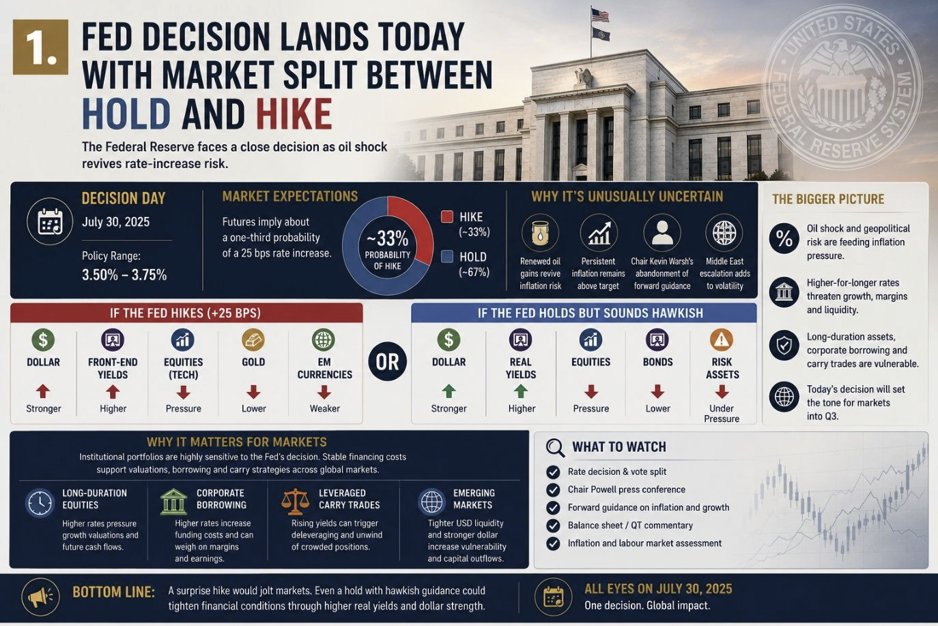
FEDERAL RESERVE DECISION LANDS TODAY WITH MARKETS SPLIT BETWEEN HOLD AND HIKE
Key Details: The #FED Federal Open Market Committee concludes its two-day meeting today in the least predictable policy call in years. The range is expected to hold at 3.50%–3.75%, but futures put hold odds at 62%, down from 87% on 17 July, with hike probability climbing to 37% from 12%. Nobody expects a cut. The two-year yield has held at or above 4% since mid-May, signalling the #bond market does not regard policy as sufficiently restrictive. Chair Kevin #Warsh has stressed price stability since taking the chair in June and has abandoned forward guidance, and the decision arrives alongside major technology earnings, renewed Middle East escalation and newly announced tariffs.
Impact Assessment: A hike would be the cycle’s first reversal and would reprice the entire curve, lifting the #dollar and front-end yields while pressuring #technology #equities, #gold and emerging-market #currencies. Front-end positioning is unusually thin, leaving gold, the #yen and long-duration equities with the greatest asymmetry. The energy-driven inflation impulse argues against tightening, but Warsh’s communications discipline leaves little room to fade the hawkish tail.
Thoughts of the day, Daily Market News over the last 24 hours.
Read more, for the full analysis
Thoughts for the day NEWS
https://t.co/uULkRUqwot
See our new quarterly earnings updates page.
https://t.co/dKwXKoXwsy
#FederalReserve #Tariffs #Investing #GlobalTrade #FinancialMarkets
Follow me on X, search for @GryphonIAB
@3benson Wealth concentration is the angle that matters most here. Top 10% of US households hold roughly 93% of equities. Policy backstops at these allocation levels aren't just market support, they're political economy decisions.
Their instinct is right. Productive economics first, carbon optionality second. The real bottleneck is bankability, not demand. Measurement without restructurability doesn't unlock institutional capital.
A few observations on the carbon credit market in 2026
During our recent FastForest Investor Update Day, one of the questions I was asked was how climate change may influence the future of agricultural assets.
Part of my answer was about carbon credits.
I believe it's important to separate today's business model from tomorrow's opportunities.
At @Web3Eco, carbon credits are not part of our current financial model. Our economics are built on productive assets, timber, and agricultural production. But that doesn't mean we should ignore how this market is evolving.
Over the past few months, several developments have caught my attention.
🇪🇺 The European Commission has proposed another major update to the EU Emissions Trading System, with greater emphasis on carbon removals and stronger incentives for industrial decarbonization.
📈 Analysts also expect carbon allowance prices in Europe to continue rising as the supply of emission permits gradually tightens.
At the same time, according to Abatable, companies have retired more than 1.1 billion carbon credits over the past decade, with demand increasingly shifting toward projects supported by transparent methodologies and measurable environmental impact.
These trends matter because biological assets remain one of the few scalable ways to remove carbon from the atmosphere. Reforestation, commercial plantations, and sustainable forest management are becoming part of a much broader conversation about climate and capital allocation.
For companies like ours, this is worth watching carefully.
If carbon markets continue to mature, well-managed plantation projects may eventually create value in more than one way.
Until then, our focus remains unchanged: building productive agricultural assets with sound economics, while keeping an eye on long-term developments that could shape the industry in the years ahead 🌿