@SECNigeria has published the Nigeria Capital Market Masterplan 2.0 (NCMMP 2.0), a ten-year roadmap for 2026 to 2036 built on five pillars and anchored on the national aspiration of a US$1 trillion economy by 2030. Director-General Dr Emomotimi Agama told the National Capital Market Conference in Abuja on October 19, 2026, that the Commission aims to grow the market from about N250 trillion to N750 trillion over the plan period, a tripling that implies compound annual growth of 11.61% in nominal naira terms.
The plan’s baseline table records equity market capitalisation of N146.5 trillion, equal to 33% of nominal GDP of N442 trillion, alongside 146 listed companies, outstanding bonds of N76.6 trillion, pension fund assets of N27.5 trillion and just over six million retail investors. Finance Minister @taiwoyedele proposed lifting market capitalisation to at least 60% of GDP, increasing listings to 250, and raising retail investors to 20 million, within a US$1 trillion capital market by 2036.
Plan delivery runs through a Project Steering Committee, the Capital Market Masterplan Implementation Committee (CAMMIC) and an SEC Project Implementation Unit, with quarterly CAMMIC reports and an annual market-facing progress report. Proshare will track the first report against the plan’s baseline, the pace of new listings, and the conversion of the National Savings Scheme into measurable retail participation.
https://t.co/mT7WesfVPz
.@TranscorpHotels' Q3 2026 results show stronger earnings quality despite softer revenue, with cost discipline and lower finance expenses supporting margins.
The company reported revenue of ₦69.5bn, down 3% YoY, while Profit Before Tax rose marginally to ₦22.5bn and profit after tax rose 5% to ₦15.5bn. Tighter cost management supported the improvement. Administrative expenses fell 2%, while net finance cost fell 35% to ₦1.5bn, lifting the net profit margin to 22.3%.
The balance sheet also expanded, with total assets rising 29% to ₦206.8bn and shareholders’ funds reaching ₦97.5bn.
https://t.co/7vEcdve5sf
Nigeria’s equities market continued its decline on Monday, 19 October 2026, posting its second straight loss as the NGX All-Share Index fell 0.91% to close at 245,278.34 points. Market capitalisation decreased by N1.47trn to about N159.25trn, and the year-to-date return eased to 57.62%. The 2,261.39-point decline was about 13.5 times Friday’s 167.40-point loss, and the benchmark closed 2.91% below its 28 September close of 252,635.11 points, by Proshare’s computation. Market breadth weakened to 15 gainers against 40 decliners. @VitafoamNG (-10.00%) led the losses, while @DangoteCement (-5.50%) pulled the NGX Industrial Index down 2.90%, and UBA (-2.33%), @ZenithBank (-1.59%) and GTCO (-1.44%) pulled the Banking Index down 1.40%, so the selling spread from the banks to DANGCEM, one of the market’s most heavily weighted stocks.
In the foreign exchange market, the naira depreciated by 0.11% to N1,333.72/US$ at the #NFEM window, while the average #BDC rate remained unchanged at N1,370/US$. The spread between the two markets narrowed to 2.72% from 2.83%, by Proshare’s computation. Brent crude fell 1.48% to US$108.23 per barrel as investors booked profits from multi-month highs, and gold fell 0.27% to US$4,149.38 per ounce. The Oil and Gas Index eased 0.06%.
@TranscorpHotels issued a press release on its third-quarter 2026 financials on Monday, while Caverton Offshore Support Group, Fortis Global Insurance and Coronation Insurance filed board meeting notices. Proshare will track buying in the heavily weighted banking and industrial stocks, the Oil and Gas Index against Brent crude, further third-quarter filings and the BDC–NFEM spread in subsequent sessions.
Read more: https://t.co/HVcs7ehaLT
The CBN cut interest rates by 350 basis points last month, the biggest single cut since 2006. Treasury bill rates fell the very next day.
But three weeks later, the Debt Management Office rejected nearly three-quarters of the bids at its auction, and the one-year rate actually went up. Easing is not arriving in a straight line.
Ogungbayi Feyisola Faesol explains what that means for holders of Treasury bills, FGN bonds, money market funds, or fixed deposits, and why bank deposit rates have already fallen toward 6.9%.
Read it here:
https://t.co/XUt63ppTV0
Proshare has opened the survey for the 12th edition of its Online Trading Report, themed “Nigeria’s Capital Market Reforms in a World of Shocks.” The study will examine how regulatory reforms, digital innovation, changing investor behaviour and emerging risks are reshaping Nigeria’s online investment ecosystem.
The report will assess developments across the NGX, NASD OTC market, AFEX, LCFE, and FMDQ, with a focus on market access, efficiency, transparency, investor participation, and digital resilience.
Capital Market Operators, financial services firms, fintech stakeholders, platform users and retail investors are invited to participate in the 8–10-minute survey. The survey runs from October 19 to October 30, 2026, with the report scheduled for release in the second week of November.
#OnlineTrading
Nigeria’s employment challenge is not simply about producing more graduates; it is about building enough productive enterprises to absorb workers at scale while aligning skills with what the economy actually needs.
Proshare’s review of the country’s largest disclosed employers finds that the Top 10 employ about 63,754 people in Nigeria, against a labour force of about 116.58 million. Six of the ten are banks, while @DangoteGroup leads with at least 23,980 disclosed Nigerian employees.
https://t.co/3HjhCYF5DW
Stock Recommendations for the Week of October 19, 2026
Broker recommendations for the week of 19 to 23 October 2026 show a selective reassessment of Nigerian equities. The report includes five upgrades and five downgrades across banking, insurance, oil and gas, and consumer goods. In addition, Lead Capital moved STERLINGNG from Under Review to Hold. Recommendations in industrial goods, agriculture and conglomerates were unchanged. The distribution of rating changes reflects differing assessments of individual securities and their valuations rather than a uniform reassessment of sector prospects.
Banking saw the most upgrades. Anchoria Research raised GTCO and ZENITHBANK from Hold to Buy, with projected upside of 20.19% and 19.05%, respectively. PAC Research raised ETI to Buy with an expected return of 11.34%, while lowering ACCESSCORP from Buy to Hold. PAC Research upgraded OANDO to Buy, with a projected return of 12.59%, the only revision in oil and gas.
Insurance carried both the highest projected return and one of the two negative projected returns. PAC Research upgraded INTENEGINS from Hold to Strong Buy with an expected return of 33.33%. It also downgraded MANSARD to Hold with a projected negative return of 4.55%, and Lead Capital moved LASACO to Hold with remaining upside of 7.73%. In consumer goods, ARM Research lowered GUINNESS to Hold with projected upside of 1.10%, and PAC Research moved DANGSUGAR to Hold with an expected negative return of 4.53%.
Projected returns range from 33.33% on INTENEGINS to negative returns on DANGSUGAR and MANSARD, supporting a selective approach to portfolio allocation rather than broad sector exposure. Near-term positioning should consider each broker’s valuation assumptions, earnings outlook, trading liquidity and downside risks. Subsequent price movements, trading volumes, and investor participation will clarify the extent to which the revised recommendations influence market sentiment.
Read more: https://t.co/icpx9VaDUB
Cc: @FirstBankngr, @gtbank@GroupEcobank, @Fidsoncares, @ConoilPLC, @Oando_PLC, @Japaul_Group, @TotalEnergies, @BUACement, @DangoteCement, @BuaFoods, @GuinnessNGRPlc, @Sterling_Bankng, @UBAGroup, @StanbicIBTC, @fidelitybankplc, @ZenithBank, @GuinnessNGRPlc, @Nestle, @NBPLC, @AIICOINSURANCE, @AXAMansard, @aradelholdings, @SeplatEnergy, @MTNNG,
"Our ability to continue to run on 5,000 megawatts plus independent generation in homes and in businesses will always cap our growth, for a country that should be aspiring for Chinese-type 7.5% to 9% growth levels."
This edition of the Economy and Politics conversation, anchored by @ottoabasi1, features Mr Jimi Ogbobine, Head, Agusto Consulting, discussing Nigeria’s Business Environment in 2026: Business Confidence, Cost Pressures, and Growth Prospects.
Watch full video: https://t.co/QgDqxao66t
Nigeria in 1min: Economic, Business and Financial Market Headlines – 19 October 2026
Nigeria’s equities market ended the week to 16 October with a second consecutive weekly decline. The All Share Index fell 0.33% to 247,539.73 points, the Proshare Market Cap Weighted Index declined 1.17%, and the Total Return Float Adjusted Index fell 3.16%. Friday’s session reduced market capitalisation by N108.70bn to about N160.72trn, with the banking index down 0.94%.
System liquidity rose to N6.28trn from N3.71trn during the week, and the Open Repo Rate eased by 40 basis points to 20.00%. The @DMONigeria offers N1.75trn across three reopened FGN bonds today, while Sunbeth’s commercial paper offer of up to N150bn closes today and the N20bn United Nigeria Airlines issuance closes tomorrow.
The @FinMinNigeria reported that federal revenue for the first half rose 72% to N6.2trn and interest payments rose 38% to N7.7trn, lowering the interest-to-revenue ratio from 156% to 124%. It cited a @WorldBankGroup projection of debt service at 46% of revenue for the full year, but did not provide its own year-to-date budget implementation figures.
Renaissance Capital raised its valuation of #Dangote Petroleum Refinery to N700.41 per share, 33.4% above the N525 offer price, while no interim subscription figures have been published ahead of the 27 October close.
Proshare will track demand and stop rates at today’s bond auction, the measures announced at the National Capital Market Conference, the final subscription level for the refinery offer and the full-year revenue outturn against the projected debt service ratio.
Cc: @business, @BusinessDayNg, @Nairametrics, @thecableng, @PremiumTimesng, @thesunnigeria, @THISDAYLIVE, @LeadershipNGA, @Reuters, @MobilePunch, @vanguardngrnews, @LANACION, @sputnik_africa, @AfricanBizMag, @info_NRC, @NgComCommission, @afreximbank, @GuardianNigeria, @CNBC, @TechCrunch, @AP,
https://t.co/8DcYQuFCkP
The Nigerian equities market recorded its second consecutive weekly decline in the week ended 16 October 2026, with the @ngxgrp All-Share Index (ASI) falling 0.33% to 247,539.73 points, after a 0.97% loss the previous week. The benchmark’s year-to-date return moderated to 59.07% from 59.60%, while its month-to-date return stood at negative 1.46%. Proshare Data & Research’s Market Cap-Weighted Index fell 1.17% to 1,431.30 points, and the Total Return Float-Adjusted Index fell 3.16% to 1,173.06 points, both recording steeper weekly declines than the ASI.
Performance across the 22 indices covered in the report remained uneven, with seven advancing, fourteen declining and the NGX Sovereign Bond Index unchanged. The NGX Oil/Gas Index led the gainers with a weekly return of 3.13%, followed by the Commodity Index at 2.36%. The NGX-AFR Bank Value Index recorded the largest weekly loss at 3.80%, followed by the Total Return Float-Adjusted Index at 3.16% and the NGX Banking Index at 3.15%. Since the end of September, the NGX Industrial Goods Index was the only index to post a positive return, gaining 0.03%, while the Banking Index fell 6.62%.
Cumulative returns remained substantial despite the recent market weakness. The NGX Oil/Gas Index recorded the highest year-to-date gain at 131.96%, followed by the NGX Premium Index at 99.62%. In contrast, the Insurance, Growth and Sovereign Bond indices recorded year-to-date losses of 9.23%, 3.20% and 3.03%, respectively. The Total Return Float-Adjusted Index posted a year-to-date gain of 77.33%, outperforming the ASI (59.07%) and the Market Cap-Weighted Index (48.45%). However, since the close of September, the float-adjusted measure has declined by 6.06%, compared with a 2.24% decline in the Market Cap-Weighted Index.
Proshare will track third-quarter earnings releases on the NGX, dividend expectations and the performance of the NGX Banking Index in the coming week, which the report identifies as factors that will help shape near-term market direction. Proshare will also follow subscription activity in the extended Dangote Refinery public offer, which the report notes could influence how investors allocate funds between the offer and secondary-market equities. Year-to-date gains remain positive across the major equity benchmarks, and Proshare will monitor whether buying interest recovers and gains broaden across sectors during the remainder of October.
https://t.co/sMzjEYEBCB
In an environment where news and public reaction can circulate before organisations establish the facts, reputation has become an operational and governance concern that reaches beyond the communications team. In this Op-Ed, Suleyman A. Ndanusa examines how social media, digital publishers, citizen reporting and artificial intelligence have changed the relationship between institutional conduct and public confidence. His argument prioritises the quality of an organisation’s everyday decisions over its ability to control the public narrative.
Drawing on Nigeria’s changing media landscape, Ndanusa considers the responsibilities of chief executives, boards and communications professionals when complaints, incidents or misleading content enter the public domain. He advocates timely acknowledgement of verified facts, credible engagement with journalists and online creators, clear ownership of incident response and caution about promises that cannot be substantiated. The governance implications extend to information escalation, crisis preparedness, stakeholder protection and accountability for AI-assisted communication.
His central proposition is that trust develops through consistent conduct and transparent correction of failures, while no communications strategy can permanently compensate for shortcomings in institutional performance.
https://t.co/yZbOhQ3uPJ
Nigeria’s petroleum market could gain a more transparent pricing framework as @LCFE_NG moves to connect physical fuel trading with organised capital-market infrastructure.
Following its licence from the Nigerian Midstream and Downstream Petroleum Regulatory Authority (NMDPRA), the Lagos Commodities and Futures Exchange (LCFE) is seeking to create a structured marketplace for petroleum products, with observable bids, offers and transactions supporting more credible domestic price discovery.
https://t.co/Fg248TnRM9
Nigeria’s constitutional debate may ultimately be less about who wins the next election and more about how power is structured, distributed and held accountable.
In this commentary, Suleyman A. Ndanusa, PhD, OON, argues that Nigeria should examine the institutional framework inherited by the next government, rather than focusing only on personalities and electoral outcomes. He identifies the concentration of federal power, weak party discipline and uneven accountability as recurring structural concerns.
https://t.co/UFfm5LG1gs
Africa’s commodity endowment continues to support export earnings, but value distribution along international supply chains remains uneven. Raw materials leave producing economies, while processing, specialised manufacturing, technology and much of the associated financing remain concentrated elsewhere. The consequences extend beyond trade balances to industrial employment, domestic enterprise development and the capacity to withstand external shocks. Recent Proshare research on Nigeria’s commodity markets also identifies persistent liquidity gaps, uneven price discovery and institutional constraints despite reforms to commodity trading infrastructure.
In this opinion article, @collinsnweke examines how African governments can convert wider diplomatic relationships into productive capacity rather than merely diversify markets for unprocessed exports. His argument connects mineral beneficiation, the cotton and textile value chain, project preparation, domestic capital formation and digital infrastructure. He also acknowledges the commercial constraints facing industrial policy, including energy costs, financing requirements, technical capability and the risks of poorly designed local content obligations.
Nweke proposes a more demanding assessment of international partnerships, focusing on local processing, supplier participation, skilled employment, African ownership, technology transfer and retained economic value. His contribution places responsibility on African institutions and their external partners. He argues that sustainable industrial development requires credible projects, commercially competitive production and policy arrangements that let African firms capture a greater share of the value generated from the continent’s resources.
https://t.co/BVAm4nyKiW
What to Expect from the Markets this Week – 19 October 2026
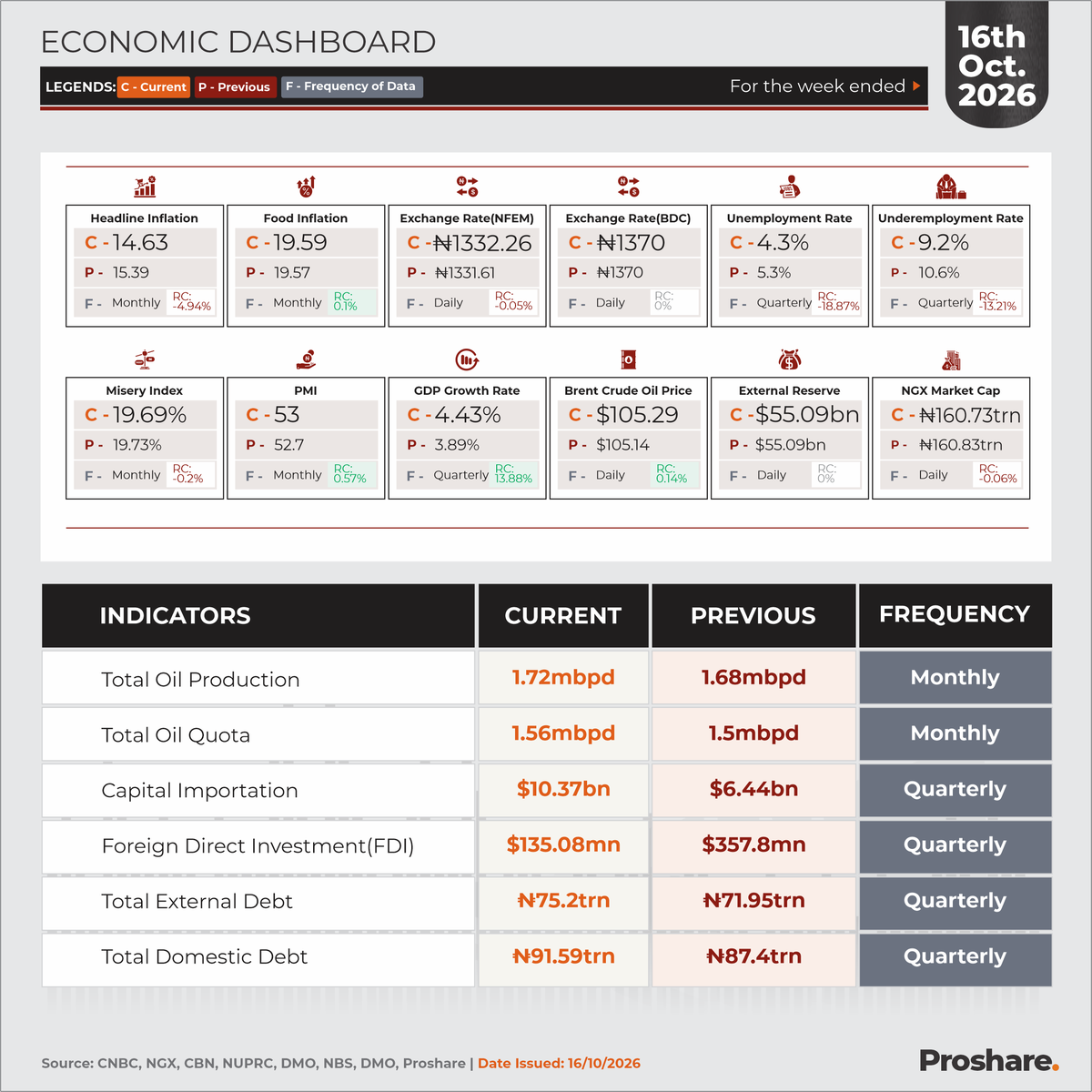
Nigeria’s financial markets closed the week ended 16 October 2026 with mixed performances across asset classes, as moderating headline inflation and improved banking system liquidity coincided with weaker equities, rising government bond yields and higher international crude oil prices. Headline inflation fell 76 basis points to 14.63% in September, its fourth consecutive monthly moderation, while system liquidity rose from N3.71trn to N6.28trn. The @ngxgrp All-Share Index recorded its third consecutive weekly decline, although fifty equities advanced against thirty decliners during the week.
September’s inflation data showed uneven price movements across components. Food prices fell 1.55% month on month, including a 2.86% drop in farm produce prices, while annual food inflation rose marginally to 19.59% from 19.57%. Core prices rose 1.11% month on month after a 0.06% decline in August, while the energy index rose 5.38%. After the Monetary Policy Committee cut the Monetary Policy Rate by 350 basis points to 23%, the gap between the policy rate and headline inflation stood at 8.37 percentage points. The @IMFNews revised Nigeria’s 2026 growth forecast upward to 4.2% from 4.1%, compared with the World Bank’s projection of 4.3%, and the Federal Government presented 65 investment projects requiring US$78.5bn in capital, with implementation dependent on financing commitments and project execution.
In the money market, placements at the Standing Deposit Facility reached N6.08trn, and the overnight rate fell 47 basis points to 20.38%, while the Open Repo Rate fell 40 basis points to 20.00%. Average Treasury bill yields remained broadly stable at 17.97%. At the 14 October auction, subscriptions reached N1.03trn against N450bn offered, with N982.21bn directed at the 364-day tenor, where N220bn was allotted against N350bn offered, and the stop rate increased by 5 basis points to 15.90%. In the FGN bond market, average medium- and long-tenor yields rose by 37 and 15 basis points to 16.72% and 15.46%, respectively, while short-tenor yields were unchanged at 15.74%. The naira closed at N1,332.26/US$ in the official market, and the parallel market premium over the official rate narrowed from 3.29% to 2.83%.
The NGX All-Share Index fell 0.33% to 247,539.73 points, bringing its year-to-date return to 59.07%. The NGX Banking Index fell 3.15%, while the NGX Oil/Gas Index rose 3.13%. Equity turnover declined by approximately 38% to N98.09bn from N158.28bn, and the number of deals fell to 184,632 from 209,986. In international commodity markets, Brent crude gained 3.48% to US$107.99 per barrel, and WTI rose 5.85% to US$97.11 per barrel, while gold, silver, platinum, and palladium closed lower.
The calendar for the week commencing 19 October includes China’s third quarter GDP release, the People’s Bank of China’s interest rate decision and September inflation data from the United Kingdom, South Africa, Canada and Japan. Domestically, Proshare Data & Research expects money market rates to stay near the 20% floor of the policy corridor, Treasury bill yields to remain range-bound in line with system liquidity, and primary market demand to stay concentrated in the 364-day tenor.
In the FGN bond market, the house view anticipates lower secondary market yields as unmet subscriptions from next week’s primary auction return to the secondary market. Equity positioning is expected to remain selective, with fundamentally sound and dividend-paying stocks likely to provide limited support. The Dangote Petroleum Refinery public offer at N525 per share remains open after a two-week extension from 13 October. Proshare Data & Research expects any further easing by the Monetary Policy Committee to remain conditional on core and energy prices settling.
https://t.co/jOryuxOXlM
Brent held near $105/bbl this week as post-Hurricane Isaias shut-ins in the US Gulf fell to ~200k b/d. Focus now: Houthi strikes on Aramco’s Dhahran HQ, Ukraine renewing hits on Russian refineries, and Iranian LPG/jet fuel cargoes slipping past the US blockade.
The IEA sees diesel tightness lasting into 2027, with output down 1.7m b/d y/y. In Nigeria, SEC extended the Dangote Refinery public offer (4.1bn shares at N525, N2.15trn) to 27 Oct on strong demand.
https://t.co/ZLscbRCKFx