OpenAI ha publicado un curso gratis de Códex.
Te explica cómo desarrollar e iterar webs y apps.
✓ 22 lecciones. 3,5 horas. Sin tarjeta
✓ Skills, plugins y feedback visual para iterar menos
En inglés pero con subtítulos:
→ https://t.co/C7FoDBMzkw
Si eres programador en 2026, NO leas únicamente libros sobre:
- Lenguajes
- Frameworks
- Patrones
- Algoritmos
- Clean Code
La IA está cambiando qué habilidades hacen valioso a un programador.
Estos son los 10 libros que leería AHORA:
Bibliotecas de JS sin las que no puedo vivir:
🛡️ zod → validaciones
📅 Temporal → fechas
📊 tanstack-table → tablas
🔐 better-auth → auth
🎞️ motion → animaciones
🔤 fontsource → tipografías
📈 chart.js → gráficas
🐻 zustand → estado global
🖱️ pragmatic-drag-and-drop → drag & drop
🧭 nuqs → estado en la URL
I’ve been working as an AI Engineer for ~2 years.
If you’re trying to break into AI Engineering, these are the topics I’d prioritize learning:
• RAG — Retrieval-Augmented Generation
• Embeddings & Vector Databases
• Quantization — AWQ, GPTQ, GGUF, FP16, INT8, INT4
• RAG Evaluation — RAGAS
• Model Routing & Fallbacks
• Observability — logs, metrics & traces
• MCP — Model Context Protocol
• AI Agents & Agentic Patterns
• Memory & Context Management
• Guardrails & deterministic input/output validation
• Inference Engines — vLLM, TensorRT, SGLang
• Load Balancing & Queuing
• Local vs Cloud Inference
• Backend Fundamentals & System Design
The biggest mistake I see is focusing only on prompting and calling LLM APIs.
AI Engineering is much more about building reliable, scalable systems around models.
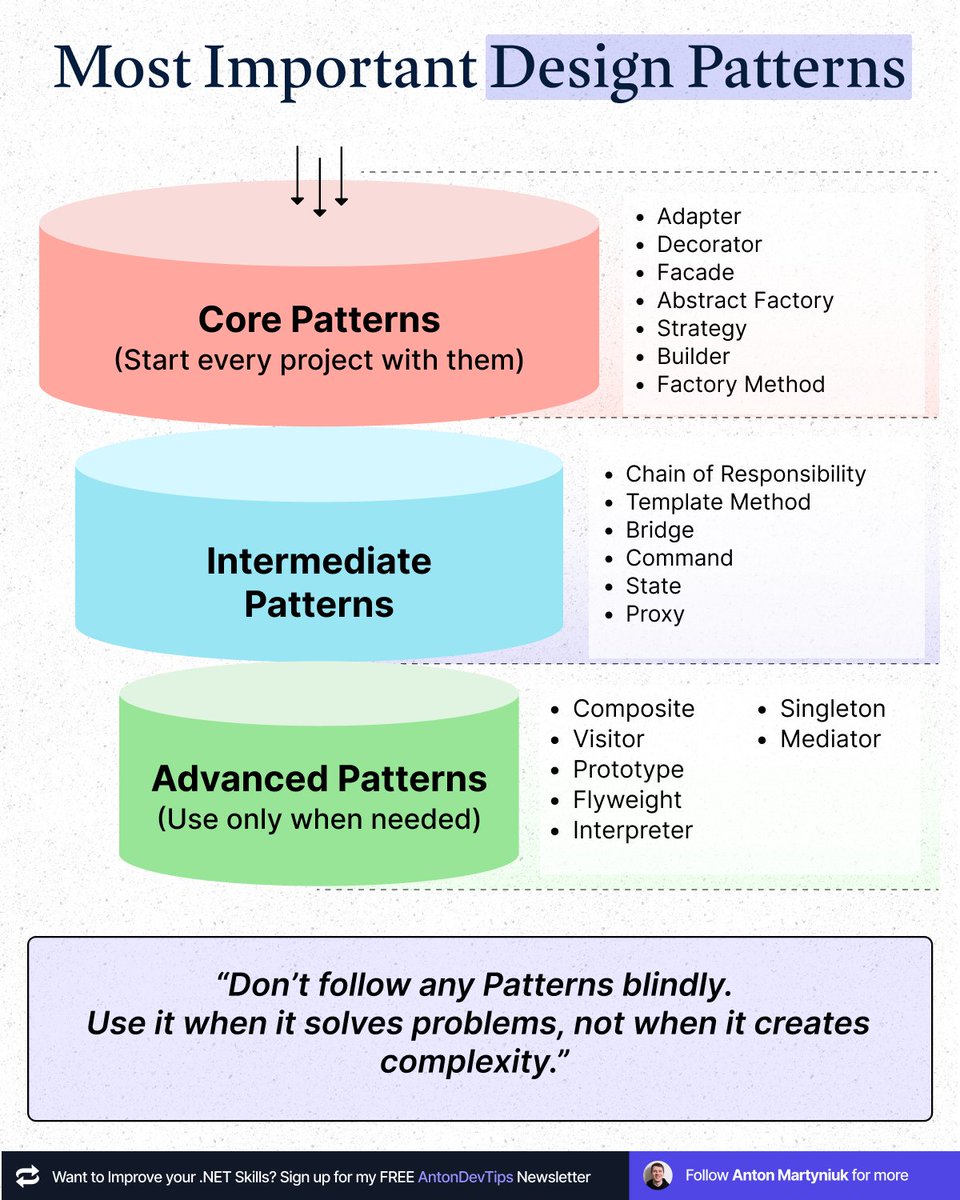
You learn Design Patterns the wrong way
Here is a correct approach (27,000 devs learned from me)
You don't know the order in which to use design patterns based on your experience.
And please don't trust AI because it can't replace the judgment of someone who has mastered them.
Not all patterns have the same value at every stage of your career.
There are even some design patterns that are easy on paper, but in reality they require the skills of a mid- or senior-level developer to get them right.
I recommend learning design patterns in the following way 👇
Start with 𝗖𝗼𝗿𝗲 𝗣𝗮𝘁𝘁𝗲𝗿𝗻𝘀
They are your foundation at the beginner level. You will recognize and use them in almost every project.
1️⃣ Builder
2️⃣ Factory Method
3️⃣ Abstract Factory
4️⃣ Strategy
5️⃣ Adapter
6️⃣ Decorator
7️⃣ Facade
➡️ You use them to create and organize objects to keep your architecture modular and clean.
If you're a junior developer, mastering these patterns will immediately improve your design thinking.
If you are a middle developer, it's time for 𝗜𝗻𝘁𝗲𝗿𝗺𝗲𝗱𝗶𝗮𝘁𝗲 𝗣𝗮𝘁𝘁𝗲𝗿𝗻𝘀
Once you gain more experience, you will be assigned to more complex tasks and to solve them, you need better tools:
1️⃣ Chain of Responsibility
2️⃣ State
3️⃣ Proxy
4️⃣ Template Method
5️⃣ Bridge
6️⃣ Command
➡️ With these patterns, you will learn how to manage behavior flow, abstract implementations, and manage different responsibilities.
You will use these for building scalable and extensible systems.
If you are a senior or your architecture gets complex, you will need 𝗔𝗱𝘃𝗮𝗻𝗰𝗲𝗱 𝗣𝗮𝘁𝘁𝗲𝗿𝗻𝘀:
1️⃣ Singleton
2️⃣ Mediator
3️⃣ Flyweight
4️⃣ Interpreter
5️⃣ Composite
6️⃣ Visitor
7️⃣ Prototype
➡️ These patterns will help you manage object hierarchies, optimize performance, and coordinate multiple class hierarchies.
If you are a middle or a senior developer, remember this golden rule:
Don't use patterns blindly.
Use patterns ONLY when they simplify your design or solve a problem.
And never use because your code will feel "more cool" or "more Enterpisy".
Overusage of design patterns and SOLID principles leads to overcomplicated code and multiple layers of unnecessary abstraction.
Do you agree with my priority list? Leave a comment down below 👇
——
♻️ Repost to help others learn Design Patterns in a better order
➕ Follow me to improve your .NET and Architecture Skills
Want to become an AI developer?
Learn in this order:
1. Python
2. Git + GitHub
3. NumPy
4. Pandas
5. SQL
6. Machine Learning basics
7. Neural Networks
8. LLMs
9. APIs
10. RAG
11. Vector Databases
12. AI Agents
13. Build real projects
What AI project would you build first?
8 RAG architectures for AI Engineers:
(explained with usage)
1) Naive RAG
- Retrieves documents purely based on vector similarity between the query embedding and stored embeddings.
- Works best for simple, fact-based queries where direct semantic matching suffices.
2) Multimodal RAG
- Handles multiple data types (text, images, audio, etc.) by embedding and retrieving across modalities.
- Ideal for cross-modal retrieval tasks like answering a text query with both text and image context.
3) HyDE (Hypothetical Document Embeddings)
- Queries are not semantically similar to documents.
- This technique generates a hypothetical answer document from the query before retrieval.
- Uses this generated document’s embedding to find more relevant real documents.
4) Corrective RAG
- Validates retrieved results by comparing them against trusted sources (e.g., web search).
- Ensures up-to-date and accurate information, filtering or correcting retrieved content before passing to the LLM.
5) Graph RAG
- Converts retrieved content into a knowledge graph to capture relationships and entities.
- Enhances reasoning by providing structured context alongside raw text to the LLM.
6) Hybrid RAG
- Combines dense vector retrieval with graph-based retrieval in a single pipeline.
- Useful when the task requires both unstructured text and structured relational data for richer answers.
7) Adaptive RAG
- Dynamically decides if a query requires a simple direct retrieval or a multi-step reasoning chain.
- Breaks complex queries into smaller sub-queries for better coverage and accuracy.
8) Agentic RAG
- Uses AI agents with planning, reasoning (ReAct, CoT), and memory to orchestrate retrieval from multiple sources.
- Best suited for complex workflows that require tool use, external APIs, or combining multiple RAG techniques.
Most architectures here involve some form of retrieval-time decision. But they all run on top of whatever was already indexed.
If that indexing step outputs messy chunks, every architecture inherits them. Improving it is a separate problem from the 8 above.
I wrote about a better unit for the indexing step. The technique:
- cuts corpus size by 40x.
- reduces tokens per query by 3x.
- improves vector search relevance by 2.3x.
And it doesn't alter the retrieval algorithm, the reranker, or the embedding model.
Read it in the article quoted below.