You know what really pisses me off? When I’m zoomed all the way in on a road in Google Maps and it won’t show me the fucking road name, I have to scroll around until I find a label somewhere else. If I’m zoomed in on the road, just show me the name of the road @googlemaps
Back at it again with a long one, but can't help myself on the Space Academy topic.
Interesting to read some of the policy experts who have taken skeptical, and in some cases negative, public positions on the need for a United States Space Academy. People are certainly entitled to their opinions. There are also those who believe we should not build a single spaceship or invest in technological progress until we solve every problem on Earth. That is simply not how you build a better future for our children.
I suspect, for some, the objection has more to do with the politics than the merits. So let me address a few of the common concerns and offer some rationale.
Global dependence on space is increasing at an astronomical rate. Weather forecasting, disaster response, precision navigation, communications, agriculture, national security and scientific discovery all depend on capabilities in orbit. Connecting the disconnected and expanding access to knowledge is itself foundational to solving many of the world's problems. The data we will be taking in, whether from Earth observation or instruments like Roman, will answer questions we do not even know to ask today.
And there is no going back from the trajectory we are on. A decade ago, the FAA was overseeing barely more than a dozen commercial space launches per year. Today, nearly a dozen U.S. companies are operating or developing orbital launch systems, chasing economic opportunity measured in the trillions. But the upside is far greater than economics. Think about what we stand to learn scientifically, what technologies will have to be pioneered to explore out there, and how many of those breakthroughs will make life better back here.
Our new national space transportation policy calls for the United States to support more than 1,000 launches annually by 2030. Some already believe that is off by an order of magnitude.
America will certainly establish a permanent outpost on another world in the years ahead, and we are not alone in our ambitions. That outpost will become NASA's proving ground for where we go next. Mars. And then we continue on. It is our destiny to harness more of the energy of our star, unlock more of the energy potential in matter, and venture farther outward, in the same spirit as the explorers of centuries past who discovered the New World.
And we have no idea how quickly that timeline could accelerate in a world transformed by artificial superintelligence, robotics, quantum technologies and additive manufacturing. All of it is unfolding in the context of a great power competition where falling behind could materially affect our way of life and the trajectory of civilizations.
I do know the future will require a bright new generation educated and prepared for this environment. Many will serve in inherently governmental roles. They will need specialized education in disciplines that barely exist today, including nuclear power and propulsion for space applications, before having the opportunity to continue careers across government or the private sector.
If you understand the increasingly important and contested environment above us, then a Space Academy is as timely and necessary today as the Space Force has already proven to be.
So what are the objections? It blurs the line between peaceful applications in space and the military.
This may be the weakest argument I have seen. NASA's history began with astronauts flying to space on ballistic missiles. Several Space Shuttle missions were, and remain, classified. NASA Aeronautics flies repurposed U-2 spy planes for high-altitude research and F-15s for high-speed research. Breakthroughs pioneered through NASA aeronautics have benefited civil aviation and national security alike.
The U.S. Merchant Marine Academy, under the Department of Transportation, graduates students who go into industry, government and the military. Some have even become astronauts. Three of the four Artemis II astronauts came from the military, as have many NASA astronauts throughout our history, and some have continued serving in uniform after their NASA careers.
NASA's mission is as peaceful as it is patriotic. We explore for the benefit of all humankind, but we go there under our flag. That mission would be impossible without the Guardians standing watch over the domain as we venture outward. There is no contradiction in giving future civil, commercial and national security space leaders a common educational foundation, especially when our adversaries draw no such distinction themselves.
What about the cost? Congressional leaders and Governors from both parties have been reaching out and assembling potential funding packages.
It is interesting, I face questions during congressional hearings over whether we are investing enough in STEM education. We can absorb billions of dollars in canceled programs from mismanagement. But investing in the education of the next generation, in a domain increasingly central to our scientific, economic and national security future, is somehow uneconomical?
We should look past the politics on this one.
Go back to 1963, when the world was captivated by the possibilities of space, and remember another iconic JFK speech. He reminded us that we all treasure our children's future. Fittingly, he delivered those words at a university commencement.
It is time for another great American academy. A United States Space Academy worthy of the extraordinary adventure ahead.
Regret the tone of my post on data centers yesterday.
What I should have said:
There were reasonable concerns about data centers 18ish months ago: water, taxes, jobs, electricity prices, the environment and what they would do to small towns. Well-structured data center projects have largely addressed these concerns today and we should be celebrating this.
On balance, data centers are awesome for America in every way.
On water: U.S. data centers use a fraction of what golf courses use. A lot of the numbers from 18 months ago were off by over 1000x. Newer data centers use closed-loop systems or recycled water. Should be required by every town approving a data center project.
On taxes: looking only at sales-tax exemptions, as Ronan Farrow did, is the wrong way to evaluate this. Data centers pay significant property taxes. Loudoun County, which is the wealthiest county in America, now collects on the order of $1 billion a year from data centers. In Quincy, WA, data centers are more than half the property-tax roll. Over time, property taxes can go to zero while government spending increases in these towns.
On jobs: this has been unambiguously awesome for blue collar Americans. Demand for electricians, plumbers, welders, HVAC techs, and contractors has gone vertical, and it is not a one-time construction job. These buildings get upgraded and expanded over time. That is why the building trades are fighting for them, and why some unions are now treating opposition to data centers as a reason not to endorse politicians.
On power: the original fear was that households would pay for the incremental electricity demand in the form of higher prices. That is why the ratepayer-protection deals and the new large-load tariffs exist. The right structure is: the data center brings or pays for new generation and signs a contract long enough that existing customers are protected. Where that is happening, utilities are cutting or freezing residential rates and saying so on the record. Where it is not, people are right to object. Electricity prices are going down *today* in a number of large states because of data centers.
On the environment: data centers overwhelming use natural gas today, which is the cleanest power source outside of nuclear, solar and wind. And the companies that are building the data centers are committed to carbon neutrality such that an equivalent amount of solar will likely be built. Maybe more importantly, the data centers need batteries to function effectively and these batteries can also sell energy back into the grid (which recently prevented blackouts in Texas). Over time, data centers will run on solar plus batteries.
On the towns: Poverty in Quincy, WA fell from 29% to 6%. Data center taxes paid for a new high school, a hospital, a library, police and fire stations. This is happening in many left for dead former mill and farm towns that had no other bidder for the land.
Data centers are actually reindustrializing parts of America and creating the kind of working-class jobs both parties have spent decades claiming to support. That should not be a partisan issue. Data centers can and should be awesome for America and they increasingly, overwhelmingly are. Supporting the outsourcing of data centers to China will likely age just as well as support for the outsourcing of high quality, blue collar manufacturing jobs to China has aged.
When the facts change, I change my mind. I hope that reasonable people who had good faith reasons to oppose data centers at least consider updating their beliefs given the change in the facts over the last 18 months. This really matters for America.
I will say I also think the idea of making data centers beautiful is a good one that has yet to be implemented. Data centers should be just as beautiful as Grand Central Station. We can learn a lot from the railroad buildout. Neoclassical revival ftw.
Might write up open-weight AI tomorrow as this is equally essential to America.
@RepDonBacon Interesting the article makes no mention of whether she has tried in the past or is now trying to apply for US citizenship. Kind of a salient point to not address.
Come check out the planetarium at the museum!
With multiple shows to choose from, there’s always something new to see under the dome. From space exploration and NASA missions to the science behind the universe, our planetarium offers something for everyone.
Grab a seat, look up and enjoy the show.
I like to try and make a post like this every time it moves me. Follow me along on this short story..
I just got off a three day trip with my airline. For those of you that don't know me I am an Airbus Captain for a US east coast airline. I experienced many long delays getting home due to many constraints that really don't matter to this story, but what does matter is I landed in Orlando at 145am, almost 5 hours late. My drive home to Jacksonville is another 2.5 hours.
This late arrival creates a decision point. Both for driving safety, life management for appointments the next day, and general work life balance.
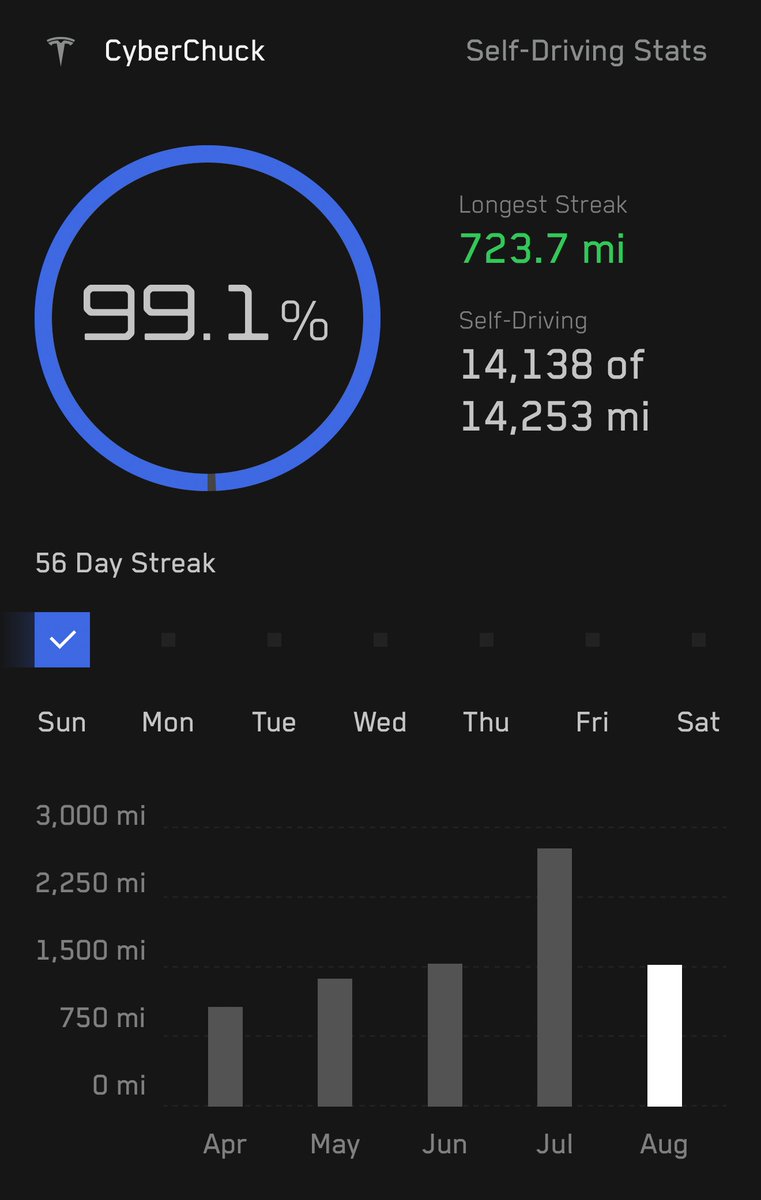
Having FSD on your vehicle changes the math on this decision. Before FSD it would have been an automatic choice to either sleep in the parking lot, or try and find a hotel room to rest until I was ready for the drive home. With FSD the decision matrix changes. Get a cup of coffee, enable FSD, and do the drive.
This is what I did last night, not arriving home until close to 445am. It wasn't scary, it wasn't dangerous, but I would never have done it if FSD didn't have my back.
There were several scenarios on my drive home last night where Semi Trucks were swerving into my lane, and FSD safely avoided any close calls.
I hope people that don't understand this technology can see through the popular rhetoric. This is not only life changing for safety, its also life changing for giving you options. It really feels like I am supervising a train. I just sit there watching it drive. My reaction time in the WOCL (Window of Circadian Low) is definitely lower, but with FSD its not unsafe.
If you don't own a Tesla and your life has a similar use case, you need to think about looking into this technology further, or talking to someone that uses it every day.
If you own a Tesla and don't own or subscribe to FSD for your commutes or longer drives .. you are wasting your investment in the platform that is capable of this level of automation.
It is a game changer.
@Tesla@Tesla_AI
News agencies are the enemy of the people. Framing a story to mislead… the headline suggests OPS “lost” $50M and is victimized, when in reality the district received $30.5M in excess state aid due to an error, spent it, and is now pushing an 8-cent levy increase for a net $10M budget expansion despite the corrected cut.
• OPS has a C+ overall Niche grade with C- academics (only ~30% math and 40% reading proficient), ranks in the bottom 50% of Nebraska districts on proficiency, and has a ~70-72% graduation rate that has declined—performance that lags suburban peers like Elkhorn and Millard.
Blame school board members and the corrupt teacher’s union that runs Omaha.
They took $50 million in state aid from every taxpayer in Nebraska they were not supposed to get, spent it. Now spending an additional $10 million and taxing the residents of Omaha. Get it right @KETV Tell the truth.
Ur lucky he doesn’t force zero based budgeting on everything. The idea that a 5% cut is so off putting to you is exactly what’s so wrong with our government. It’s not your money to begin with, and govt has had zero accountability to spend it wisely or try to minimize it. Wish he cut more
FIFA President Gianni Infantino:
“I have seen the public comments regarding the decision of the independent FIFA Disciplinary Committee related to the suspension of Folarin Balogun, and I would like to reiterate a fundamental principle of FIFA’s governance.
“FIFA’s judicial bodies are independent. They operate autonomously, apply the FIFA Disciplinary Code, and decide cases based on the applicable regulations and the specific facts before them. Their independence is essential to the credibility and integrity of football, and this must always be respected.
“Yes, I regularly discuss matters related to the FIFA World Cup with the President of the United States, and on this matter, I did receive a call from President Donald Trump, just as I receive calls from heads of state, government officials, football stakeholders and business executives from around the world on many different issues. During our conversation, I explained that there was an ongoing legal process involving FIFA’s independent judicial bodies and that the case would be decided in due course by the competent bodies. That is how FIFA’s system works, and it is a principle that I will always uphold.
“I read the decisions of the FIFA Disciplinary Committee when they are issued. Sometimes I am surprised by them. Sometimes I agree with them, and sometimes I disagree.
“What I always do, however, is respect those decisions and the autonomy of the bodies that make them. Whether we personally like a decision or not is irrelevant. Respect for independent institutions and the rule of law is what protects the integrity of our competitions and the credibility of FIFA at all times.”
@SawyerMerritt Unless you’re a Tesla solar panel and powerwall user- in which case they STILL haven’t released the software for those users to enable Cybertruck to PowerShare!
“There is no room in this country for hyphenated Americanism... Americanism is a matter of the spirit and of the soul. Our allegiance must be purely to the United States. We must unsparingly condemn any man who holds any other allegiance.” - Theodore Roosevelt
🚨 JUST IN: Gov. Ron DeSantis MIC DROPS rude and interrupting Fake News reporter whining that he's abolishing property taxes for millions of Florida homeowners
"EXCUSE ME! YOU asked the question, I'm answering it!"
"EVERY local government has a self-interest in keeping the GRAVY TRAIN [of money] going!"
"If you can't SEE that, I don't know HOW I can help you. You're going to continue to be inundated by this. They're going to tell you, they're going to tell you there's no money for infrastructure. You're not going to have any money for police, you're not going to have any money for any of these things. They are going to say that over and over again!"
"DON'T buy the HYPE that you can't do these things. I can tell you any time the property tax is put to voters around the country, you hear the same arguments over and over again."
"They are going to say, 'oh, we can't give pay raise because property tax, we can't do this, we can't do that!' You're going to be inundated with that. They're going to try to get every single person who is connected to local government to be hostile to doing things for taxpayers!"
No more property taxes! The ballot amendment will first and foremast benefit primary homesteaders based on property value.