Only one day live on https://t.co/w6Zru5JfAu and the Diamond Hands Sprint has already clocked 189,620 in total trading volume. 🤯
Have you secured your spot among the top 20 eligible operators yet? The volume tracking is updating in real-time, and trust the process-it is definitely not too late to get your spot setup running.
Jump into the leaderboard and track your metrics:
🔗 https://t.co/fVKFopNxcs
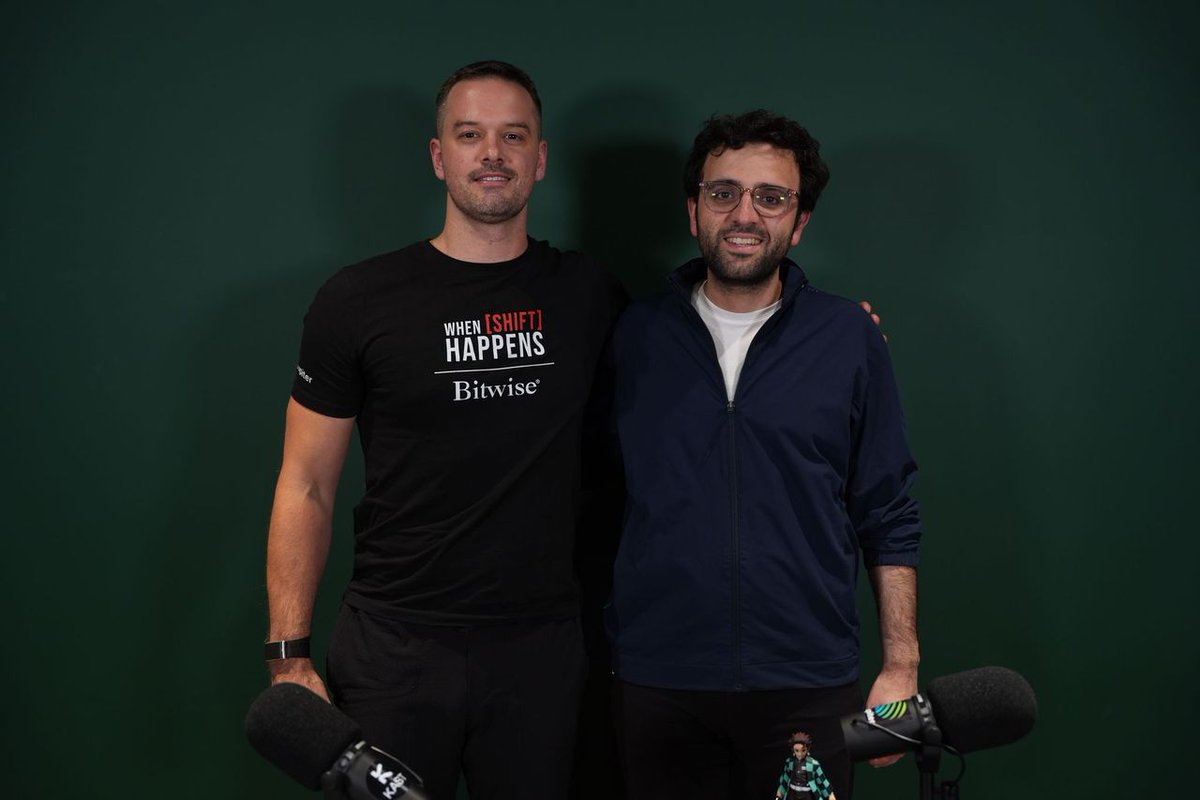
EMERGENCY EPISODE: This Monday, I'm releasing a conversation with @mansourtarek_ - co-founder and CEO at @Kalshi that just launched the first regulated Perps in the USA!
Tarek grew up in Lebanon with a single mom who operated on a "nine out of ten is a loss" standard, found refuge in the certainty of mathematics, got into MIT from Beirut, went to work at Citadel, and then spent six years building a prediction market that regulators kept blocking - before it finally became one of the most talked-about financial products in America.
We talk about:
- What Kalshi's first regulated perpetuals in the US are and why the offshore market proves Americans already want them
- Why Kalshi outperforms every institution at forecasting jobs, GDP, inflation, and interest rates
- Why Tarek publicly disagrees with Brian Armstrong that insider trading is acceptable in prediction markets
- How Kalshi blocks politicians, athletes, and coaches from trading on markets they can influence before they even try
- Why 70-80% of Kalshi users log in daily just to read forecasts - and what that says about where financial media is going
- How Tarek thinks about the difference between leverage that's healthy and leverage that turns a market into a casino
- Why being a first-time founder is actually a superpower for the category of company nobody thinks can work
- How differently he feels now that he is worth mroe than $2 Billion at just 30 year old
And much more...
Podcast out this week!
Coinsilium Backed @otomato_xyz Unveils UK Technology Venture Builder Improbable as its new Strategic Investor 🇬🇧 $COIN.AQ 🇺🇸 $CINGF
https://t.co/M4yCCWS70K
“We are therefore delighted to see Otomato attract investment from a globally recognised technology venture builder such as @Improbableio and congratulate the team on this important achievement. We believe this further validates both the quality of the Otomato project and Coinsilium’s long-standing strategy of identifying and supporting promising ventures operating within some of the most innovative and fast-evolving areas of the digital asset sector.”
Today we're excited to announce a $2M raise led by @improbableio.
We're building the most precise and complete portfolio assistant for onchain users.
Paste your wallet address. We know every position you hold and alert you on every event linked to it.
3,000+ users so far.
🧵
Gm Folks
We are back!
This is another edition of the Predict Alpha Report, our bi-monthly collaboration with @CoinsiliumGroup tracking the rise of prediction markets, event-driven finance, and the growing role of AI agents within it. Each edition focuses on the signals that matter, from capital flows and fundraising activity to regulatory shifts and product innovation. As information is increasingly priced in real time by both humans and machines, the Predict Alpha Report will track where these signals lead.
But first, let’s get this part out of the way:
Always DYOR:
This bulletin is for informational purposes only and contains summaries of news articles originally published by third-party media outlets. Please refer to the full disclaimer at the end of the post.
Now, let’s get started.
Here are the highlights:
💸 Capital Signals
👉Pretty Impressive, Kalshi
👉A Partnership, A Raise
👉Welcome HIP-4
👉Robinhood Expands…
👉Coinsilium CEO on "When Shift Happens" Podcast
📈 Industry Pulse
👉NHL, CFTC V Insider Trading
👉India Blocks Polymarket, Kalshi
👉In Japan by 2030?
👉Bio Prediction?
💸 Capital Signals
💰 Pretty Impressive, Kalshi
Kalshi has just extended its already massive Series F round with an additional $200 million raise led by Baillie Gifford and Layer Global, keeping the company’s valuation at $22 billion. The fresh capital comes just weeks after Kalshi announced a separate $1 billion raise, backed by firms such as Coatue, Sequoia, Andreessen Horowitz, Paradigm, Morgan Stanley, and ARK Invest. Altogether, the company has now raised roughly $2.77 billion since launching in 2018.
Kalshi’s growth is pretty impressive. Monthly trading volume reportedly crossed $14 billion in April, nearly triple what it was last October, while annualised revenue has climbed above $1.5 billion. Also, Baillie Gifford (traditionally known for backing long-duration growth companies like Tesla and Shopify) participating in the round is an excellent signal.
💰 A Partnership, A Raise
Polymarket is in advanced talks to raise another $400 million at a $15 billion valuation. The raise is coming shortly after Intercontinental Exchange (ICE), the parent company of the New York Stock Exchange, reportedly invested $600 million as part of a broader push into event-driven trading markets. Just a year ago, Polymarket was valued closer to $1 billion, but that valuation has been quickly repriced.
At the same time,
Polymarket is expanding beyond politics and sports into private markets through a new partnership with Nasdaq Private Market. Users can now trade contracts tied to the valuations, IPO timelines, and secondary market activity of companies like OpenAI, SpaceX, Stripe, Anthropic, and Databricks. This means that retail traders are getting access to a layer of market speculation and price discovery that was historically limited to venture firms, private equity funds, and accredited investors.
💰Welcome HIP-4
Hyperliquid has officially entered the prediction market race with the launch of HIP-4, a new upgrade that adds fully collateralised outcome contracts directly into the platform’s existing trading infrastructure. The design is interesting because Hyperliquid is integrating prediction markets into a unified trading system where traders can manage spot positions, perps, and event-based contracts from the same account. The contracts settle between 0 and 1 depending on whether an outcome happens, and unlike leveraged futures, they are fully collateralised upfront, meaning there is no liquidation risk. The first live market is tied to Bitcoin’s daily price outcome, but the infrastructure already supports more complex event markets.
💰Robinhood Expands…
Robinhood is moving deeper into prediction markets by expanding access to event-based contracts tied to politics, economics, and sports, while deliberately avoiding markets that could raise insider trading, manipulation, or reputational concerns. Instead of building its own independent system, Robinhood is partnering with regulated US platforms like Kalshi and ForecastEx to keep the products within existing compliance frameworks.
Recently, CEO Vlad Tenev described prediction markets as the company’s fastest-growing segment. For a platform that originally built its brand around making stock and options trading accessible to retail users, prediction markets are increasingly being positioned as the next layer of alternative financial exposure.
And rounding up this section:
💰 Coinsilium CEO Eddy Travia Outlines Vision for AI Agent Integration and Prediction Market Infrastructure on "When Shift Happens" Podcast
Coinsilium Group CEO @eddybitcoin appeared on the When Shift Happens podcast to discuss the structural convergence of AI agents, prediction markets, and stablecoins into a unified, machine-driven internet economy. Eddy contextualised Coinsilium's recent US$150,000 investment in @Predictive_Labs, framing data aggregation and intelligence systems as high-leverage infrastructure opportunities that avoid the regulatory complexities faced by direct trading venues like Polymarket or Kalshi. In his view, prediction markets, blockchain infrastructure, and autonomous AI systems are converging into a new “agentic economy” where machines may eventually interpret signals, allocate capital, and coordinate economic activity in real time.
📌 FYI: Coinsilium’s shares are traded on the Aquis Stock Exchange Growth Market in London, under the ticker symbol "COIN", and on the OTCQB Venture Market in the United States under the ticker symbol "CINGF".
But it’s not just capital flowing into the space.
Keep reading for the latest signals in regulation, adoption, and structure.
📈 Industry Pulse
⚡️NHL, CFTC V Insider Trading
The NHL and the Commodity Futures Trading Commission (CFTC) have signed a formal agreement to coordinate on fraud, insider trading, and market manipulation tied to hockey-related prediction markets. The move follows a similar agreement signed with Major League Baseball earlier this year.
Under the arrangement, the NHL will share data and integrity-related information with the CFTC to help monitor suspicious trading activity across platforms like Kalshi and Polymarket. The league was already ahead of most major US sports organisations in this area, becoming the first professional American sports league to formally partner with prediction market operators back in late 2025. Now, the relationship is becoming more institutionalised as regulators and sports leagues work together to prevent manipulation and insider-driven trading.
⚡️India Blocks Polymarket, Kalshi
India has officially moved against prediction markets, ordering internet providers to block access to Polymarket and reportedly preparing similar restrictions for Kalshi. The decision follows the rollout of India’s new online gaming regulations, which now classify prediction markets as “money games” under the country’s betting laws. In practical terms, Indian regulators are drawing a hard line: if users are staking money on future outcomes, the activity is being treated as gambling regardless of whether the platform is crypto-native like Polymarket or federally regulated in the US like Kalshi.
What makes the move especially significant is the scale of the market involved. India is one of the world’s largest retail trading and crypto markets, and both platforms have continued onboarding Indian users even after regulators issued warnings in April. Authorities have now escalated from public advisories to ISP-level enforcement while also pressuring VPN providers that help users bypass restrictions.
⚡️In Japan by 2030?
Polymarket is reportedly preparing a long-term push into Japan, appointing Mike Eidlin, formerly Jupiter’s head of Japan, to lead local expansion efforts as the company explores regulatory approval in the country by 2030. The move is notable because Japan is currently a restricted jurisdiction for Polymarket, with users blocked due to local gambling and financial regulations. Despite that, demand appears to be building organically. Polymarket’s Japanese social accounts have already attracted tens of thousands of followers, and the platform hosts a growing number of contracts tied to Japanese politics, macroeconomics, and Bank of Japan decisions.
The expansion effort also highlights how important Asia is becoming in the global prediction market race. Japan has one of the world’s most active retail trading cultures and a highly developed digital asset ecosystem, making it strategically valuable for firms like Polymarket and Kalshi looking beyond the US. At the same time, it is also one of the more legally complex markets to enter since Japanese gambling laws remain strict, and regulators across the region are increasingly scrutinising event-based trading platforms as volumes grow.
Lastly,
⚡️Bio Prediction?
Prediction markets are beginning to spill into one of the most sensitive corners of finance and science: clinical trials and drug development. A new platform called Endpoint Arena has launched a pilot marketplace where users can trade on whether biotech companies like Jazz Pharmaceuticals, Argenx, and Palisade Bio will successfully hit key clinical trial endpoints. At the same time, larger platforms like Kalshi and Polymarket have started listing more biotech-related event contracts tied to drug approvals and FDA timelines.
Supporters argue these markets could become valuable forecasting tools. Instead of trying to price an entire biotech company through its stock, prediction markets isolate specific outcomes like whether a trial succeeds or whether a drug gets approved. Endpoint Arena’s founder even argues that crowd-based forecasting could eventually help surface scientific signals earlier, improve resource allocation, and create incentives for deeper public engagement with clinical research.
On the other end, critics worry that once real money becomes attached to trial outcomes, prediction markets can begin influencing the underlying events themselves. Poor odds could discourage patient participation or impact funding. There is also the risk of insider trading in biotech, where access to non-public trial data can be enormously valuable. Regardless of the possibilities, for now, the sector remains small and highly experimental.
And that’s it!
Long read, but if you enjoyed this, set a reminder in your calendar for the next edition of the Predict Alpha Report.
Thanks to Coinsilium, we’ll be dropping these updates every other Monday, i.e, twice a month.
Till then,
Thank you for being a part of the When Shift Happens family.
Full Disclaimer
All rights to the original content belong to the respective publishers. We do not claim ownership of any third-party material and provide proper attribution, including source links, for transparency and reference. While we strive for accuracy in our summaries, we make no warranties or guarantees regarding the completeness or accuracy of the information provided.
Any mention of cryptocurrency, financial products, public company stocks, or other investment instruments in this newsletter or the referenced articles is not intended as financial advice or a recommendation to invest. The information is not tailored to any individual’s circumstances and should not be relied upon for investment decisions. Readers are encouraged to consult the original articles and seek independent financial, legal, or professional advice before making any investment.
The author(s) of this report may hold, directly or indirectly, positions in the securities or digital assets (including shares or tokens) of the company(ies) or project(s) mentioned herein. Any such holdings are disclosed for transparency and should not be construed as a recommendation to buy, sell, or hold any financial instrument.
@AlexisYellow Similar arbitrage opportunities in HK for RMB exchange rate especially from 2006 to 2013 when RMB was continuously appreciating compared to the USD and the HK monetary authority working daily to keep the HKD pegged to the USD
"Eddy contextualised Coinsilium's recent US$150,000 investment in @Predictive_Labs , framing data aggregation and intelligence systems as high-leverage infrastructure opportunities that avoid the regulatory complexities faced by direct trading venues like Polymarket or Kalshi.
In his view, prediction markets, blockchain infrastructure, and autonomous AI systems are converging into a new “agentic economy” where machines may eventually interpret signals, allocate capital, and coordinate economic activity in real time."
Gemini processed 3.2 quadrillion tokens last month. In the whole of last year, it did 480 trillion.
Each token is quantifiable agentic work that used to be human work.
How do these agents transact with each other? Yellow handles that: escrow, clearing, dispute resolution.
My co-founder at GSR taught me what it means to be "long-term greedy."
Long-term greedy is an old Goldman Sachs concept coined by Gus Levy. It means you don’t prioritize short-term profit. Instead, you obsess over customers, deliver exceptional service, and win the long game because you’ve built unshakeable trust.
In other words, if your incentives favor short-term gains, you inherently destroy long-term growth.
Since the start of 2026, more than 30 crypto companies have closed their doors, many with investments, and only a fraction of them did it publicly.
Tally, Leap Wallet, Nifty Gateway, Parsec, Slingshot, Magic Eden Wallet.
The list grows every week because the financial layer killed their products, which is the consequence of lacking a long-term greedy mindset.
When a product is built around a volatile financial asset from day one, it attracts speculators.
Magic: The Gathering and Pokémon have survived for decades because people came to play the games. The secondary financial value of the cards came much later. Placing a live price chart between the player and the game attracts a completely different crowd.
Once that happens, there's rarely a way back.
Any tweak to game mechanics moves the asset price. Any new feature redistributes wealth. The team stops building a product and starts managing a market.
In crypto, a year is short-term. 10 years is the long game. And as you already know failing to be long-term greedy has its brutal consequences.
When we built Yellow, we decisively refused to take the speculator shortcut. We chose to build a company designed to be cash-flow positive and self-sustaining from day one.
To protect this vision, we refunded nearly 100% of our external VCs (totaling $8M), retaining only those who acted strictly as long-term ecosystem advisors like Coinsilium or syndicated through Republic.
This paved the way for us to build an unshakeable foundation.
Today, the Yellow Network sits at the center, supported by the Yellow SDK powering 500+ apps in the ecosystem. More recently, we introduced Yellow Pro, with several new developments well on their way.
Yellow is the utility token that ties it all together, ensuring settlement, staking security, and governance participation across our ecosystem. We implemented a non-inflationary fee model to ensure value scales with genuine usage.
Building this way is harder. It always takes longer than expected and often requires turning down easy money.
But if you want to survive the graveyard of short-term speculation, you have to choose utility and be long-term greedy.
Eddy Travia On How AI Agents Could Change Investing, Fundraising, And Crypto
In this episode of When Shift Happens, I sit down with @eddybitcoin to discuss the convergence of AI agents, prediction markets, crypto infrastructure, and the future of capital allocation. As the co-founder and CEO of @CoinsiliumGroup, one of the earliest publicly listed blockchain investment firms, Eddy has spent more than a decade watching the digital asset industry move through waves of euphoria, collapse, reinvention, and adoption. And now, Eddy believes the next phase is much bigger: an “agentic economy” where AI agents increasingly make decisions, move capital, and reshape entrepreneurship itself.
From Early Internet to Early Crypto
Eddy’s worldview was shaped by seeing multiple technology cycles up close. He compares crypto today to the internet wave of the late 1990s, particularly the feeling that entirely new forms of economic coordination were emerging before most people fully understood them. Coinsilium itself was built around that thesis. Rather than positioning the company as simply a crypto investment vehicle, Eddy describes it more like an accelerator for emerging technology entrepreneurs.
It also explains why Coinsilium backed projects like @Yellow and even supported When Shift Happens early. Eddy says he was drawn to media because of its leverage inside crypto ecosystems and the ability to attract high-quality guests unusually early for a young platform.
That pattern of identifying infrastructure before the broader market fully values it shows up repeatedly throughout the discussion.
Why the Bitcoin Treasury Model Eventually Fails
One of the strongest sections of the episode is Eddy’s breakdown of the Bitcoin treasury company boom of 2025. Coinsilium was one of the companies that benefited from the wave, and at one point, the company reportedly generated £115 million in trading volume in a single month, even surpassing Tesla on certain UK retail platforms. The basic model was straightforward: raise capital, buy Bitcoin, let investor enthusiasm drive the stock higher, then repeat the cycle.
But Eddy is unusually honest about the limitations of that strategy. The problem, as he explains, is that the model only works when retail demand remains strong. Once enthusiasm slows, the loop begins to weaken. Bitcoin itself may still be attractive, but if investors are no longer aggressively buying the shares of treasury companies, the mechanism stalls. And here he delivers one of the deeper themes of the episode: sustainable businesses cannot rely entirely on financial momentum.
Eddy argues that many treasury companies became too “monolithic,” i.e., overly dependent on Bitcoin appreciation rather than building operational capabilities around it. Coinsilium’s response was to diversify beyond passive exposure and continue building businesses, investments, and infrastructure around emerging markets. Eddy is still strongly bullish on Bitcoin, but he separates belief in the asset from blind dependence on market cycles.
The Real Opportunity Isn’t Trading but Infrastructure
Eddy believes many investors misunderstand where value is actually being created right now. While the public focuses on the biggest platforms like Polymarket or Kalshi, he thinks some of the most interesting opportunities exist in the infrastructure layer underneath them. That is part of the reason Coinsilium backed @Predictive_Labs, a company focused on aggregating fragmented prediction market data across platforms. Instead of competing directly with trading venues, the company is building an intelligence infrastructure that traders, researchers, institutions, and eventually AI agents can use.
The logic is similar to what happened during earlier internet cycles. The biggest winners are not always the consumer-facing brands. Often, the deeper value sits in the systems enabling coordination, discovery, and distribution. Eddy sees prediction markets becoming especially important because they convert future uncertainty into machine-readable probabilities. Once that happens, AI agents can begin acting autonomously on top of that information.
The Rise of the Agentic Economy
The core idea running through the episode is Eddy’s belief that AI agents and blockchain are naturally converging. “I think you cannot have AI agents without blockchain.”
His reasoning is practical. AI agents need systems for payments, verification, transaction execution, coordination, and ownership. Blockchain technology already provides many of those primitives. Eddy imagines a world where AI agents continuously consume information, interpret prediction markets, execute trades, move stablecoins, coordinate logistics, and make operational decisions with minimal human involvement.
That shift, he argues, will dramatically accelerate the speed of economic activity. The implication is that markets will stop operating primarily at human speed. Instead, agents will begin reacting to probabilities, signals, and events almost instantly, creating feedback loops between information and capital allocation. In that environment, entire industries will become structured around machine compatibility.
He points out that even entrepreneurship itself changes under this model. A single founder may eventually operate with a network of AI agents functioning like a miniature executive team handling research, marketing, data analysis, customer engagement, and operations simultaneously. Notably, Eddy does not frame this purely as a utopian future. He openly acknowledges that many repetitive jobs may disappear in the process. But he also believes the transition will create an explosion of new entrepreneurial activity as barriers to building companies collapse.
Why Distribution Matters More Than Capital
One of the most interesting conclusions Eddy reaches is that capital itself may become less important in the future. If AI agents increasingly optimise investment decisions based on traction and measurable performance, then entrepreneurs with real user growth could find funding much more easily than before.
“Any company that shows traction will easily be investable.” In that world, the scarce resource is no longer money alone. It becomes visibility, distribution, network effects, and execution speed.
That idea reframes the role of investors entirely. Instead of simply writing cheques, firms like Coinsilium increasingly position themselves as ecosystem builders helping founders navigate growth, adoption, and go-to-market execution.
It is a fitting perspective from someone who has survived multiple cycles already. Throughout the conversation, Eddy is far less interested in short-term narratives and far more focused on the underlying systems reshaping how markets, businesses, and economies function. And for him, that transformation is only beginning.
👉If you enjoyed reading the summary, head over to When Shift Happens on YouTube or your favorite podcast platform to access the full convo.
In @DecryptMedia, @DiegoMYellow of @yellow__capital notes "instead of being focused purely on digital assets, crypto infrastructure starts becoming a way for people to participate in broader financial opportunities."
https://t.co/zFy4LfGpX6
JUST IN: Otomato just launched the most precise DeFi portfolio monitoring app
Auto-detects your positions. Alerts you before liquidation. Tracks airdrops, perps, NFTs.
Free to use. Paste your wallet.
SDK lets developers build brokerages, trading apps, and liquidity‑sourcing tools on top of @Yellow network.
It improves liquidity in three ways:
1. SDK lowers barriers to onboarding liquidity providers. Brokers and market makers can plug once into Yellow, then connect to multiple chains and venues. As more venues and LPs join the network, the liquidity pool gets bigger for everybody.
2. SDK enables streaming of money via state channels. Brokers can offer tighter spreads and higher order‑throughput, which in turn attracts more traders and more liquidity.
3. SDK makes cross‑chain liquidity bridgeless
because it routes transfers through Yellow ClearNet. Liquidity moves between chains without extra counterparty risk or custody, which encourages institutions to keep capital deployed across chains inside the Yellow ecosystem, rather than withdrawing to a single chain.
SDK multiplies the velocity and reach of your existing liquidity by letting many different apps and brokers reuse the same settlement layer.
If you are in the business of liquidity, SDK is the growth flywheel.
If you cannot name the source of mispricing, you do not have a trade.
A trader who looks at a market priced at 65 and thinks 'that feels too high' is not trading edge. They are trading vibes!
Edge requires a hypothesis about why the consensus is wrong, and the hypothesis has to map to a recognisable failure mode of the market.
🧮We classify real mispricing into 6 recurring failure modes.
1⃣ - Information lag (the news has broken, the price has not caught up).
2⃣ - Narrative anchoring (the market is priced to a story that no longer fits the data).
3⃣ - Liquidity dislocation (a forced seller or thin book has pushed the price away from fair value).
4⃣ - Resolution-rule confusion (the contract wording prices in a different question than the market thinks).
5⃣ - Cognitive bias clusters (recency, salience, availability, all observable in retail-heavy contracts).
6⃣ - Cross-venue divergence (the same event is priced differently on Polymarket and Kalshi, with no oracle reason for the gap).
A trade that does not match one of the 6 is a guess.
A trade that matches 2 of the 6 is high conviction.
#PredictionMarkets #Polymarket #Kalshi