@dtothetk I published a conference paper on DCog in CS Ed my second year so I don't think so. I was first introduced via the Cognition in the Wild book - maybe the key is finding a representation of the idea that will resonate - there are tons of examples of it in interdisciplinary groups
@ksm_csed@SIGCSE_TS Another style that I've seen work well is just smaller time commitments spread out like weekly reading groups. Something like weekly watch parties for some of the recorded sessions on a weekly basis after - it could be a fun longer-running interaction
@ksm_csed@SIGCSE_TS I think the best style I've seen is those Twitter chats where there is a span of an hour or two with pre-picked discussion questions for people to respond to (obviously biased by the fact I use Twitter) - but the side threads might mimic the hallway track?
@amyjko Would this include things like PEML https://t.co/5LlL6sOMGw that make content standardized and able to be transferred between platforms? Open source systems with for-charge hosting (e.g. PraireLearn)? I am always amazed at how tied to for-profit platforms instructors become...
Congratulations to my postdoc Karen and her co-authors @rdgswanson@merredith_CEEO for the publication of their @JEE_Editors paper "Characterizing engineering outreach educators' talk moves: An exploratory framework" https://t.co/pbaIiIcYY5 @DuncanMullins2 and I are super proud!
The Division of Equity for Excellence in STEM (EDU/EES) is recruiting for two IPA program officer positions. The position is announced as open until filled.
Directorate: STEM Education (EDU)
Science Education Administrator (Program Director)
https://t.co/77uub7Gqin
Codex can generate a correct error message explanation about half the time -- and can provide a correct fix about a third of the time #SIGCSE2023
Also, codex likes to blame indentation and sounds confident when it is wrong.
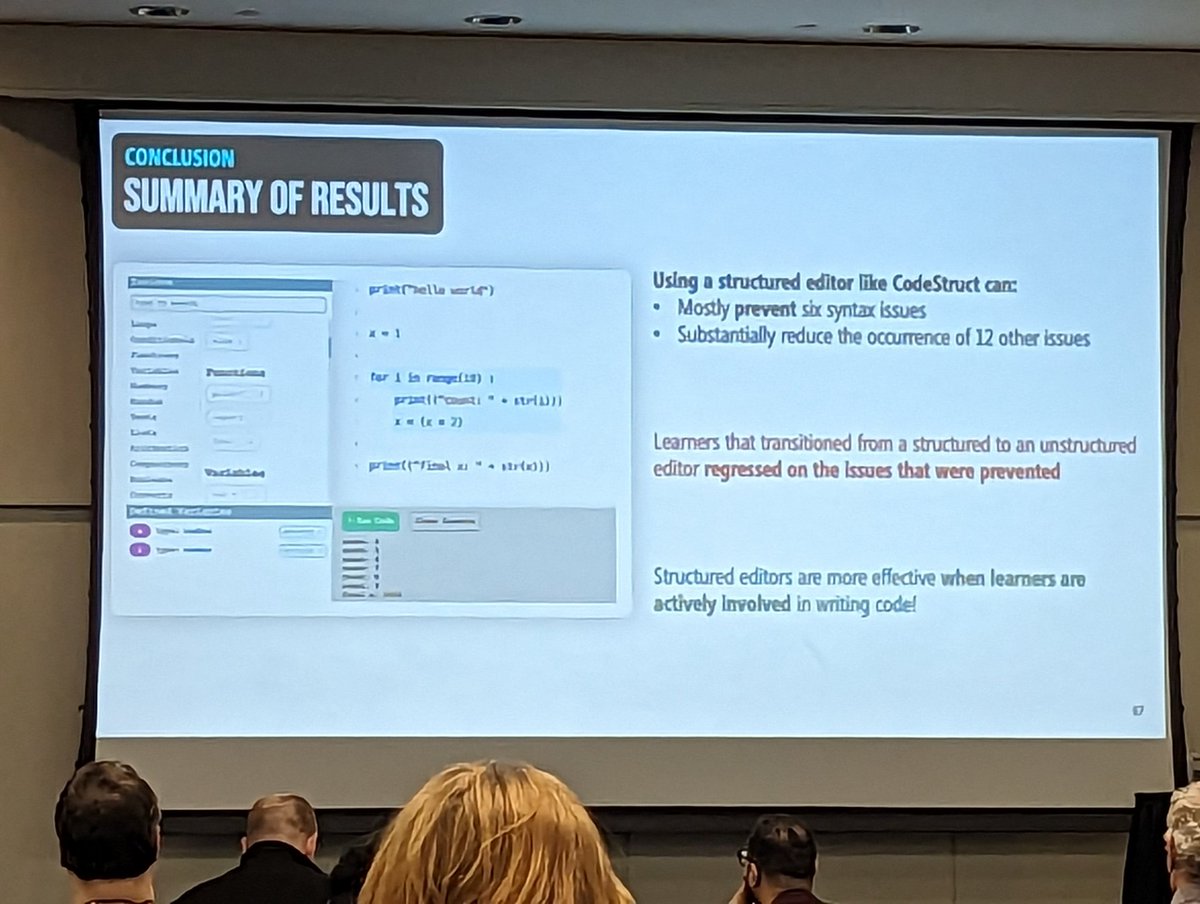
Students using a structured ide as a scaffold regressed when errors were prevented -- when scaffolding blocks to text needs to keep students actively writing code. #SIGCSE2023
Another concern is the juggling of tools - would be best to keep students in one tool.
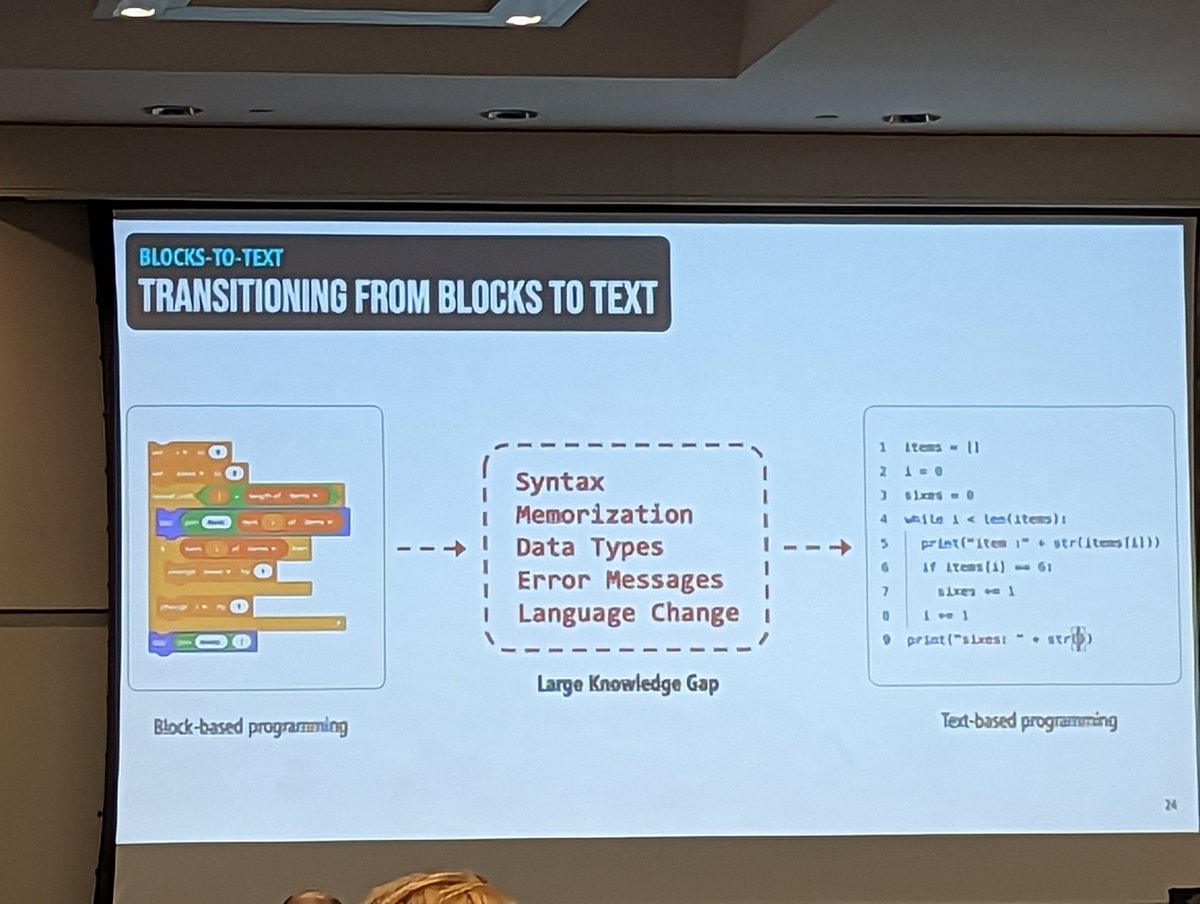
Some challenges when transitioning from blocks to text include syntax, memorization, data types, error messages, and language change. This represents a large knowledge gap and students are likely to hit many errors during this transition #SIGCSE2023
How unreadable is that error message? Look at
1. Length (# of words)
2. Proportion of Basic English words
3. # reserved words or "jargon"
4. Is it a complete sentence?
#sigcse2023
Now that we can measure error message readability, we can improve it!
7 tips for teaching:
1. Borrow - don't start from scratch
2. Make concepts visual
3. Interactive lectures
4. Use visual and interactive tools (and make mistakes!)
5. Use applications to show why
6. Make it hands on and fun
7. Make change happen
#sigcse2023
The Programming Exercise Markup Language: Towards Reducing the Effort Needed to Use Automated Grading Tools kicking off with "who needs another markup language? Not me!" #SIGCSE2023 Maybe it's worth it for compatibility?
Claim: for profits want market differentiation and are not interested in making porting easier or exporting easy to parse, common formats so won't drive this effort. The speaker missed the @CodioHQ session - we love json and yaml! #SIGCSE2023
The final pitch? Use a mixed approach - start with immediate feedback on assignments then remove so students are motivated to write tests (of varying quality) for their code. It would be interesting to see if this holds water... #sigcse2023
Let's dive into the importance of timeliness of feedback - Studying The Impact Of Auto-Graders Giving Immediate Feedback In Programming Assignments #sigcse2023
Interesting to see immediate feedback helping female identifying students slightly more than male identifying counterparts - opening up the question does immediate feedback help support other historically marginalized populations? #sigcse2023