7 days. One mission: give kids back their childhood. DOMI + partners are running a Paediatric Surgical Camp in Arua City, treating hernias, Hirschsprung's disease, hypospadias & more. Give: https://t.co/4fcMuvUeGo #DOMIUganda#RestoringHope#Uganda
“Millions of People around the world survive cancer and continue to live productive lives. “@JacksonOrem noted .
Let us all fight a habit to seek medical attention at a late stage, let us all embrace early diagnosis 📌📌.
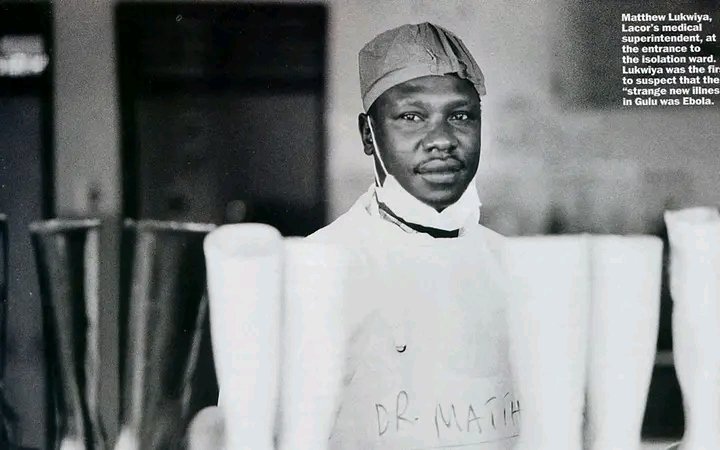
In Memory of Dr. Mathew Lukwiya
In his final hours, he spoke to Sister Apio Anyai Angioletta, the paediatric nurse who had known him for years. She would later remember his exact words.
"Sister, things are worsening. I have tried to fight. The battle is almost over. Now I am seeing that I am also going. The time has come for me to go. That I know. I am going. But if I go, I will be at the doorway. Nobody is going to die now. I will tell my God that enough is enough."
Then he began to sing a hymn about war. Everyone in the room broke down. Sister Apio replied, "No, doctor, it will not be like that." But it was. On December 4th his breathing briefly stabilised. Later that evening his lungs began to haemorrhage. He died at 1:20am on December 5th, 2000.
He was buried at 4pm the same day. The coffin was sprayed with Jik bleach as it was lowered. Margaret asked if she could see him one last time and was refused. The body was considered too infectious.
He was placed in a grave he had chosen himself while he was dying, at the Grotto inside the hospital grounds, beside Dr. Lucille Teasdale and later Piero Corti. Teasdale had died in 1996 of AIDS, contracted while operating on an HIV-positive patient.
The student was buried beside his mentors.
And then something extraordinary happened. After Lukwiya's death, every remaining Ebola patient at Lacor survived. Not another single person died at the hospital. Sister Apio remembered the promise he had made on his deathbed: "I will tell my God that enough is enough." It is the kind of detail you would not believe if you read it in a novel.
By the time the WHO declared Uganda Ebola-free on February 6th, 2001, 425 confirmed and probable cases had been recorded, and 224 Ugandans had died, including thirteen health workers from Lacor alone.
The survival rate during the outbreak was nearly 50%, compared to as low as 10% in previous African outbreaks, largely because of the systems Lukwiya had built before anyone else even knew what was happening.
This is what the mainstream story leaves out. The intern who refused a teaching job in England. The doctor who walked into the bush instead of the nuns. The administrator who turned the hospital into a shelter for nine thousand people, most of them children, every night.
The Acholi son of a smuggler who topped his country in school, won the John Hay Prize at Liverpool, and still chose Gulu over everything else. By the time he made that final speech to his nurses, the heroism was already the entire shape of his life. The Ebola work only made it public.
Happy Heroes Day, Dr Matthew and all healthcare workers who sacrifice more than they should have to! #HeroesDay
# *Copied*
@drpiyushENT Experience in practice is something I'm learning to appreciate more as well.
Even personally, over time, you see things different from when you started out
Fine. If an intern is a student, let's honour that fully. Student hours. Monday to Friday, 8AM to 5PM.
No weekends. No night calls. Public holidays off.
And since students choose their institution, each intern studies from the hospital of their choice.
Why deploy someone to Mbale when their family home is in Busheyi and can easily walk to Ishaka.
A student selects where they learn.
That is how education works.
No more emergency calls at 2AM.
No more covering wards alone on Sunday. No more C-sections at midnight.
After all, a student cannot be held professionally liable.
A student cannot be the last line of defence in a labour ward.
A student cannot be the reason a mother survives the night.
But the moment you strip the allowance, that is exactly what they become. A student.
So let us be consistent.
Either they are students, and we treat them accordingly.
Or they are doctors, and we pay them accordingly.
You do not get to call them students at the payroll office and doctors at the emergency ward.
Pick one.
As a Senior Consultant, the reason I haven't raised my voice is simple:
When the interns are gone, I will gladly show up at 5AM, clerk 80 patients, draw the blood, and run the night calls myself.
I am superhuman. Obviously.
As a Senior Nursing Officer, the reason I am silent is obvious:
I have no problem running three wards alone, fixing lines, tracking vitals, delivering babies, doing the paperwork.
I don't need hands. I have dedication.
As a Policymaker, the reason I haven't spoken is elegant:
The interns are a budget problem I solved by terming the students.
My children are not doing internship in Uganda, after all.
As a Patient, the reason I haven't complained is clear:
Even if the doctor cutting me open has worked 36 hours without food, just cut me open and take the baby out.
Hunger sharpens the hands. Everyone knows this.
As a Citizen, the reason I am unbothered is rational:
None of my children is a medic.
I have my pastor.
The system runs on miracles. Always has.
This policy is brilliant.
Let's all stay quiet and watch the magic happen.
The burden of heart disease in Uganda is steadily rising, with specialists warning that lifestyle-related conditions such as high blood pressure, diabetes stroke and heart attacks are increasingly affecting younger populations.
@MugenyiHenry_#NBSLiveAt9#NBSUpdates
VIDEO: The word 'internship' has been used loosely in many places. However, officials in the Ministry of Health understand that a fifth-year intern is already a doctor. - Dr Frank Asiimwe
#NBSMorningBreeze#NBSUpdates