Solo Founder vs. Co-founder: The Crypto Reality
VCs scream: "Get a co-founder or we won't invest." They’re relying on outdated Web2 logic. In crypto, the data tells a different story.
The Data (200+ Crypto Projects):
Solo founders are just as likely to succeed as co-founders.
Retention rates and survival rates are nearly identical.
Why Crypto flips the script:
Open source = free co-founders. You don't need a partner; you need contributors.
Token alignment. Incentives attract talent faster than equity splits.
Speed. No consensus debates. One person makes decisions; the product ships faster.
When to stay Solo:
You are technical enough to build and communicate.
You are building in public (your community is your co-founder).
You want to bootstrap and maintain control.
When to look for a Partner:
You have a massive skill gap (e.g., pure coder with zero BD).
You need 24/7 global coverage.
You must secure VC funding and can't handle the "team risk" bias.
The Trap:
Don’t force a co-founder relationship just to please a VC. A bad partnership at month 6 will kill you faster than being solo at month 1.
The Edge Approach:
Start solo. Build for 3-6 months. See what role you actually need to fill-then either hire for it or find a partner organically.
Bottom line: A strong community beats a forced, dysfunctional co-founder team every time. Don’t optimize your cap table for VCs; optimize for speed and product.
The Pivot Paralysis: How founders kill projects by changing course every 3 months.
Seen this a hundred times. Instead of fixing distribution, founders just swap the product. Result: 6 pivots in 18 months and a dead bank account.
Constant pivoting is just hiding from the hard work. Here is how to tell panic from reality.
When NOT to pivot:
Growth is "slow" after 3 months. Building is hard. You haven’t actually tested your marketing channels yet.
A competitor raised a huge round. That’s a reason to differentiate, not to run away.
The team is bored. Tech is routine. Pivot = resetting your progress to zero.
One VC said "interesting, but...". A VC's opinion is not market reality. They are wrong constantly.
When to ACTUALLY pivot:
1 Core assumption is proven wrong. A feature becomes illegal or tech regulations completely block your path.
2 12+ months, tried everything. 100+ user interviews, 5 different go-to-market strategies, 10 pricing changes. Total silence.
3 The market literally disappeared. Like the ETH merge killing entire MEV niches overnight.
The Persistence Test
Most founders quit after 2-3 marketing channels and 15 user calls. Real persistence is testing 10+ channels, running 50+ experiments, and grinding for a year.
Pivoting burns cash, confuses your community, and kills team morale. It’s always easier to change the product than to fix the distribution—but the best founders push through the discomfort.
Stop restarting. Start iterating.
The team is locked in, finalizing the core structure for the upcoming Edge RWA Cohort.
We spent the last few days dissecting the biggest bottlenecks founders face in the RWA space. Deploying a smart contract is only 10% of the battle. The other 90% is complex legal structuring, institutional liquidity, capital efficiency, and distribution.
We’ve dialed in our operational and strategic playbooks to make sure the incoming projects can execute without friction.
It's going to be a heavy summer. Soon.
Everyone likes talking about RWA, but nobody wants to talk about the actual heavy lifting. Getting compliance right, sourcing real institutional liquidity, and mapping out the legal architecture takes months of grinding before you even touch a smart contract.
We just wrapped up a massive session with the team, aligning our ecosystem partners to fix exactly this for the upcoming Edge RWA Cohort.
We aren't here to back wrappers. We're here to help founders build scalable financial infrastructure.
Applications open soon.
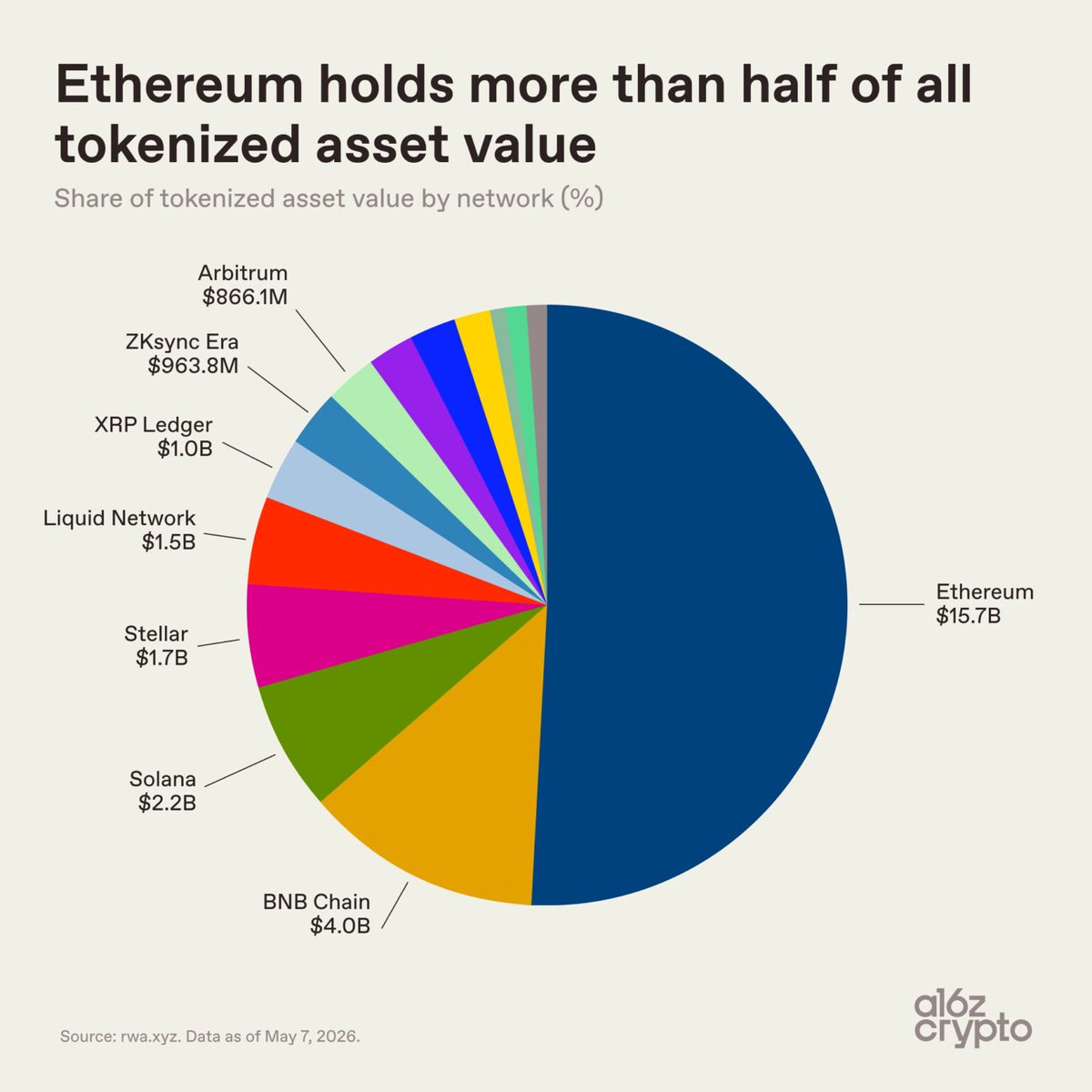
Ethereum still dominates tokenized assets, consistent with its headstart in DeFi and institutional adoption.
Ethereum: $15.7 billion
BNB Chain: $4B
Solana: $2.2B
Stellar: $1.7B
Liquid Network: $1.5B
XRP Ledger, ZKsync Era, Arbitrum: ~$1B each
Rather than converging around a single chain, tokenized assets are spreading across multiple blockchain ecosystems — given criteria like cost, liquidity, compliance requirements, and go-to-market relationships.
The most expensive mistake early-stage founders make is building in a vacuum to protect their IP.
If your competitive advantage relies entirely on keeping your source code hidden until launch, you don't have a moat. You have paranoia. In the current market, speed to feedback loops beats your "secret sauce" every single time.
Ship a compromised, raw version to 10 real users on day one. Let them break it. If they don't complain when it's broken, you’re building something nobody gives a shit about.
We don't fund ideas. We fund teams that can survive the reality shock of their first users.
Most RWA and infra projects are running on pure financial fiction.
You boast about $50M in "committed TVL" on your pitch deck, but 90% of it is sticky capital from friends, family, and yield-farming sybils who will dump you the second a higher percentage appears elsewhere. That isn't traction. That’s a hostage situation.
Real institutional money doesn't care about your artificial lockups. They care about depth, slippage, and whether they can exit a $5M position at 3 AM during a market cascade without crashing your entire ecosystem by 40%.
If your product can’t survive real toxic flow, you aren't building the future of finance- you’re running a temporary testnet.
We supply $100K–$1.5M to teams who design for real-world stress, not beautiful pitch decks.
Most infrastructure and RWA teams design their tech for the best-case scenario. Institutional capital tests for the absolute worst.
A clean audit doesn’t mean your architecture can handle a sudden 40% liquidity drain or a fragmented cross-border legal bottleneck. If you haven't engineered your system to withstand extreme market stress and compliance friction from day zero, you aren't building infrastructure - you’re building a tech demo.
Stop pitching us your "revolutionary TPS." Show us your stress-test frameworks and how you plan to manage downstream liquidity.
No vanity metrics. No endless community building without a product. No boring mentorship zoom calls.
We are Edge Accelerator - an investment-first ecosystem designed for hard-core tech teams and institutional scaling.
What we offer:
$100K to $1.5M direct investments.
Straight line to tier-1 institutional liquidity.
Execution-first growth tracks overseen by former founders and top exchange operators.
If you are building robust tech and aiming for real traction, check the link in bio. Let’s talk.
#EdgeAccelerator #Web3 #DeepTech #VentureCapital
Scaling from 20 to 200 engineers isn't a hiring problem. It's a decision-architecture problem.
The companies that stall don't run out of talent. They run out of clarity about who decides what — and by what deadline.
Org design is the first product you ship at scale.
One client this quarter: entered three jurisdictions simultaneously — EU, UAE, US — and closed Series B in the same window.
Cross-border isn't slower than single-market. It's slower only when sequenced badly.м
$4.2B+ in capital mobilized across 180+ companies in 42 markets.
The number we care about more: 97% client retention.
Capital is a milestone. Retention is the verdict.
Most go-to-market plans don't fail at execution. They fail at the assumptions baked in three months earlier.
The pattern we see repeatedly: founders pressure-test the pitch, but not the market math underneath it. By the time the gap shows up in pipeline, the burn is already committed.
Diagnose the assumptions before you diagnose the funnel.
@johnreyesofc@Alquima7 Hola querida, soy Farbin Akhtar. Me enviaste un mensaje pidiendo libros para colorear de Fiverr. Quiero hacer tu trabajo fuera del mercado de Fiverr, luego el 20% de tu dinero se venderá a partir de caracteres y yo sobreviviré con el 20%. Podemos negociar aquí por trabajo si