I see the frenzy around the Ghana Stock Exchange and my first instinct is to stay out of it. But I cannot simply stand by and watch people make grave financial mistakes. These are the kind of mistakes that will cause many people to lose their heads when the tides turn.
As Warren Buffett famously said, “Only when the tide goes out do you discover who’s been swimming naked.” The tides are indeed in full swing. Markets are roaring to life, orders are hitting brokers and all time highs are being set. Soon enough we will see those who are swimming naked because it cannot go on forever.
Some very well-read and knowledgeable people on this platform like @readJerome@DesmondBredu@GameliMartey have served as bulwarks of financial intelligence on Ghana’s side of X and I do not wish to “take their place”. All I ask is for you to hear me on why you might be making a mistake chasing the greens on the Ghana Stock Exchange.
There are very few stocks on the GSE (38 currently). Just by obeying the Pareto principle, there are even lesser solid companies on the exchange. Most companies aren’t making their disclosures properly and have weak financials. The exchange is however portrayed to be full of “cheap” companies that are doing extremely well.
This has caused FOMO among retail investors, driving prices upwards as they rush in to get a spot. The frenzy is not among retailers alone but also among UHNW buyers and institutional buyers. Everyone wants to get a piece of the action in this bull market.
The GSE has recorded an impressive 50 percent plus return this year and has crossed GH¢ 250 billion in market cap. Stocks like MTN, GCB, Benso Oil Palm have done good this year climbing in double digits percentages. These are the smoke screen headlines but underneath all this buzz is a dire problem that unless solved poses a big threat that could derail the morale of Ghanaians to participate in investments of any sort.
In 2021, I had the chance to participate in a meeting that would shape the future of our markets; the launch of IC’s electronic brokerage. Yes, it was in 2021, that our lead broker was going electronic to better serve clients. In this meeting I asked the MD of the GSE what work was being done to bring in market makers who could increase liquidity on the exchange, reduce volatility and thus spur further investment on our exchange. In response I was told that work was being done behind the scenes to increase liquidity and deepen the market. As we speak brokers still match buyers to sellers without the active work of any market maker.
Anyone who has been in finance for a while knows how critical market makers are to the structure of markets. Without them, sellers would have to wait for buyers to be able to offload shares increasing volatility and rendering many unable to participate in the boom.
The GSE lacks this essential mechanism and thus no surprise for me to see that shares are being offered without matching bid size. In most instances orders to buy or sell shares expire. I have suffered this on several occasions. The reason stocks make huge upward moves and equally sharp declines is the volatility created by illiquidity.
As you’re investing on the exchange just know you’re taking a big illiquid risk, what happens when everyone’s rushing out the door in an economic or a market crisis. Who will be left holding the bag. The big moves and order expirations hitting after several weeks should tell you there’s a big problem and not a major opportunity. When it’s time to exit how will you do that.
Many people are falling for the self-styled gurus who post things like “if you had invested GH¢10,000 in XYZ here’s how much you’d have today”. Good luck with getting that much in shares with some notable exceptions easily. This is greed being sold as financial intelligenc
I leave you with some humor about understanding markets. “When your barber starts giving stock tips, it’s time to sell.”
1) Go to school
2) Get a well paying job
3) Save up to get married
4) Save up to buy a car
5) Live with your parents till mid 30s
6) Pay exorbitant fees for your kids
7) Struggle for promotion
8) Travel with years of savings.
9) Save again to cover travel expenses
10)Complain about Kid’s fees
11) Put up a semi-finished home with store-front for retirement.
12) Advise youths to follow your trajectory because you tried taking risks and also failed
13) Retire and live on pension pay
14) Debate politics and consume news all day
15) Die and leave pension home as inheritance.
The life cycle of the average Ghanaian man.
@naval@morganhousel@nntaleb Chapter 3 talks about the concept of happiness. In his submission @morganhousel describes happiness as your expectations minus reality. This means that low expectations generally makes a person happier. I personally believe happiness is seasonal and not the goal, satisfaction is.
@naval@morganhousel Risk is what’s left over after you’ve thought of everything.~Carl Richards
Strikes a chord of humility. Chapter 2 opens the mind to the uncertainty of the future. What a way to express it. You can never be too careful hence the need to always have a plan in case your plan fails.
@naval@morganhousel Chapter 2 opens up on the premise that we don’t know what will actually move the needle hence we’re bad at predicting the future. I remember a historian saying that history books give a cause and effect tone to history, truth is at that point in time you couldn’t predict it.
@naval You could also add Buffett’s statement that only 12 decisions have turned Berkshire Hathaway into the trillion dollar behemoth it is today. I would add that what @morganhousel describes supports that a few decisions separate the rich from poor but with vast net worth effects.
@naval The 1st chapter talks about how seemingly inconsequential decisions leads to wide drifts in the course of history. This reminds me of Charlie Munger’s story of he and his friend where she was bitten by a dog and died while he was spared. Imagine a world without Charlie.
That’s what this book is about: In athousand parallel universes, what would betrue in every single one?
@naval has inspired founders, businessmen, CEOs, and authors. You’ve got to give him his flowers.
“In 1,000 parallel universes, youwant to be wealthy in 999 of them. Youdon’t want to be wealthy in the fifty ofthem where you got lucky, so we want tofactor luck out ofit… I want tolive inaway that ifmy life played out1,000times, Naval is successful 999times.”
Starting SAME AS EVER by @morganhousel. If you’ve ever read the book please don’t give me spoilers. I’ll share what I learn from the book under this post. Wish me luck.
https://t.co/gicv3DQFb3
Just uploaded my first YouTube video on $ENTO for the meme stock lovers. Let me know what you think in the comment section and don’t forget to subscribe, like the video and share.
This may sound comic, but there are couple of things I find fundamentally wrong with this post. The first is that this post assumes that any person at all can rise to something without any connection to wealth or the economic pie. Part of making it big is being connected to…
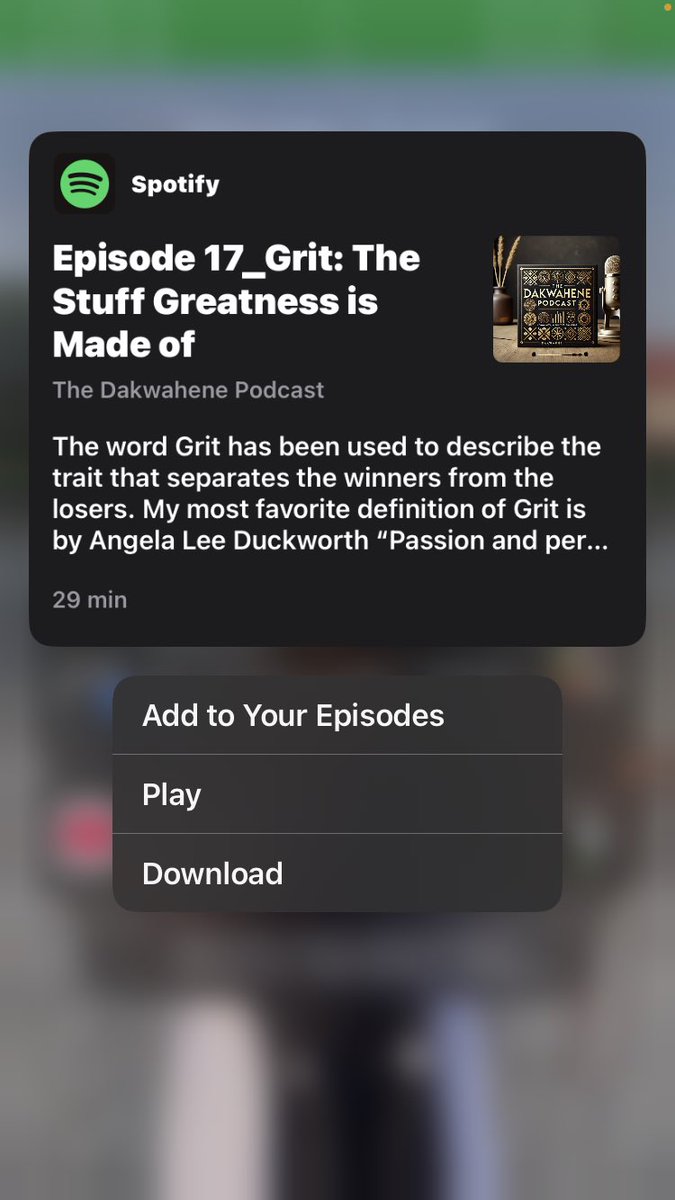
Huge thanks to @angeladuckw for inspiring this episode. It’s been weeks in the making talking about Grit. Notable mentions include @naval, @paulg who I borrowed the Quote of the Week from.
“It’s not your idea that matters most but the determination with which you execute it.”
Not where I planned to be today 5 years ago, but rather I’ve learnt the lessons on what it takes to have attained those heights. A promise I’m making to myself is that 5 years from now it will be double all of the original plan. So help me God.✋🏽
https://t.co/bQAWTX5FaZ Failure serves as a demoralizing force. Even the best of us do fail. But what really is failure and how do you overcome it. In this episode Dr. Dakwahene shares the real meaning of failure and what it is for an entrepreneur on the entrepreneurial journey.