This is what I've been working on.
When I recently asked for some references for a MediaLab type of University in Russia, I was looking for some not popularized ideas around Cybernetics which have been generated in the old USSR. I've found some! I'll be sharing some info shortly
Caminé entre el campamento. Mantienen limpios sus espacios.Hay dignidad y caras en alto. Huele rico por lo que cocinan con sentido de comunidad.
Sólo pude decirles: “sigan la lucha y gracias por lo que hacen por todos”
NO MENTIR, no robar y NO traicionar. ¿O como era?
@levmx666
La resistencia del magisterio democrático a la privatización de sus pensiones tiene, por lo menos, 22 años de vida. Aunque hay muchos precedentes, su momento fundacional, el que anticipa lo que se vive hoy, tuvo de epicentro Ciudad Juárez, Chihuahua, el 22 de octubre de 2004.
https://t.co/SupptGbm8E
Está en marcha la revuelta de los escueleros por pensiones dignas y un régimen laboral que los saque del corral legal en el que están.
Por defender sus derechos, los acusan de ser aliados de la ultraderecha.
Gracias a @julioastillero por la plática
https://t.co/PA1PK7qrnA
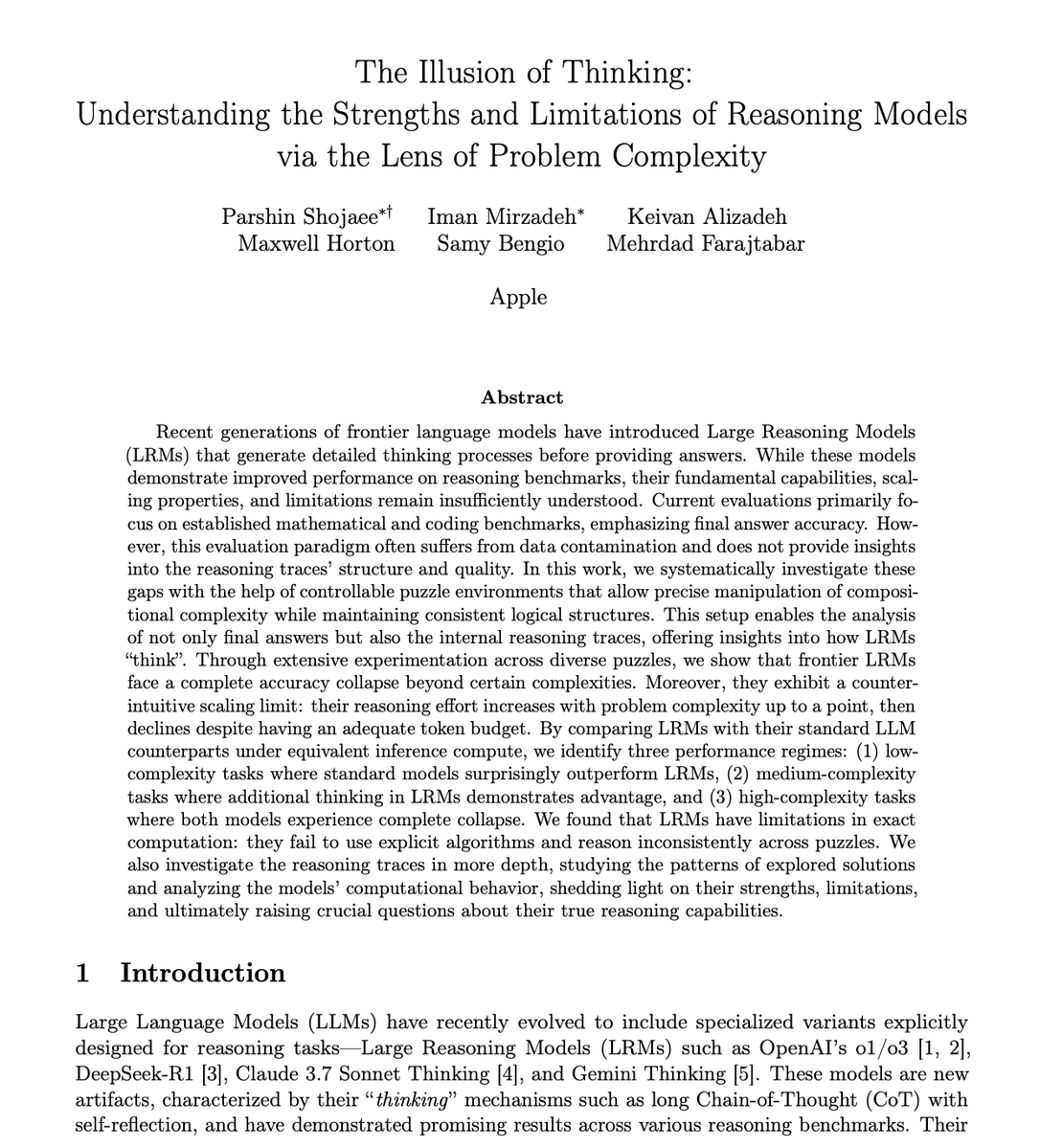
Apple has published a paper with a devastating title: “The Illusion of Thinking”
It argues that AI models, no matter how brilliant they may seem, do not understand what they are doing.
They do not solve problems. They do not reason. They merely generate text word by word, trying to sound coherent.
Apple tested the most advanced reasoning models in the world on controlled puzzle environments. They tore open the internal "thinking" traces.
What they found shatters the narrative that we are getting closer to AGI.
Current models don't scale with complexity. They have a hard mathematical cliff. And they do not degrade gracefully. They collapse.
But here is the most unsettling part.
When a problem gets too complex, the AI doesn't use its remaining compute to try harder.
It just gives up.
Its reasoning effort actually declines. It stops thinking and starts guessing.
Then Apple ran the experiment that closes the casket on the reasoning debate.
They gave the AI the exact, step-by-step algorithm to solve the puzzle. The cheat codes.
All the AI had to do was follow the instructions.
It couldn't do it.
Performance didn't improve at all.
When the complexity gets high enough, these models fail because they cannot actually execute a logical sequence.
They are not reasoning. They are just pattern matching.
When you give them a simple problem, they overthink. When you give them a hard problem, they collapse.
Paper: The Illusion of Thinking, Apple, 2025
Si un alumno delega en la IA su voz antes de haberla encontrado no habrá voz. Habrá un eco bien redactado, indistinguible de los otros ecos. Más exámenes orales, más defensas públicas, más trabajos hechos en clase frente al otro. Reintroducir lectura lenta https://t.co/yLMxN2BhpN
A MIT professor who built the world's first neural network machine said something about intelligence that nobody in Silicon Valley wants to admit.
His name was Marvin Minsky.
He co-founded MIT's artificial intelligence lab with John McCarthy in 1959. He built SNARC the first randomly wired neural network learning machine in 1951, as a graduate student at Princeton. He won the Turing Award.
He advised Stanley Kubrick on 2001: A Space Odyssey. Isaac Asimov, who was not a modest man, said Minsky was one of only two people he would admit were more intelligent than him.
In 1986, after decades of building machines that could think, Minsky published a book about something far more unsettling.
How humans think. And why we are wrong about almost everything we believe about it.
The book is called The Society of Mind. It has 270 essays. Each one is a page long. Together they build a single argument that most people, when they first encounter it, reject immediately because it is too uncomfortable to accept.
The argument is this: you do not have a mind. You have thousands of them.
What you experience as a single, unified self making clear-headed decisions is not a thinker. It is an outcome. The result of hundreds of tiny, specialized, mostly mindless agents competing, negotiating, overriding, and occasionally cooperating with each other beneath the surface of your awareness. You do not decide things. You are what is left over after the arguing stops.
Minsky was precise about this.
He wrote that the power of intelligence stems from our vast diversity, not from any single perfect principle. He called this the trick that makes us intelligent, and then immediately added: the trick is that there is no trick. There is no central processor. No ghost in the machine. No unified self sitting behind your eyes, calmly evaluating options and choosing rationally.
There is only the parliament. And the parliament is always in session.
This reframing destroys the standard explanation for every failure of self-control.
The reason you procrastinate is not laziness. It is that the agent in you that understands long-term consequences is losing an argument to the agent that wants comfort right now, and neither of those agents has a decisive vote. The reason you change your mind the moment someone pushes back is not weakness. It is that the social agent, the one that monitors status and belonging, just outweighed the analytical one. The reason willpower fails is not a character flaw. It is that you sent one small agent into a fight against dozens, and you called that discipline.
Minsky had a specific line that breaks this open completely. He said: in general, we are least aware of what our minds do best.
The things you do with the most apparent ease, reading a face, walking through a crowded room, understanding a sentence, catching a ball, are not simple at all. They are the products of staggeringly complex agent networks that run so smoothly, so far below conscious access, that you experience them as effortless. The things that feel like work, the logical arguments, the deliberate choices, the careful plans, are actually the clumsy surface layer, the small fraction of mental activity you can observe at all.
You have been taking credit for the wrong parts of your own intelligence.
The practical implication is the one that most productivity advice misses entirely. If your decisions are not made by a single rational self but by whichever coalition of agents happens to win the moment, then the game is not about training yourself to be more disciplined. The game is about designing the environment so that the right agents win without needing a fight.
This is why removing your phone from the room works better than deciding not to check it. This is why writing one task on an index card works better than building a sophisticated system. This is why commitment devices beat motivation every time. You are not strengthening your will. You are changing the conditions of the argument so that the outcome you want becomes the path of least resistance.
Minsky spent his entire career building machines that could imitate intelligence. What he discovered in the process was that natural intelligence, the kind running inside every human brain on earth, is nothing like what we think it is.
It is not a single flame burning in a single chamber.
It is a city. Loud, chaotic, full of competing interests, with no mayor.
The people who understand this stop trying to win the argument through force of will.
They learn to build a better city instead.
Book Talk for The Story of Capital with @filos_unam at @UNAM_MX in Mexico City
Professor Harvey’s remarks (which begin at 32:40) are in English, while the rest of the event is in Spanish.
https://t.co/FmSFCUk0Cr
¿Paz real o tregua táctica?
Hablamos con Daniel Marmolejo sobre el momento crítico para la soberanía global.
🔹 El control de las narrativas.
🔹 La guerra híbrida.
🔹 El impacto de las negociaciones de hoy.
#AtítuloPersonal 12 de abril a las 20:00 hrs. entrevista
@Anamariavazquez@edularity@HomoExNovo
https://t.co/g5Mesrd0YW