@is_glasgow Mid 70s Yokermill Road an old bottle dump was discovered, sparking a winner takes all dig. Lots of glass 'cod' bottles with the ball in the neck were unearthed along with stone ginger bottles with various coloured tops. Lucrative business for a lot of kids that year.
Officials from several nations have privately expressed their support for the efforts of Liberation Scotland to join the United Nations list of countries seeking decolonisation, a statement from Salvo confirmed. #UnitedNations#Scotland#LiberationScotland#Salvo#SaraSalyers
We know we have to do this properly and in agreement with the UK."
Worth weighing that sentence, because it carries the whole strategy.
"We know" is a script, not a strategy. It names no procedure, cites no precedent, and has no answer to a counterparty whose settled interest is refusal. The "we" is a cartel, not a country: a closed circle that hands down the lines, files doubt as disloyalty, and has turned twelve years of waiting into a livelihood.
The script has been tested. Every Prime Minister asked for the agreed route since 2014 has refused it. Twelve years is not a work in progress. It is a completed experiment, and refusal is the published result. Yet the experiment never closes, because inside the permission cartel the waiting is the career.
Westminster's own record goes further. On 4 July 2018 the House of Commons endorsed the Claim of Right for Scotland on an SNP motion: "the sovereign right of the Scottish people to determine the form of government best suited to their needs." No division was forced. The Scotland Office then confirmed the endorsement in writing that September. Mr Wishart's own benches put the people's sovereignty on Westminster's record, and the House let it stand. Permission as a precondition asks Scotland to treat that resolution as decorative. In 2018 the script was sovereignty. Mr Wishart has forgotten his own lines.
Sara Salyers is right on the substance. No route runs on England's agreement, the question is international in character, and correct procedure is not a shortcut. Recognition follows facts. Agreement, where it comes, arrives last, not first.
Sovereignty in Scotland lies with the community of the realm. It has since before 1320. Only the exercise lapsed, and the exercise is ours to resume.
A marked convergence is under way within the 'Scottish independence' movement, an awakening of sorts. It is no coincidence that Scotland's status as an English colony stands further exposed at the very moment the world is wrestling with the reality of modern colonialism and elite power.
In Scotland, sovereignty is already held by the people. Only the exercise of our power remains.
What’s in a name can be what determines our reality, and naming our own remedy is the first exercise of the power that is rightly ours as Scots. Every word Scots are usually offered to describe the status of our sovereignty concedes something to the de facto colonial power in Westminster. Restoration concedes loss: you restore what was taken. Reversion concedes the sovereignty effectively left. Recovery and reclamation concede it left your hands. Return concedes it went away. Scotland’s true position surrenders none of it. The sovereignty of the Scots is held by the community of the realm, declared and codified at Arbroath in 1320, inalienable and imprescriptible, never transferred, because the people never voluntarily submitted. What England built around it is an encasement: a structure that holds the exercise in stasis while the right stands untouched beneath it.
Reactivation concedes nothing and names the cause. Something held in stasis by an external mechanism gets switched back on. The remedy is not to ask, not to restore, not to create anything new. It is the community of the realm giving effect to what its instruments already declare: the collapse of the encasement, and the reactivation of the exercise.
In the coming days we will launch a new series setting out the practical mechanics of collapsing the structure England imposed on Scots in 1707 and sold as a Union, and exposing what the current colonial administrators could and should have done since 2015 to give effect to the Scots’ right of self-determination.
The #ReactivationSeries will set out how putting "All Of Us First" is within the power of Scots.
@SimonForrest11 "I bit into the roots of forbidden fruits, with the juice running down my legs." Journey Through Dark Heat (Where Are You Tonight) Street Legal Bob Dylan.
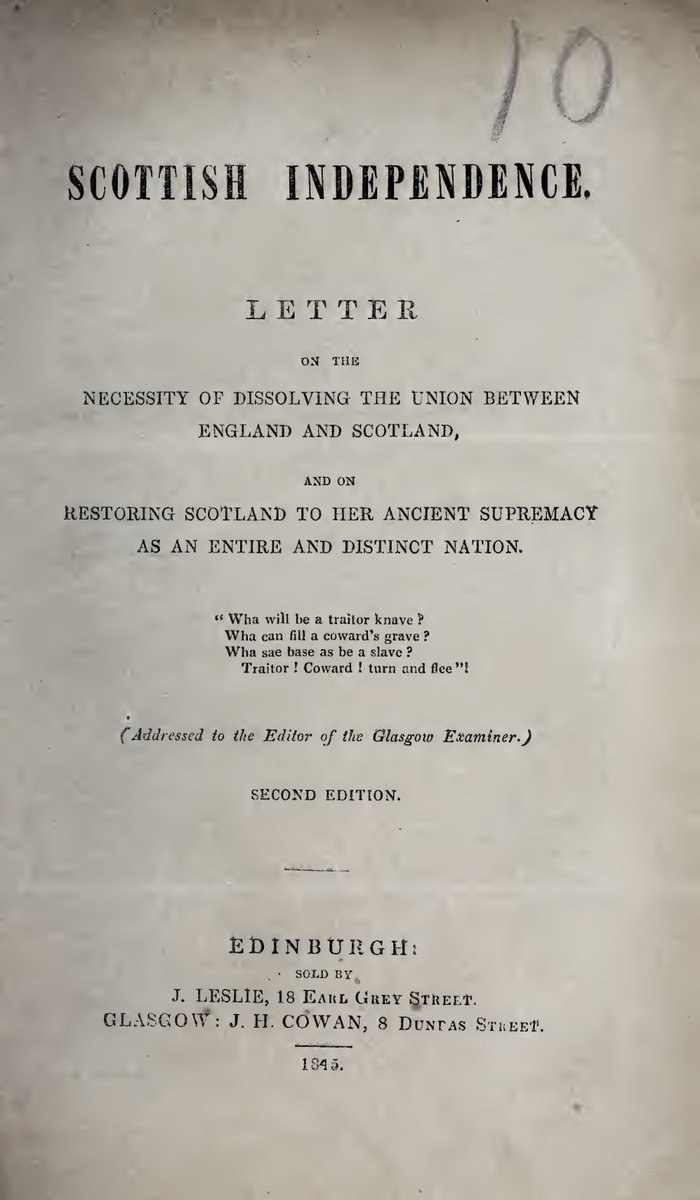
Independence - Dissolve the Union between Scotland and England...
"Restoring Scotland To Her Ancient Supremacy As An Entire And Distinct Nation"
LETTER on Independence from JOHN STEILL 14th Nov 1844
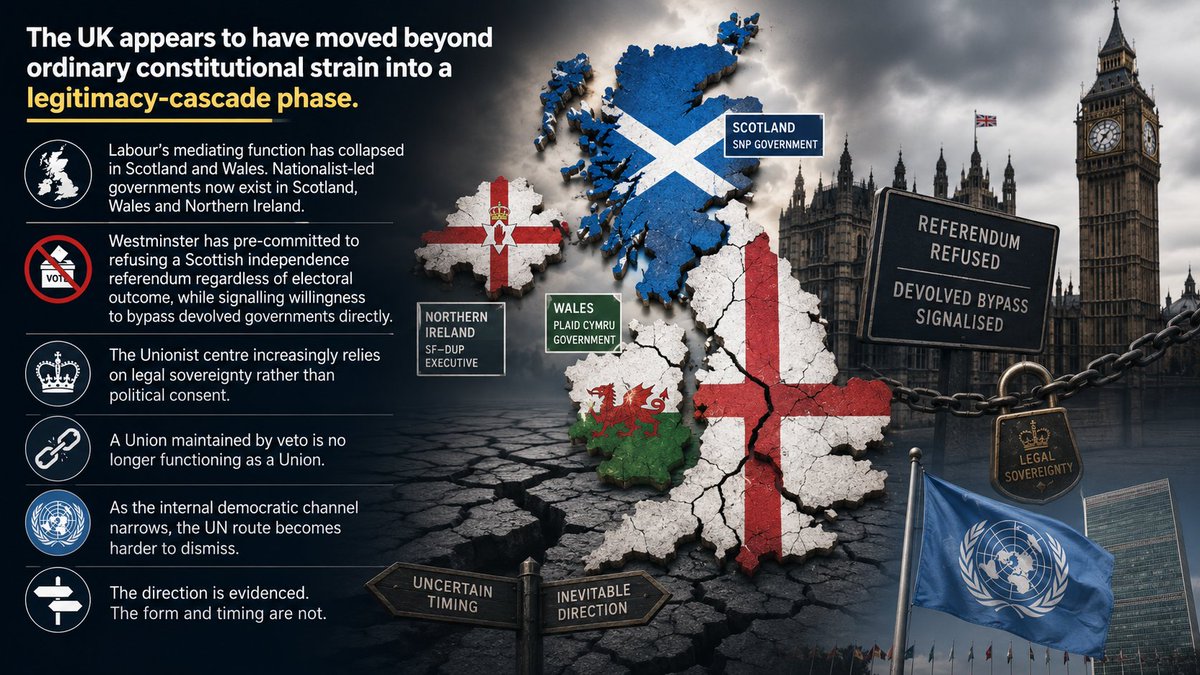
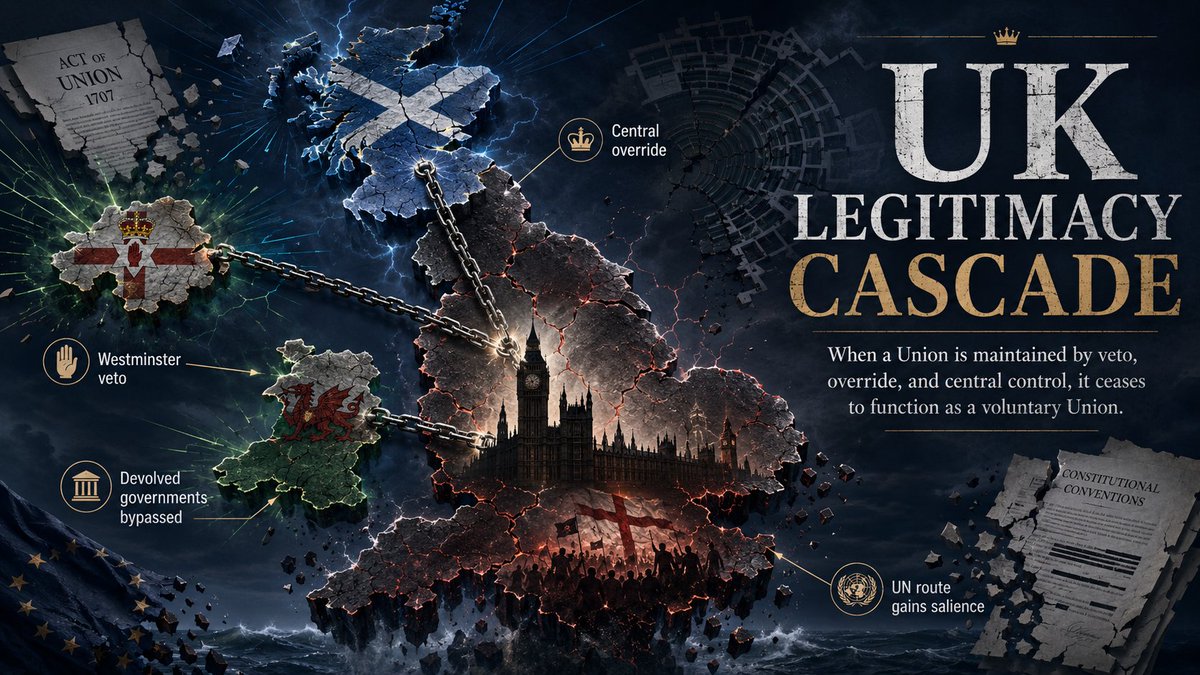
The UK appears to be moving beyond ordinary constitutional strain and into a legitimacy-cascade phase.
A legitimacy cascade occurs when trust in a political system begins to fail in a self-reinforcing chain. Each attempt by the centre to block, override, or deny the problem confirms that the system can no longer correct itself.
In the UK context, this means the Union doesn't collapse because of one single event. It begins to fracture because repeated attempts to preserve it by central authority make it look less like a voluntary union and more like a structure of colonial containment.
Labour's mediating function has collapsed in Scotland and Wales. The old Unionist centre is weakening, while Unionism itself hardens and polarises. In England, that vacuum is increasingly being filled by a populist far-right English-nationalist force.
Nationalist-led governments now exist in Scotland, Wales, and Northern Ireland. Westminster has already pre-committed to refusing a Scottish independence referendum regardless of electoral outcome, while also signalling a willingness to bypass devolved governments directly.
The Unionist centre therefore relies increasingly on Westminster sovereignty, veto, and imposition rather than political consent. At the same time, populist far-right English-nationalism is becoming the largest political force in England itself.
A supposed Union maintained by veto and central override is no longer functioning as a Union, even on its own terms.
As the internal democratic route narrows, the UN route becomes harder to dismiss. It takes the question beyond Westminster’s control for the first time in more than 300 years, places the facts before the international community, and forces attention onto the reality of Scotland’s present and historical condition.
The direction of travel is now clearly evidenced, not least in the increasing commentary on the situation, and feverish denialism from the Unionist commentariat.
The form and timing of dissolution or fracture isn't clear... yet.
"...what is English nationalism if it no longer has the cover story of the Union Jack?"
"Certain elements among us are still haunted by this idea that England has got to be more than just England.
"It's a very weird... it's almost a case for a psychotherapist, this notion of what is English nationalism if it no longer has the cover story of the Union Jack?
"And this goes way, way back in our history. It's something I'm wrestling with at the moment because it's such a profound story.
"I mean, just to remind your viewers, listeners, that the last time, the only time, that any English regime has publicly and openly said, in word and imagery, that it is an English empire, that it rules the archipelago by force of arms, and intends to gather an empire the same way in the name of England, that was the same regime which killed the King of England, in other words, Cromwell's regime, and banned Christmas, as a pagan festival, briefly.
"There is something very, very strange and, and uncanny almost, about this notion of what actually is England.
"Has England become associated with an idea of empire, of colonialism, and that for the people who feel Englishness most closely and most fiercely, the decline of empire has made it very difficult to countenance an England that is not in some sense, an imperial nation.
"And we can't govern India anymore, we can't govern these far flung parts of the world. But if you're that kind of English nationalist, where can you govern? Well, you can keep the Scots in line, you can tell the Welsh what to do, a little part of the island of Ireland will still be yours."
@JamesHawe@LiberationScot@ScotSalvo@SalvoHighlands@SSRG2021@MarkMmcnaught1@thomsonchris@SSalyers2@Broonpot@CraigMurrayOrg@PAlanMcMahon@bruce_hosie@Scotpol1314@HazelLyon16 #AdrianGoldberg Full Podcast 🎥 https://t.co/X0K0jmj9uA