HAPPENING TODAY: Join @MyConstitution's Praveen Fernandes, @AHoagFordjour, and @wuc3 on December 4 for our virtual conversation, “Back to the Future: Embracing the Progressive Aims of the Constitution."
https://t.co/Orti4qNkcd
Looking forward to this upcoming conference at UChicago on “Sovereign Power and the Constitutional Text.” Great lineup, addressing an array of topics, including Indian law, immigration law, extradition, and the extraterritorial application of criminal law. https://t.co/gFRDFSYgde
"No basis in originalism." . . . "As an originalist, I'm embarrassed." . . . Important conversation about the complete absence of historic basis for the conservative majority's immunity decision last week.
Thanks to @SeattleULaw for convening
"There's no constitutional provision stating that the president cannot be tried for actions taken during his presidency, and there is historical evidence suggesting that was intentional." Watch the full @seattleulaw panel featuring @eeksmita: https://t.co/yxczGvvxOY
"There's no constitutional provision stating that the president cannot be tried for actions taken during his presidency, and there is historical evidence suggesting that was intentional." Watch the full @seattleulaw panel featuring @eeksmita: https://t.co/yxczGvvxOY
If the Court wanted to resolve this case quickly, it could avoid for now resolving all the complex issues about the boundary of any presidential immunity. It could say we assume for purposes of this decision that immunity exists for official acts (though we don't decide that or whether it exists for only some official acts) -- contrary to the DC Circuit.
Even so, most of the acts charged in the indictment involve private acts, as the President's lawyer conceded at argument. In addition to the acts already conceded to be private, the Court could also decide now whether any additional acts charged in the indictment similarly involve purely private acts. There is no immunity for any of those acts, even under the President's own theory. The trial could proceed based just on the acts considered personal.
But it does not seem the Court is going to do that. It seems inclined to a broader opinion that grapples more generally with the novel questions of the scope of any possible immunity for former presidents from criminal prosecution.
love to listen to Supreme Court oral arguments about fun hypotheticals like “if you have a womb is it possible you aren’t a person” and “should we have a king”
God bless you, KBJ! Now asking why the President alone gets to break the law when everyone else with difficult consequential jobs has to make their decisions against the backdrop of possible criminal prosecution.
Great speaking with @LeverNews about Cantero v. BOA--a case that @ktyschwnk connects to the 2008 financial crisis. Prof. Wilmarth (writing for @CSBSNews as amicus) helps connect the dots...
As CAC's @eeksmita explains in @LeverNews, Cantero v. Bank of America will determine whether "the power of states to make rules that protect their residents apply to national banks."
https://t.co/9oo1s9jF2p
Exactly right. This is inexcusable, from how long it took SCOTUS to decide to hear the case, to giving the parties so long before the argument in late April. But the initial problem was how slow AG Garland was out of the gate.
Bottom line: The silence of SCOTUS on the immunity case tells us almost nothing.
But every additional day of silence increases the odds that the news isn’t good for anyone who wants Trump’s shocking conduct around the 2020 election to be adjudicated before the 2024 election.
Our Constitution created a government with presidents, not kings. CAC Appellate Counsel @eeksmita wrote in @newsweek about why the DC Circuit's decision rejecting Trump's immunity claim was supported by the text and history of the Constitution: https://t.co/x9f0wX5WCS
The Supreme Court is holding a special Thursday session today for oral arguments in Trump v. Anderson. I believe the Supreme Court has held oral arguments on a Thursday only twice before this century... 🧵
The lawyer is arguing that "officer" means someone "under" the president.
But the Constitution says elsewhere that the President is an "Office."
This is gerrymandering.
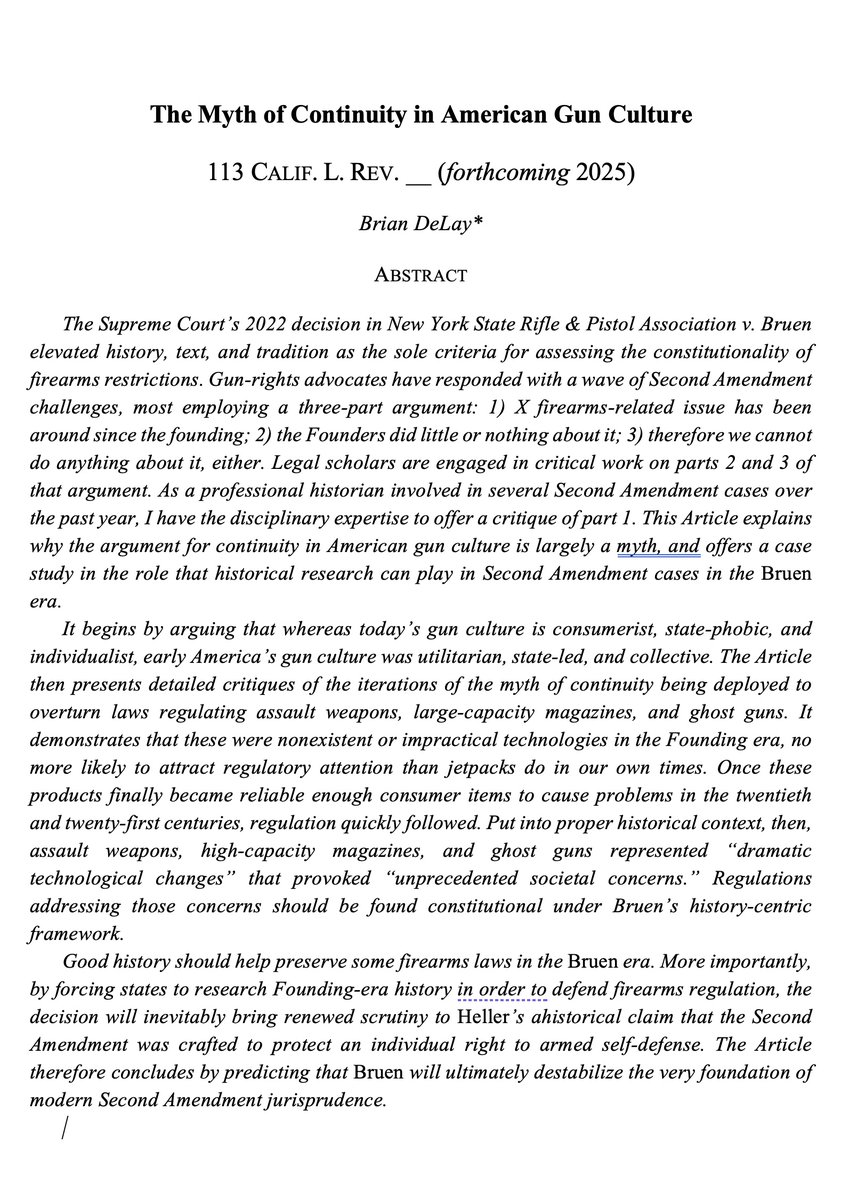
I'm thrilled that "The Myth of Continuity in American Gun Culture," a long (35k word) article that I spent most of the past year working on, will be published by the California Law Review in Feb. 2025 https://t.co/OuvV9Oq8Rs
“Trump’s lawyers claim that the framers of the 14th Amendment intended to ban former officials who engage in insurrection from holding office, unless they held the most powerful office in the United States government.”