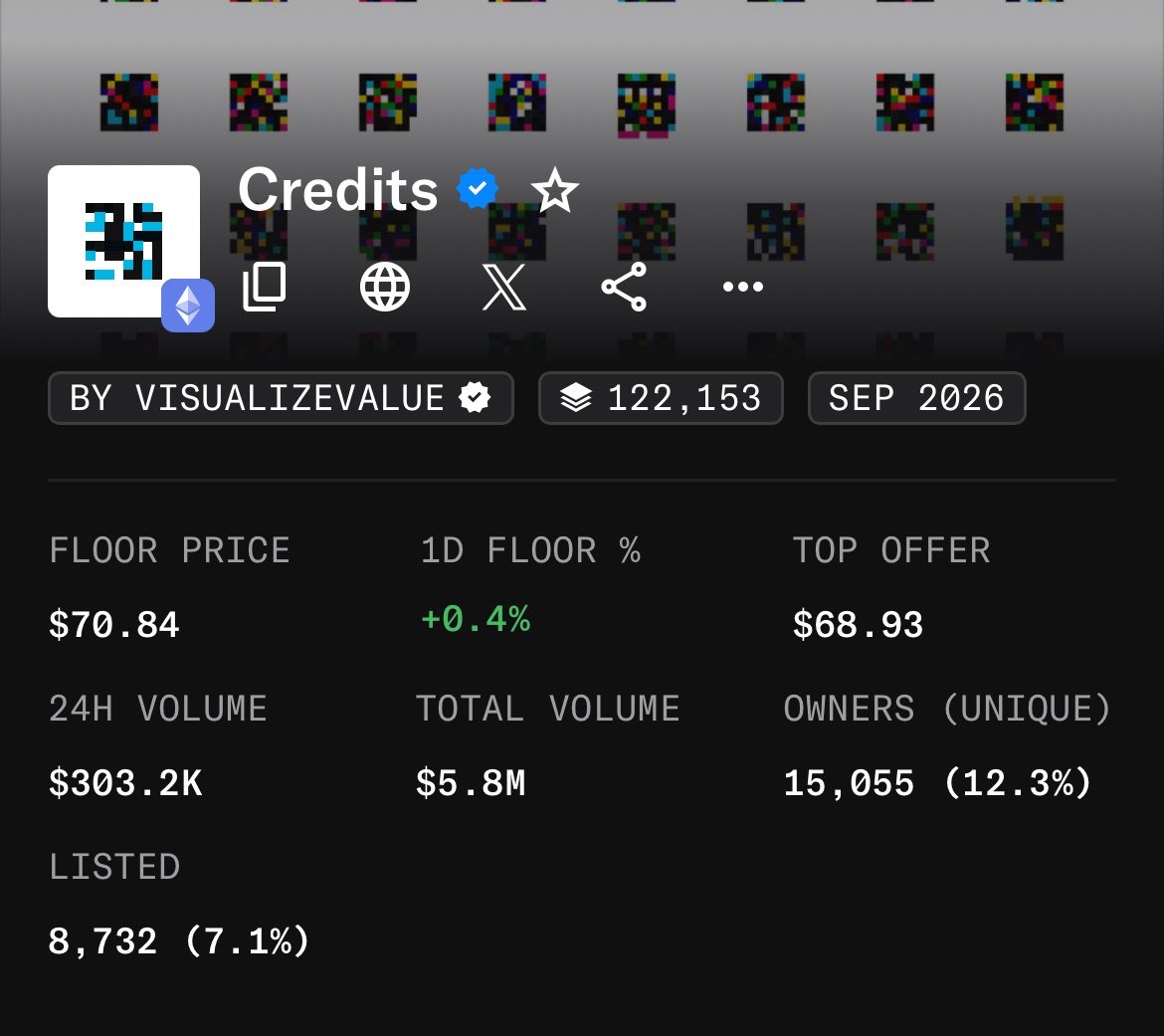
added more Credits around the $60-80 range.
sitting at 40ish now, floor is still around $75 and i feel like this has room to move over the next few days.
@jackbutcher collections usually don’t stay quiet for long.
wdyt?
HOW TO GRADE JACK BUTCHER’S CREDITS
What ~13K sales tell us + some admittedly dubious price guesses
If you’re just tuning in...
Jack launched an open edition through X Money
You sent $8, include an ETH address & the transaction ID became the seed for one Credit
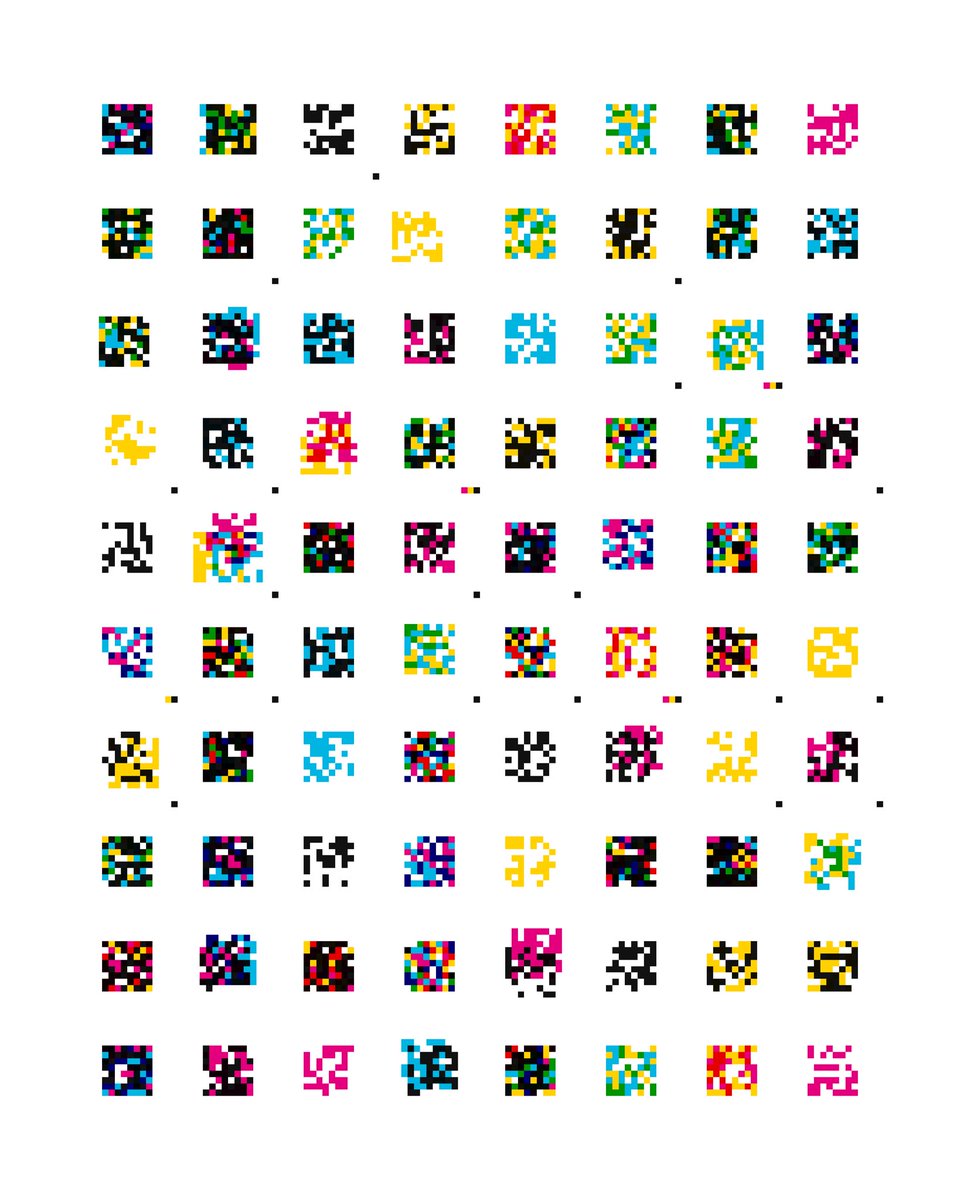
The ID becomes four 8×8 CMYK grids, payment time selects the layers & literal 8s register visually
Final supply: 122,154 Credits
Each Credit is a complete artwork, but collectors can also burn 80 to assemble one Statement
Statement assembly opens eight days after launch with a maximum possible supply of 1,526
━━ WHERE THINGS STAND ━━
When I last checked, OpenSea had indexed:
▷ 60,865 of 122,154 Credits
▷ 12,621 sales
▷ 507Ξ volume
▷ 0.0318Ξ floor
Less than half has arrived, so this is very early price discovery
OpenSea ranks are basically useless while indexing continues
Grade the traits, not the current rank
━━ MARKET SIGNALS ━━
EIGHTS are the clearest rarity signal
▷ Five Eights: 1
▷ Four: 26
▷ Three: 398
▷ Two: 4,238
▷ One: 27,996
▷ None: 89,495
The first ~13K sales show a clean price ladder:
▷ Four Eights: 1.50Ξ median
▷ Three: 0.28Ξ
▷ Two: 0.062Ξ
▷ One: 0.0353Ξ
▷ None: 0.035Ξ
The Five-Eights one-of-one is unlisted with a 4.5 WETH offer
Three Four-Eights sales have cleared at 1Ξ, 1.5Ξ & 1.81Ξ
One means little financially so far
Two gets attention
Three gets serious
Four or Five is trophy territory
Outside EIGHTS, two traits show a repeatable premium:
▷ Extreme Weight: 0.068Ξ median, 1.02% supply
▷ Loose Print: 0.058Ξ median, 0.80% supply
Four Plates / full CMYK looks great, but its 0.037Ξ median is barely above the broad 0.0353Ξ market
━━ MY GRADING SCALE ━━
S+ | Five Eights
The one-of-one
S | Four Eights
Only 26 exist
A | Three Eights
398 exist with early sales reaching 0.8Ξ
B | Two Eights, Extreme or Loose
Stack two and I’d consider moving it up a grade
C | Drift, CMYK or a genuinely great composition
COMMON | Zero or One Eight with common Print and Weight traits
Still complete artworks & still raw material for Statements
Visual quality matters inside every tier
━━ SPECULATION ━━
This is unreliable, probably wrong & obviously the fun part
My short-term guess is the common floor gets messier before it gets cleaner
Another ~61,300 Credits must arrive, so commons could hit 0.02Ξ–0.03Ξ as large allocations land
Then Statement assembly becomes the counterforce
At a 0.0318Ξ floor, acquiring 80 Credits costs roughly 2.54Ξ (~$7,000) before gas
If collectors want Statements, cheap Credits become raw material
My admittedly optimistic ranges once distribution settles, assembly opens, and the quest to collect 80 grows:
▷ Commons: 0.05Ξ–0.10Ξ
▷ Two Eights: 0.10Ξ–0.20Ξ
▷ Extreme or Loose: 0.15Ξ–0.25Ξ
▷ Three Eights: 0.50Ξ–1Ξ+
▷ Four Eights: 2Ξ–5Ξ+
▷ Five Eights: wherever one determined collector decides it belongs
The Five already has a 4.5 WETH offer
Since everything revolves around 8, someone will surely try to manufacture an 8Ξ or 8.88Ξ headline
Statements are harder to guess
With an 80-Credit replacement cost near 2.54Ξ, a 3Ξ–5Ξ opening conversation feels obvious
But original participants could have acquired 80 Credits for only $640
Some will think in replacement cost, others in cost basis
That gap should create absolute chaos when assembly opens
So it honestly could be that I’m being way too conservative on such an iconic and historic collection
My bull case is the market splits into three lanes:
▷ Commons priced around Statement demand
▷ Rare Credits priced as standalone art
▷ Statements priced as the scarce assembled layer
The bear case is simple
Supply overwhelms buyers, too few burn 80 & prices drift toward the original $8 entry, but I doubt that happens
Way too early to know where it settles
But the first receipts are already telling us where collectors are looking
Good luck everyone, and have fun collecting these beauties
A couple of key dynamics with Interns creation.
The mechanism for creating Interns is built in such a way that minting an Intern becomes more expensive every day. The cost to create increases by 10% every 24 hours for the first 10 days (now at 1,099 $STONKBROKER), and then by 1% each day over the 355 days after that.
So today it costs roughly $33 to create an Intern. One year from now, the price to create an Intern will be 89,999 $STONKBROKER, or roughly $899 at today’s token value.
However, there is a kicker: since the token itself is deflationary, that dollar value could change drastically by the time that date comes.
Value accrual and deflation are built into the ecosystem. The more users use and market the protocols we have available for everyday use — i.e. swapping tokens via @MancerXYZ, getting physical collectibles via @TheCardWall, enjoying Nightshades via @MeebitCompany, or bridging with @TickerYardHQ — all of these processes lead to value accrual and burns of the $STONKBROKER token downstream.
So even though the supply of Interns is 8,888, 20% of those Interns are already officially burned due to our Anvil AMM infrastructure. 1,777 will never leave their parent Broker, and that number increases daily.
Bad tokenomics previously rewarded users for staking through token inflation. We flip that on its head and reward users for using the protocols they need anyway, while building value accrual through deflation of the assets they hold.
Supply down = Demand up.
Also, I just noticed you can’t spell Intern without Internet.
Welcome to all the new members of the StonkBrokers ecosystem. Let’s change the world. The collective voice of Robinhood Chain just got a lot louder and more unified.
This may be the biggest project on Robinhood.
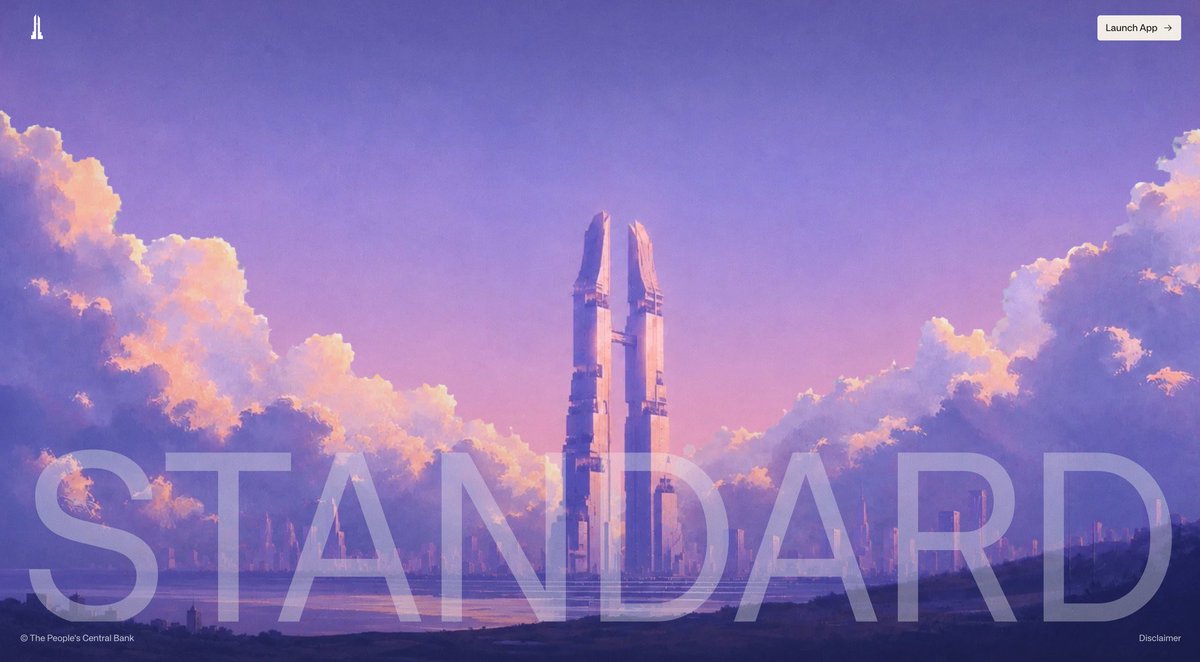
What is Standard Reserve? (@standard_rsv)
In plain English: an experiment in an “onchain central bank.”
Instead of a committee deciding when to print money, the rules live in code.
Two pieces matter:
1) $STANDARD | the token
2) Genesis Charter | an NFT that acts like a limited banker license
Only 1,000 Charters exist.
Holding one makes you a “Banker.”
Each Charter starts with 1 Branch (think: one bank branch) and can expand up to 10.
Branches earn a share of new $STANDARD the system issues over time.
So you’re not just minting art.
You’re minting access to the issuance.
How the system is supposed to work (simple version)
The protocol watches ETH moving in and out of its pool.
• More ETH in than out → expand (issue more $STANDARD) and build reserves
• More ETH out than in → contract (slow issuance / buybacks and burns)
Mint is today (Sep 14) on Robinhood Chain.
Whitelist window:
5:30 PM – 8:30 PM EST
Price: 0.15 ETH
After whitelist closes, leftover Charters go to a public Dutch auction:
starts at 1.25 ETH and walks down toward a 0.15 ETH floor.
Per the team: 100% of mint proceeds go to liquidity + protocol vaults (0% to the team).
After mint, $STANDARD trading opens with a temporary anti-snipe tax that starts very high and decays in the first hour.
What are people actually paying?
Official prices (confirmed):
• Whitelist mint = 0.15 ETH
• Public Dutch = 1.25 ETH → 0.15 ETH floor
That means if you’re WL, all-in is 0.15 ETH to mint.
If you’re not WL, you’re competing in the auction; early bids can be much more expensive than waiting.
On secondary / “pre-sale” style WL trading:
Before the fee was announced, CT talked about WL spots trading OTC for thousands of dollars even when the mint was expected to be free.
After the 0.15 ETH fee was added, clean public OTC receipts got quieter... and the supposed 5 figure demand wasn't brought up again.
Still, every big name on this app has been discussing this.
It certainly seems the hype is real.
I don't have WL, not sure if I'm gonna participate on the Dutch auction.
But am extremely interested in seeing how this all plays out.
I believe AI has a major role to play in our future crypto infrastructure. Although there have been some scares recently, long term access to the RWA supercycle on Robinhood Chain will require creative new interfacing and execution technologies.
I have been experimenting and laying the foundation for a product I call a DAIO (Decentralized Autonomous Intelligent Organization), which could, two to three years down the line, operate a fully decentralized product line like Clutch Markets developments.
I call the base of this infrastructure, this potential AI CEO in training, "L.A.U.R.A": Layered Autonomous Unified Reasoning Agents. Although LAURA isn't ready to run a company yet, it is time to begin developing the core infrastructure required for this super agent, and that process will be an open source one, which we can all study together.
CEO Vlad Tenev defended the company’s push into tokenized stocks on Wednesday, saying public companies can’t control the financial products built around their shares once they go public, after $AMC recently slammed Robinhood’s tokenization efforts
Says these are backed 1:1 with #AMC stock and no voting rights
This new tool by StonkBrokers is one that I believe will revolutionize Robinhood Chain, and Stock Tokens on Robinhood Chain specifically.
Generally speaking, we have a liquidity problem for Stock Tokens on Robinhood Chain, as well as a unique opportunity to earn yield in a sustainable way.
You can now enter single sided staking for Stock Tokens via our Smart LP vaults. But what is the source of the fees?
The answer is simple: we are capturing volatility from every attempted meme stock squeeze on Robinhood Chain. We do this by placing a band of liquidity above the price of the Stock (via an easy one click staking button). This band captures the swap fees that occur during price spikes and arbitrage moments on the Stock Tokens themselves. Fees are then compounded automatically into the position, which is periodically rebalanced by our proprietary algorithm.
These INTERNS will need some time to adjust to their new surroundings.
But they bring their own unique style and energy to the STONKBROKER ecosystem like all the new generations do.
No slacking on the trading floor tho.
CLOCK IN. ⏰
In the year 2026, we can choose to spend our time on social media competing for attention and trying to win a game of liquidity musical chairs.
Or we can build the future of finance in a sustainable way, built on peer-to-peer interactions that bring equal investment opportunity to every human being on Earth in a permissionless manner.
The internet will forever store the information and interactions we’ve had. What we built and shared. What we shilled and pushed.
How will you be remembered?
I choose to be a technologist.
I choose to be a pioneer.
No matter the cost.
Over the past 24 hours the StonkBrokers ecosystem has created over 20 million dollars in decentralized trading volume on Robinhood Chain.
Our goal with our special projects ecosystem is to become a decentralized on chain Y Combinator and assist great stockfi and DeFi technologies in scaling.
That starts with good tokenomics.