If RSI is real, even being a few weeks ahead might be enough to lock in the AGI race. This immediately reminded me of Nick Bostrom’s Superintelligence.
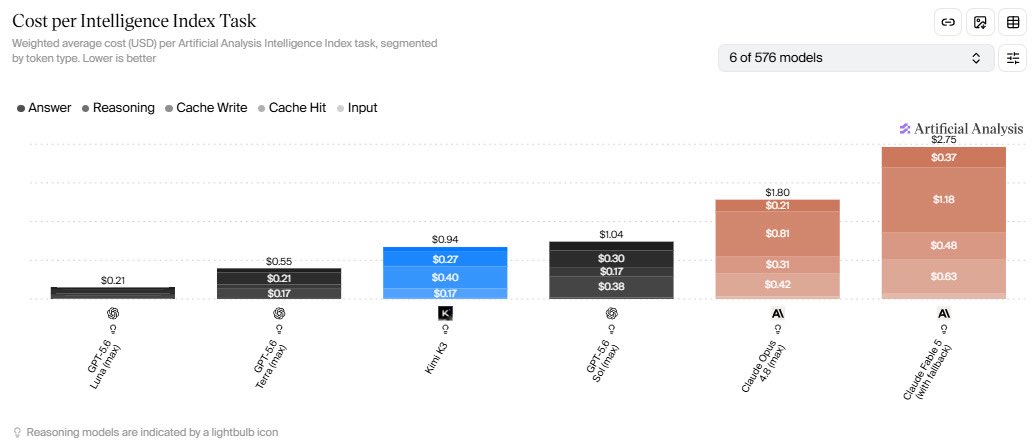
Kimi K3 may be an important inflection point for AI. Potentially negative for Anthropic and OpenAI while being net positive for essentially every other company in the world. I mean that very literally. Although the real “Sputnik moment” would be an open-source frontier model that was also token efficient unlike Kimi K3 which is 50-70% more expensive to run than GPT 5.6 per Artificial Analysis.
Rationale:
A world where there are only 2-3 dominant frontier labs with 90% inference margins is net negative for every other layer while being awesome for those 2-3 labs. Those labs would become monopsonies for power, data centers, semiconductors and hyperscalers and would obviously vertically integrate over time into all those layers while also completely subsuming the application/software layers.
Anything that lowers margins and increases competition at the model layer is good for every other AI layer: power, semiconductors, hyperscalers, neoclouds and yes even software.
This is why Jensen is so supportive of open-source. An open-source model requires the *exact* same amount of compute to run as a closed frontier model of similar size and architecture. Kimi K3 is roughly the same price as GPT 5.6 Terra on a per token basis, which actually suggests that it is less computationally efficient as I am sure that GPT 5.6 is priced to a higher margin than K3. And given that K3 is a token wastrel, i.e. token inefficient, it is significantly more expensive per task than GPT 5.6 and Grok 4.5, which are much more token efficient. Cost per token and token efficiency (i.e. intelligence density per token) are the drivers of intelligence per unit of cost. The winning AI companies will be those that offer the most intelligence per $ over time.
Lower margin % at the model layer = more margin $ at every part of the infrastructure layer and is a godsend for software. This can happen either through open-source models like K3 at the frontier *or* having a vertically integrated model company like Meta, SpaceX or Google at the frontier. Both outcomes result in a lower margin % at the model layer as vertically integrated model companies don’t really care where the margin $ come from. This is why it was so painful for OpenAI and Anthropic when Google was right there with them from a model competitiveness perspective and why Grok 4.5 and Muse 1.1 were just as important as Kimi K3.
The reason Kimi K3 is only *potentially* negative for Anthropic and OpenAI is 1) the @ericvishria point that the Claude and ChatGPT products and harnesses may be more important than their models today and 2) the hypothesis that they have much more advanced model checkpoints internally that are already being used for RSI. In the latter scenario, reaching RSI even a few months ahead of other labs might be enough to cement a permanent lead.
Time will tell on both points. And likely fairly quickly.
Caveat would be that since Kimi K3 is not token efficient and thereby actually more expensive than ChatGPT 5.6, we may need to see a more token efficient open-source model at the frontier or see Grok 5/Composer 4/Muse 2 at multiple points on the Pareto frontier for this potential risk to Anthropic and OpenAI to play out. And I am sure they will both vertically integrate as quickly as possible while continuing the product/harness strength they have shown over the last 8 months.
In France, we believe in science.
That is why, on May 5, I issued a clear and open call to the world: for science, choose France.
I am very proud to see that this call has resonated so strongly.
Around forty leading researchers have chosen France.
Through “France 2030”, we have invested more than €30 million to advance health, climate action, artificial intelligence, and fundamental sciences.
Science has found its home.
Introducing the File Search Tool in the Gemini API, our hosted RAG solution with free storage and free query time embeddings 💾
We are super excited about this new approach and think it will dramatically simplify the path to context aware AI systems, more details in 🧵
And we are liftoff 🚀
I'm really excited that we're now live with our Product Hunt launch of @heyplaymaker: Document AI: https://t.co/MKmimbYbd9
These past weeks were amazing, thank you all the Playmakers 🎉🤩
@ilkersozdinler O kadar berber gezdim hala ilk geldiğimde denk geldiğim Türk berber kadar iyisini bulamadım. Arabayla bir dünya yol yapıp hala ona giderim. Ayrıca Türk berberden memnun olmayan İngilize de denk gelmedim. Her şey yerine oturuyor 😂
Let's rethink embracing the internal combustion engine so quickly. It's automating high labor, dirty, and hazardous jobs at an alarming rate. We need to pause and consider the broader implications. It's time to reassess this technological rush.
– The Daily Chronicle, 1875
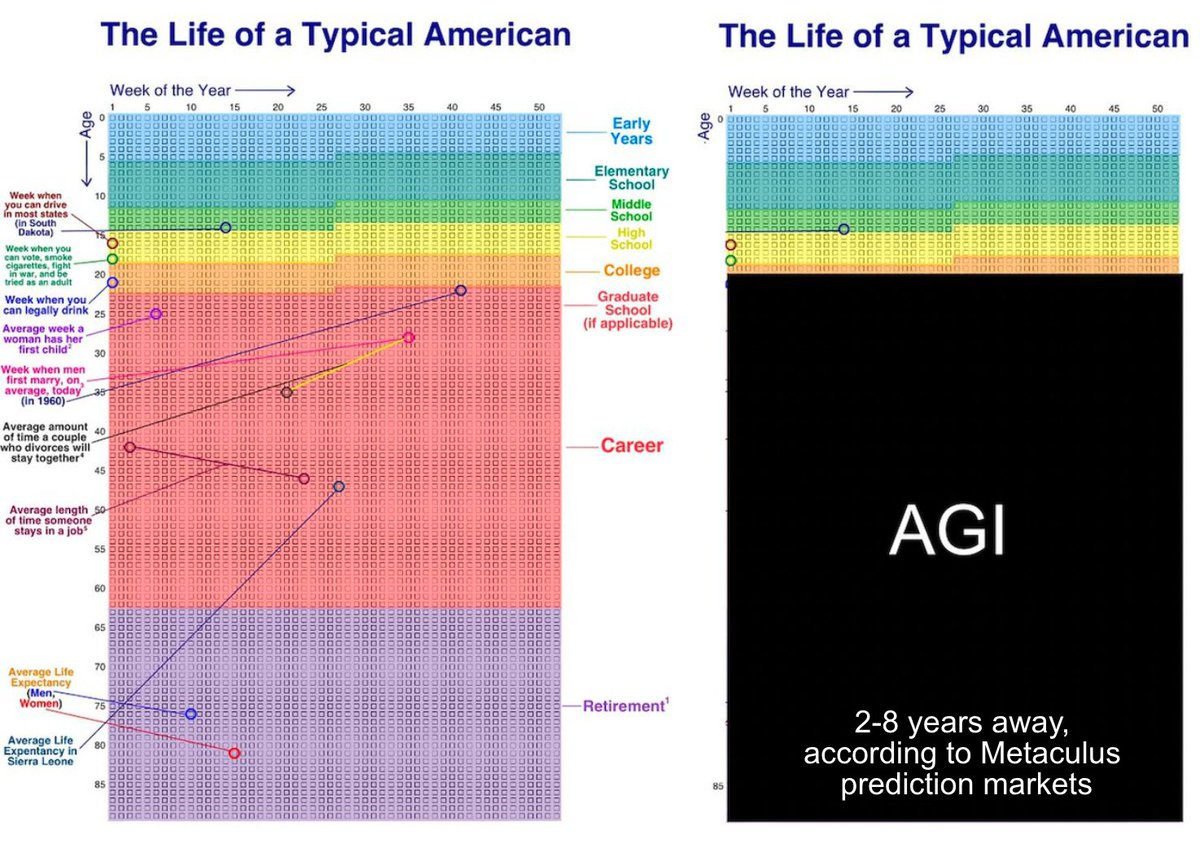
Skeptics just one year ago: don’t worry, AGI is 100 years away
Skeptics now: don’t worry, AGI is at least 3-5 years away
Have you stopped to think about what this means?
The world as we know it really may end in the next few years.
Americans are now 5 to 1 (!) in favor of banning the development of superintelligent AIs - with bipartisan support.
The average AI engineer thinks there is a ~40% chance AI destroys the world.
A few tech companies are playing Russian Roulette with the planet, racing to create an AI species that thinks a million times faster than us and will outnumber us 10000 to 1.
And, yet, we have more regulations on selling a sandwich.
No one AGI lab can unilaterally slow down, only governments can stop the race.
I don’t know how else to say this, but governments, what the hell are you waiting for?