I learn and do, I’m Efe Collins.
I learn, explore, analyze, ask questions, and pursue intriguing ideas, then share what I discover along the way.
I enjoy data, technology, ideas, development, special projects, and extraordinary things.
Please, feel free to follow me.
Africa shouldn’t only be asking how quickly we can adopt AI.
We should also be asking how well we understand the systems we’re adopting, what data they rely on, and how we verify their outputs.
Adoption without understanding can create a different kind of dependency.
We’re entering an interesting period where seeing something isn’t necessarily evidence that it happened.
AI makes content creation easier, but it also makes verification more important.
I think the challenge we face now is knowing which AI outputs we can trust.
The ability to generate information is becoming cheap, this means the ability to verify it should become more valuable.
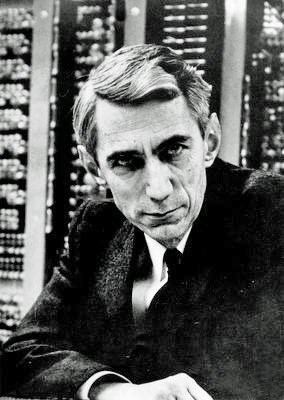
Claude Shannon’s 1948 work changed how we understand information.
He popularised the “bit,” showed that English is roughly 50% redundant, explored information density in language, and separated meaning from the engineering problem of communication.
The digital age owes him a lot.
003/1000 — Claude Shannon
We have access to more information than ever before, but, can we trust it?
This question is particularly important now, as AI spreads across Africa. Microsoft warned today that unless people trust the systems behind AI, the benefits in Africa could remain limited.
Years before ChatGPT, Claude Shannon was thinking of a different problem. He thought: "How do you get information from one point to another accurately, even when there is noise?"
In 1948, he published “A Mathematical Theory of Communication”. This groundbreaking work played a pivotal role in defining information and laying the foundation for the digital world we live in today.
What is interesting is that Claude Shannon wasn't trying to eliminate information, rather, he was trying to understand it.
The challenge we face today might be the exact opposite. Information is everywhere, AI can generate information in an instant, yet, an increase in the volume of information does not necessarily mean an increase in "truth" that hasn't been manipulated.
Perhaps the next great technological breakthrough won't be about simply knowing how to generate information but the "insight" to discern which information should be trusted.
Day 003/1000.
In the age of AI, what promotes the trustworthiness of information?
#1000Inventors
@thesupermanmx Okay, let’s take a step back and not be scared.
We won’t be delusional if we think and ask logical questions before using AI for thinking.
The people who rent their thinking to AI are the supposed delusional folks.