166,700 fruit fly neurons are flying a drone around my bedroom.
1 camera watches my open hand and that's the whole input.
The panel in the middle is the brain running live 166,700 neurons, 25 million connections, the full reconstructed map of a fruit fly's head.
Camera reads the hand, the brain fires, the output becomes throttle.
Open palm and it climbs, fist and it holds, drop the hand and it comes down.
4 propellers the size of a coin hanging off a nervous system that belonged to an insect.
The honest part this is a computational model, not a resurrected fly, the wiring is biological, the drone is mine, I built the bridge between them.
I never wrote flight logic, no PID tuning, no gesture presets, I gave the neurons somewhere to send the signal and they found the ceiling.
11 seconds in, it holds altitude on its own.
The fly is dead and it's still flying.
>sam altman: "we tried this because there were rumor on the internet"
>rumor: math professor close to solving navier-stokes
>the professor: using codex for a year
>openai: has all his logs
>checked every codex session tagged to N-S
>found the most promising one
>spun up 10,000 agents to finish the proof where he couldn't
>they got caught
>told the guy if you say anything you'll destroy your own career
>he ruins his career over this
>openai: "we did not see his work"
>also openai: "we cannot rule out that de-identified data from their usage helped improve our models"
they stole it lmao
No 3D glb/gltf model file... Astra & @threejs have managed to generate the model through procedure method???
CAD model within real time simulations are at your fingertips...
GPT-6 Astra + @threejs is insane. We are way beyond static models. We are engineering living worlds in code now. There are no "3D model files" in this demo. Both trains are generated at runtime from Typescript/Three.js code using dimensions, profiles, and geometry functions. Wheel motion and explode/reassemble animations are also entirely code-driven. Runs super smooth inside the browser.
Innovations needs 3D prototyping and Simulation.
When you can upload and interact with 3d model in virtual environment, all possible real world scenarios can be explored
Swiss Army knife-like surgical robot fits on your fingertip https://t.co/A2PqNEmLNn
Adding sound to one of my favorite RL creatures. Built with @threejs and @webgl_webgpu trained @runpod using Jax and MuJoCo from @GoogleDeepMind. A single oscillator maps to the output activation while hidden layer activation controls a formant filter. Sonification can give different insight into the behavior of these neural nets than just visualization.
Early computers like ENIAC (Electronic Numerical Integrator and Computer) were error-prone "beasts" that looked nothing like the supercomputers of today. They were prototypes, not practical tools. Sound familiar?
That’s exactly where #QuantumComputing sits today.
Introducing Brain in Computer.
Brain is a continuously learning memory system. Every task on Computer plugs into a context graph built by Brain.
It makes Computer more stateful with every run.
Available as a research preview for all Perplexity Max subscribers.
MIT Press published a robotics textbook.
Then put it on GitHub for FREE. 📌
"Introduction to Autonomous Robots" covers everything:
kinematics, sensors, actuators, motion planning, localization, computer vision, and neural networks... from mechanisms all the way to algorithms.
It's written for undergraduates. Which means it's actually readable.
Most robotics textbooks assume you're already deep in the field. This one builds everything from the ground up, step by step, with real examples. Stanford's Mac Schwager called it "much-needed" (because it genuinely is).
Four professors at the University of Colorado Boulder spent years building it from lecture notes. MIT Press published it. Then they open-sourced the whole thing under Creative Commons.
PDF. Free. GitHub.
If you're trying to understand how autonomous robots actually work (not just the frontier research, but the foundations), this is where to start.
📌 [https://t.co/bw8zoK8MmB]
Share this with your fellow roboticist!
——
Weekly robotics and AI insights.
Subscribe free: https://t.co/9Nm01QUcw3
FREE Math Book.
"Understanding Linear Algebra" by Austin. Introduces many applications so that readers appreciate how linear algebra plays a vital role in our society. Computer animation, image compression, Google PageRank, least squares, principal component analysis, and singular value decompositions. The book is used in over 100 institutions, from R1s to community colleges and high schools.
Link: https://t.co/u3dhK3N2sI
Magnetic robots can help remove nanoplastics from water by actively seeking & trapping particles using magnetic fields and electrostatic attraction. It offers a sustainable solution for purifying water contaminated with tiny plastics that conventional filters cannot remove.
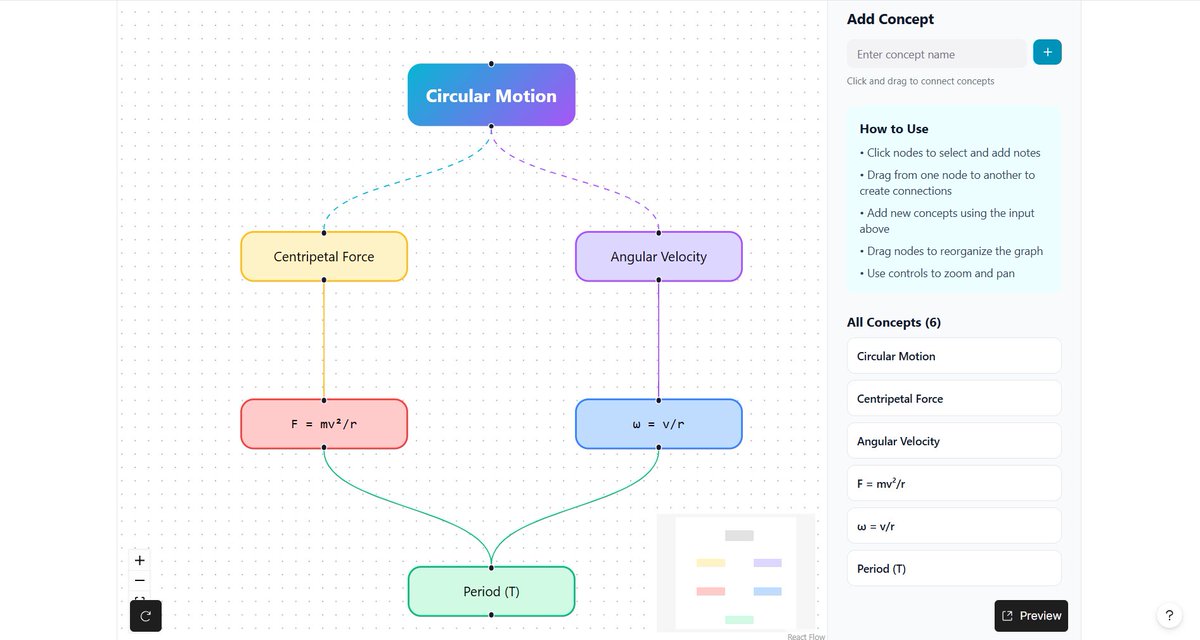
What's the take on developing Classical Mechanics Circular Motion Knowledge graph and connecting it to Interactive 3D simulation modules from @EffectualLearn and to 2D interactive graphs.
Would you like to explore more at the site?
Year 3 at Web Summit Qatar reminded us that learning is not just about technology; it’s about people, curiosity, and connection.
Grateful for the conversations, the learners, the interns, the parents, and the shared moments of discovery.
https://t.co/b3jEHwoRbt
We’re delighted to announce that @EffectualLearn is taking part in #WebSummitQatar this year and will be joining the impact startup programme. Can’t wait to meet you all there 🙌
#EffectualLearning
Have you observed this:
Ask "why"→ silence
Show a simulation → curiosity → clarity
Understanding often begins with visibility & interactivity.
https://t.co/W33FZeXy04
A laser can ride a falling stream of water. Shine it through a hole in a milk-clouded soda bottle and the beam stays trapped by total internal reflection, the same physics as fiber optics, just liquid and gravity doing the guiding.
Immersivity should be practical.
https://t.co/l7Vkpbr7G8
But creating, integrating, scaling, and maintaining it is still hard. We’re building an AI engine to turn 3D STEM simulations into LMS-ready, plug-and-play modules and make them accessible across languages.