5 Stoic Principles That Keep You Mentally Tough In Hard Times.
1. Memento Mori: Remember, you will die.
2. Amor Fati: Embrace your fate.
3. Locus Or Control: Care only about things you can control.
4. Premeditatio Malorum: Prepare for the worst.
5. The obstacle is the way
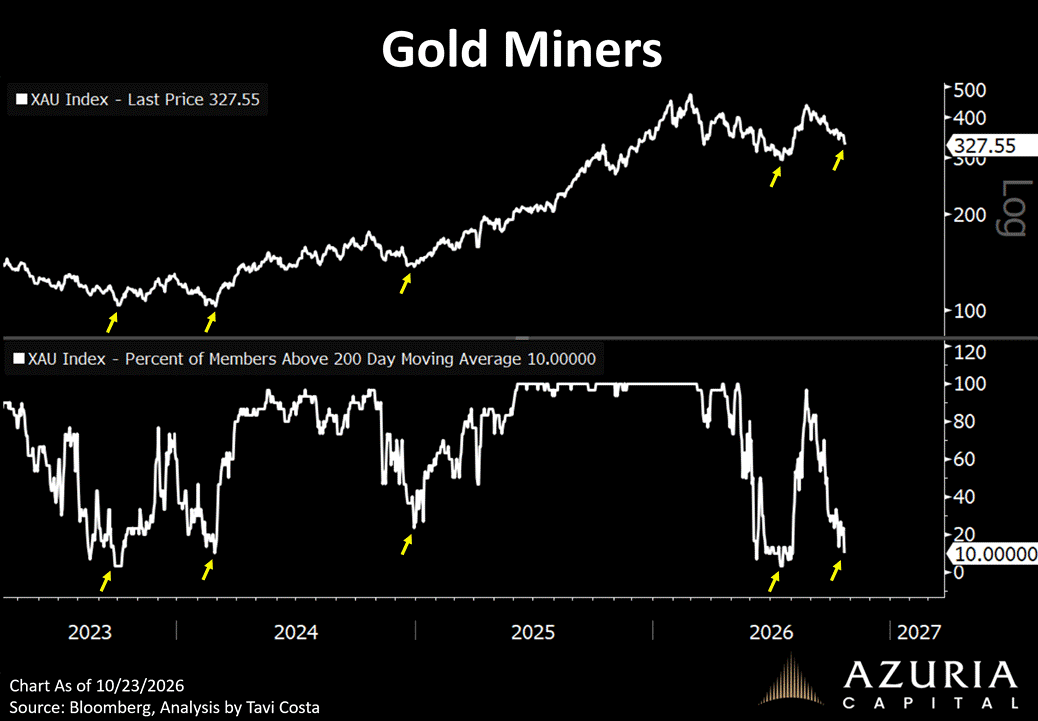
Only 10% of miners remain above their 200-day moving averages.
Historically, readings this low have coincided with important bottoms for the industry.
Long-term-minded investors know what to do here.
https://t.co/PXKGwBqrto
We need to mine as much copper in the next 18 years as we have mined in the past 10,000 years, which is 700-800 million tonnes... and that's without the AI demand.
Including AI demand, @BMO estimates we need ~35,000 tonnes of copper per gigawatt of installed data centre capacity... And according to S&P, by 2030, installed data centre capacity in the US is expected to reach 152 GW (~62 GW today).
This morning, @GoldmanSachs raised their projected 2026 US data center capacity forecast by +8% to 64 gigawatts and their 2027 capacity by -6% to 90 gigawatts.
Importantly… Goldman significantly increased their US data-centre related electricity demand to 12 gigawatts(+38%) in 2026 and 17 gigawatts (+38%) in 2027.
To put +29 gigawatts of new electricity demand growth over 24 months into context… the largest nuclear power plant in the USA (the Alvin W. Vogtle plant in Wynesboro, Georgia) is just 4.6 gigawatts.
A month ago, Helen Amos of @BMO produced a research piece stating that each gigawatt of new data centre capacity will require a matching gigawatt of new generation capacity… because the permitting of new data centres is increasingly going to require a dedicated power source. BMO estimated that the copper intensity is ~35,000 tonnes of copper per combined new gigawatt.
The rapid buildout of data centre capacity and associated power generation will require VAST quantities of copper.
The research teams at BMO and @DeutscheBank have come to this conclusion first, by increasing their long term price targets for copper to $18,000 per tonne and $22,050 per tonne… it’s $14,258 per tonne today.
https://t.co/M2M8MbK37q
While capital investment continues to rise, at best, copper production in Chile will stay the same.
This is a problem, while most pronounced in Chile, that affects the whole sector… each tonne of copper produced is becoming increasingly more expensive to mine.
https://t.co/R5ByfovRIo
Warren Buffett told Jamie Dimon: "you can report any number you want in an insurance company for a while... if you tell me I'm gonna be shot unless I come up with earnings of X carried out to eight decimal places... believe me, I can come up with that"
this is him explaining the one phone call Dimon says can add $100 million of revenue, what happens to managements he'd trust with his own daughter once they start promising numbers, and which of the two hates Bitcoin more
"...making a phone call and do some swaps and add 100 million dollars of revenue"
" I'd be glad if they married my daughter... and when they find they can't make the numbers, sometimes they make up numbers"
bookmark & watch it – then read the article below ↓
Shopify billionaire co-founder & CEO Tobi Lütke — one of the most analytically rigorous founders alive — uses affirmations.
His exact words:
"If you tell yourself or write down something about yourself 100 times, it writes into the neurofrontal cortex at such a deep level that your brain will start reconciling you to that. It just works."
His personal example:
He was terrified of public speaking.
For one week he sat down every day for 10 minutes and wrote: "I love public speaking."
A week later the fear was gone.
"It's not like a placebo. You just actively change your neurofrontal cortex in this moment."
Your brain starts shaping your behavior around the identity you rehearse most.
Before Europeans arrived, these were some of the names for The Great Lakes:
Superior: gichi-gami (great sea)
Erie: erielhonan (long tail)
Michigan: michigami (long body of water)
Ontario: Ontarí'io\kanadario (great lake\beautiful water)
Huron: karegnondi (fresh water sea)
Twenty-five years ago, the Massachusetts Institute of Technology made a bold move that most universities would never dare.
Instead of locking its world-class course materials behind campus walls, MIT decided to put nearly its entire curriculum online, completely free for anyone with an internet connection.
That decision gave birth to MIT OpenCourseWare (OCW).
What began as a bold experiment in 2001 has become one of the most significant educational initiatives in history.
Today, OCW provides materials from more than 2,500 undergraduate and graduate courses across virtually every discipline: physics, engineering, artificial intelligence, economics, biology, mathematics, computer science, and many more.
Anyone can access lecture notes, problem sets, exams, syllabi, and a growing library of video lectures, with no tuition, no application, and no account required.
According to MIT, more than 500 million people worldwide have used these resources over the past 25 years.
The impact has been profound. Students use it to ace exams, explore new fields, and launch careers. Educators around the globe integrate the materials into their own teaching. Many learners credit OCW with helping them pass professional certifications and unlock new opportunities.
Beyond its direct benefits, OpenCourseWare helped spark the global open education movement, inspiring dozens of other universities to share their knowledge freely online.
Even more impressive: the project was originally planned as a 10-year initiative. A quarter-century later, it's still expanding.
MIT now aims to reach 1 billion learners in the coming decade, while enhancing the experience with powerful new AI-powered learning tools.
Jakub Dobes on playing for the Habs:
“I love Montreal..I now have four more years ahead of me to dedicate myself to one goal:”
“Winning the Stanley Cup.”