@BarryToohey hi Barry, can you help me understand, did he have clauses in his contract or just asked for a release or did Knights get some sort of compensation or something else? Just struggling to understand with the limited information I have. Thanks 👍
@badel_cmail Help me understand, he was contracted to Knights for a couple more years. Did his contract have clauses or did Knights get a compensation or something else?
Serious athletes live differently. That's just the reality.
If you live a normal life, you'll get normal fitness.
Exceptional fitness requires an exceptional lifestyle.
Let me dump some carbs on you...
Someone said yesterday that thinking about CHO intake in terms of stores, output and "bonking" is the "old way" of looking at carbs in sport.
That pissed me off.
So, let's start with...
Only those with a bullet-proof basic understanding can have an advanced understanding.
Put another way, he couldn't tell me why this is the case. So, let me tell you why this is that case...
The error in thinking of a carbohydrate/glycogen "reservoir" comes largely in the sense that the reservoir isn't one tank.
We have...
Tank 1: Liver Glycogen
Tank 2-2,000,000 Muscle Glycogen
That is, every muscle fiber has its own little tank. So, in terms of glycogen depletion, while a significant drop in liver glycogen is obvious - the typical "bonk"...
Drops is muscle glycogen are far more subtle...
They manifest as progressive transition from more economical fibers to less economical. So, over the course of the race, pace for a given O2 uptake progressively decreases.
*Assuming CHO makes it across the gut wall to the blood*...
High levels of exogenous intake can offset this progressive depletion of more economical fibers & keep the pace high for a give O2 uptake over longer periods of time.
This is why, again, assuming good levels of clearance from the gut, high CHO intake can have a small, but meaningful impact on the pace that can be held late in a race.
TLDR...
- A liver glycogen bonk is obvious.
- Muscle glycogen depletion is subtle.
- Exogenous CHO can offset glycogen depletion (to an extent) & help to maintain pace for longer.
But....
1/ The size of the engine determines fuel needs.
2/ You can only use what you can clear (& if you can't clear it, there's a timebomb jostling around in your gut - just waiting to go off)
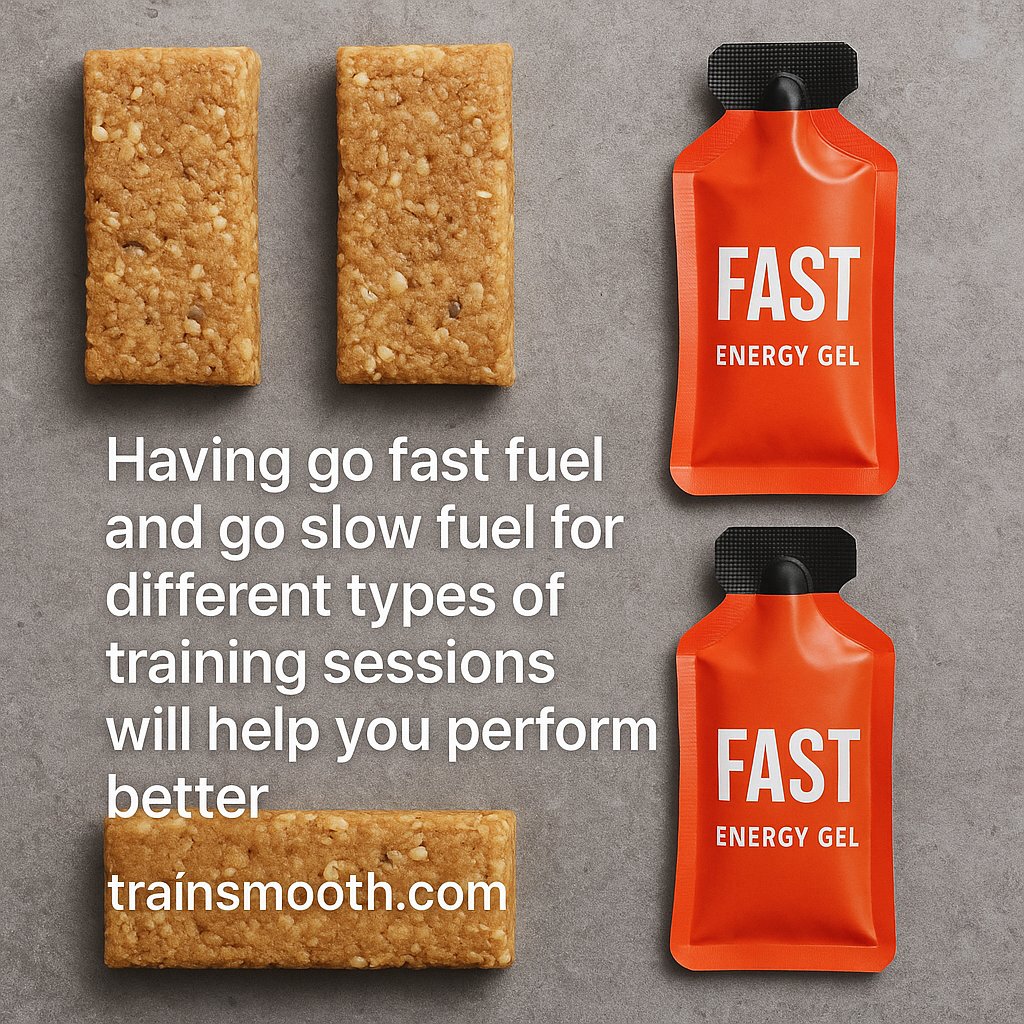
When training intensity is low, slow-releasing carbs like oat bars can be a great option to keep energy steady. When the intensity ramps up, fast releasing carbs like gels help you fuel more efficiently and perform at your best.