@nc_frey Could you please accelerate the Life Sciences Verification Program? That would really advance useful biological research without having to use "lesser" models
@jmschreiber91 I wish I knew how to auto-optimize BRAKER gene annotation. I have the feeling it can be greatly accelerated, but it might require architecture rewiring...
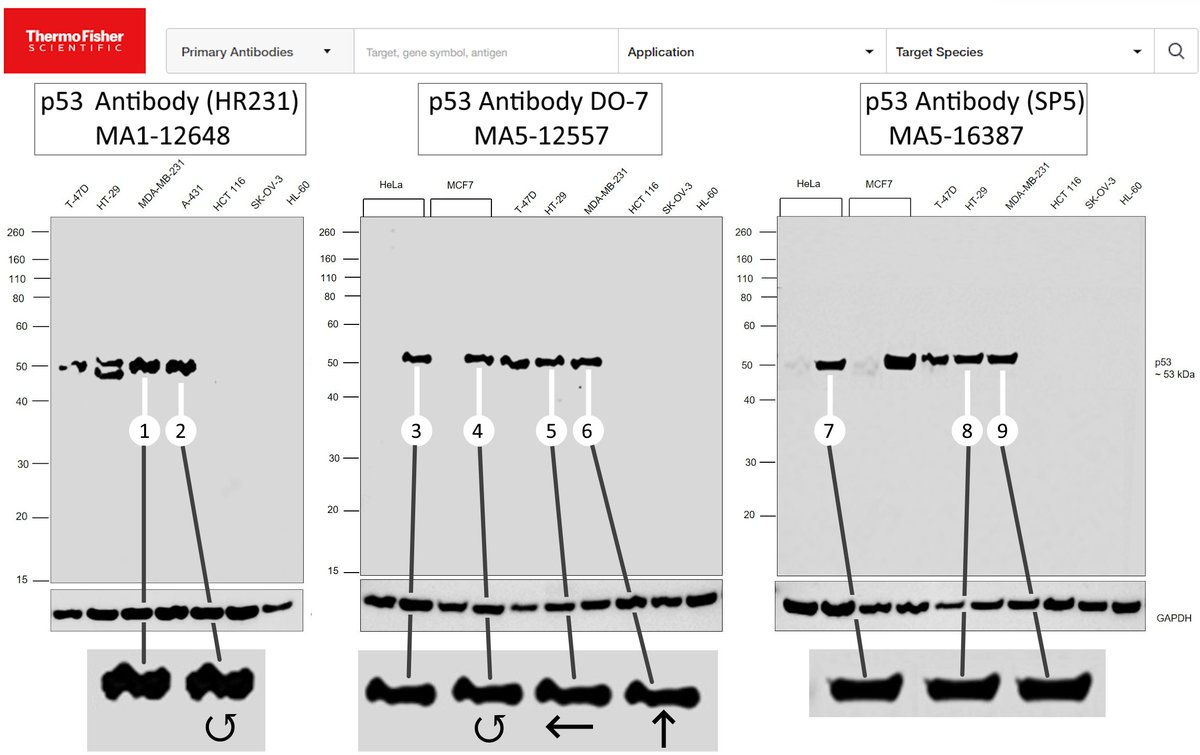
Earlier this week I posted an example of a fake western blot provided by ThermoFisher to demonstrate the validity of a p53 antibody. I considered it an amusing curiosity. In fact ThermoFisher has systematically manipulated antibody validation data. Short Thread... 🧵
@I_Rubio_Somoza If it's a coding sequence that you want to express in an eukaryotic system, you can try to add introns. Some plant virus sequences seem to be toxic in e coli.
https://t.co/DpOMDxjWwv
¿Te interesa la biotecnología vegetal? ¿Vas a cursar un máster el próximo año?
Ofrecemos una beca JAE Intro CSIC en nuestro laboratorio para trabajar en biología sintética y CRISPR en plantas.
Referencia: JAEINT26_EX_0476
Solicitud: https://t.co/DWsiOLrSHp
Agradezco difusión
@tangming2005 Wouldn't it be better to first add the whole plasmid sequence as an extra entry in the genome and check where the reads align, and then make the custom annotation ?
Contributions from plant research and innovation to the EU call for evidence for the #EULifeSciences Strategy – EPSO statement and evidence submitted 17.4.2025. https://t.co/mP8QkDK50v #PlantScience#SDG#HorizonEU