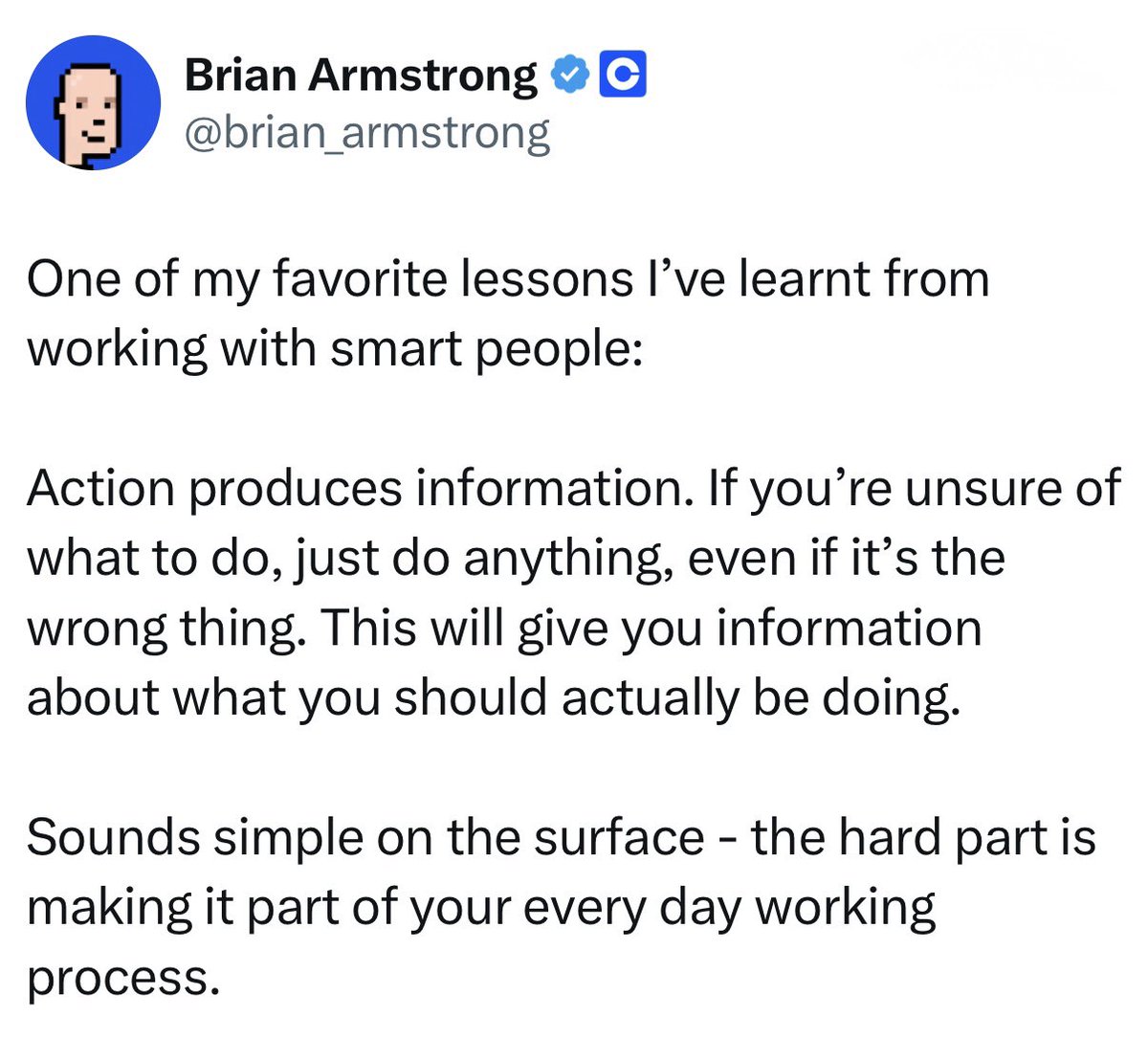
I'm increasingly convinced that burnout doesn't come from working long hours or weekends. The people I know who burned out were the ones who were really bored with their work, not the ones who worked the most hours. Burnout comes from working on things that don't energize you.
If you want people to believe in you, start carrying yourself like someone worth believing in. Do the old fashioned things well. Stand tall. Move deliberately. Make eye contact. Take care of your body and mind. Listen. Speak with intention. If you do that, you’ll start believing in yourself, and the world will have no choice but to follow suit.
4 factors to consider when making a career decision (none of which involve money):
1. Talent Density
You tend to rise or fall to the level of the people around you. When you work with exceptional people, you absorb their standards, pace, frameworks, and instincts almost through osmosis. High-talent environments compress learning cycles and force you to grow faster than you would on your own. If you care about compounding skills and judgment, there’s nothing more valuable than choosing the room with the highest talent per square foot.
2. Market Growth
A fast-growing market makes everything feel easier. It's a tailwind for skill accumulation, title trajectory, and opportunity set. Even average players can look like stars in a rapidly expanding industry; great players can compound outlier outcomes. Conversely, declining or stagnant markets create headwinds that even great performers struggle to overcome. It's very difficult to swim upstream, no matter how strong the swimmer.
3. Leadership Quality
Your manager is often the single greatest variable in your long-term development. Great leaders create environments where you're challenged, trusted, coached, and pushed into uncomfortable growth. Poor leaders create ceilings. They limit your exposure, suppress your risk-taking, and narrow your aperture of what’s possible. Choose leaders who invest in people, not just outputs.
4. Intellectual Stimulation
Intellectual stimulation is a leading indicator of future growth because curiosity compounds just like capital. You want to be in environments that make you feel alive intellectually. Where the problems are interesting, the challenges stretch you, and you're forced into deeper thinking. When your mind is engaged, you naturally develop new skills, pursue new ideas, and build momentum.
What would you add to the list (and why)?
If you worked at Goldman Sachs, there would be an expectation — unstated but absolute — that you read the Financial Times before client meetings.
That you have an informed opinion about macroeconomic conditions and how they affect your client's sector.
That you show up to every conversation already knowing things the client hasn't told you.
Nobody at Goldman sends a junior analyst into a pitch who hasn't done two hours of prep on the target company.
Nobody at McKinsey presents a recommendation without first developing a point of view based on data the client didn't hand them.
That standard exists because the fees justify it.
And the fees justify it because the standard produces outcomes that cheaper alternatives can't.
Here's the thing: you can adopt that standard right now, regardless of what you charge or who you work with.
Nothing is stopping you from doing the research.
Nothing is stopping you from forming a genuine thesis.
Nothing is stopping you from showing up to every single call having already done work that most of your competitors won't do in the entire engagement.
The difference between a $5K/month operator and a $25K/month operator is mostly not skill. It's this standard applied consistently.
What does consistent application look like?
You invest in your environment because your environment signals your standard.
The background on your Zoom calls, the quality of your camera, how you're dressed.
These aren't vanity — they're signals.
They tell the prospect, before you've said a word, whether you take yourself seriously.
And whether you take yourself seriously tells them whether to take you seriously.
You develop opinions in public.
Not just content — actual positions.
Opinions create status delta.
Opinions attract the clients who want to work with someone who has a point of view, not just a service menu.
You read. Not self-help. Not money Twitter. The industries your clients are in.
The macro forces shaping their decisions.
The regulatory changes, the market consolidations, the competitor moves that are creating urgency or anxiety in their boardrooms right now.
That's the professional standard. And it's available to you today.
Everyone should read this story…
A monk goes out on a boat in a small lake to meditate.
After a few hours of uninterrupted silence, he suddenly feels the jarring impact of another boat bumping into his.
While he does not open his eyes, he feels the irritation and anger building within him.
“Why would someone do that? Can’t they see me here? How dare they disturb my meditation?”
He opens his eyes, ready to shout at the person in the other boat, only to realize that it is empty. It had come untied from the dock and was floating in the middle of the lake.
In that moment, his anger and frustration disappears.
After all, you can’t be angry at an empty boat.
The story offers a powerful lesson, which I call the Empty Boat Mindset:
In life, you’re going to experience countless collisions. With people. With environments. With chance circumstances outside your control.
Each of these collisions will threaten to derail you. To stoke the fire of anger, stress, and frustration. To knock you off your path.
The truth is that the negative emotions that grow inside you are rarely from the collision itself, but from your perception of the negative intent behind the collision.
If you convince yourself that every collision is a deliberate action by a bad actor, negative emotions will control your entire life.
In others words, your interpretation of the collision creates your own poison.
The Empty Boat Mindset is the reminder that most of these collisions you experience in life are with an empty boat.
There is no negative intent. There is no desire to harm. They are simply the random collisions of objects floating along on the lake of life.
Interestingly, when you embrace the Empty Boat Mindset, you reassume control over your own boat.
You’re no longer prone to the spiraling emotional effects of chance collisions. You are a seasoned explorer, ready to adapt to whatever the seas throw your way.
So, the next time you feel a collision and find your negative emotions growing, pause and ask yourself a simple question:
Am I just getting angry at an empty boat?
Always carry yourself like your life matters. Because it does. Stand tall. Walk with confidence. Make eye contact. Take care of your body. Be present. Think independently. Listen before you speak. Bet on yourself. If you do that, the world will start bending to your will.
Underrated idea: Hanlon’s Razor. Never attribute to malice that which can be explained by stupidity. In assessing someone's actions, we shouldn't assume negative intent if there's a viable alternative explanation (like differing beliefs, intelligence, incompetence, or ignorance).
I highly recommend not allowing people to bait you into arguments. It’s liberating to realize that people can go out of their way to drag you into their mud, and you can just smile and go on living your life.
Life will test you with the same challenge until you learn the lesson. The same fight in every relationship. The same burnout in every job. The same regret in every missed chance. Until you do the inner work, the outer world won’t change.
The older I get, the more I realize peace has a price. You buy it by saying no. No to drama. No to noise. No to people who drain you. No to shiny objects. No to temptation. No to opportunities that aren’t aligned. Every single no creates space for the yes that truly matters.