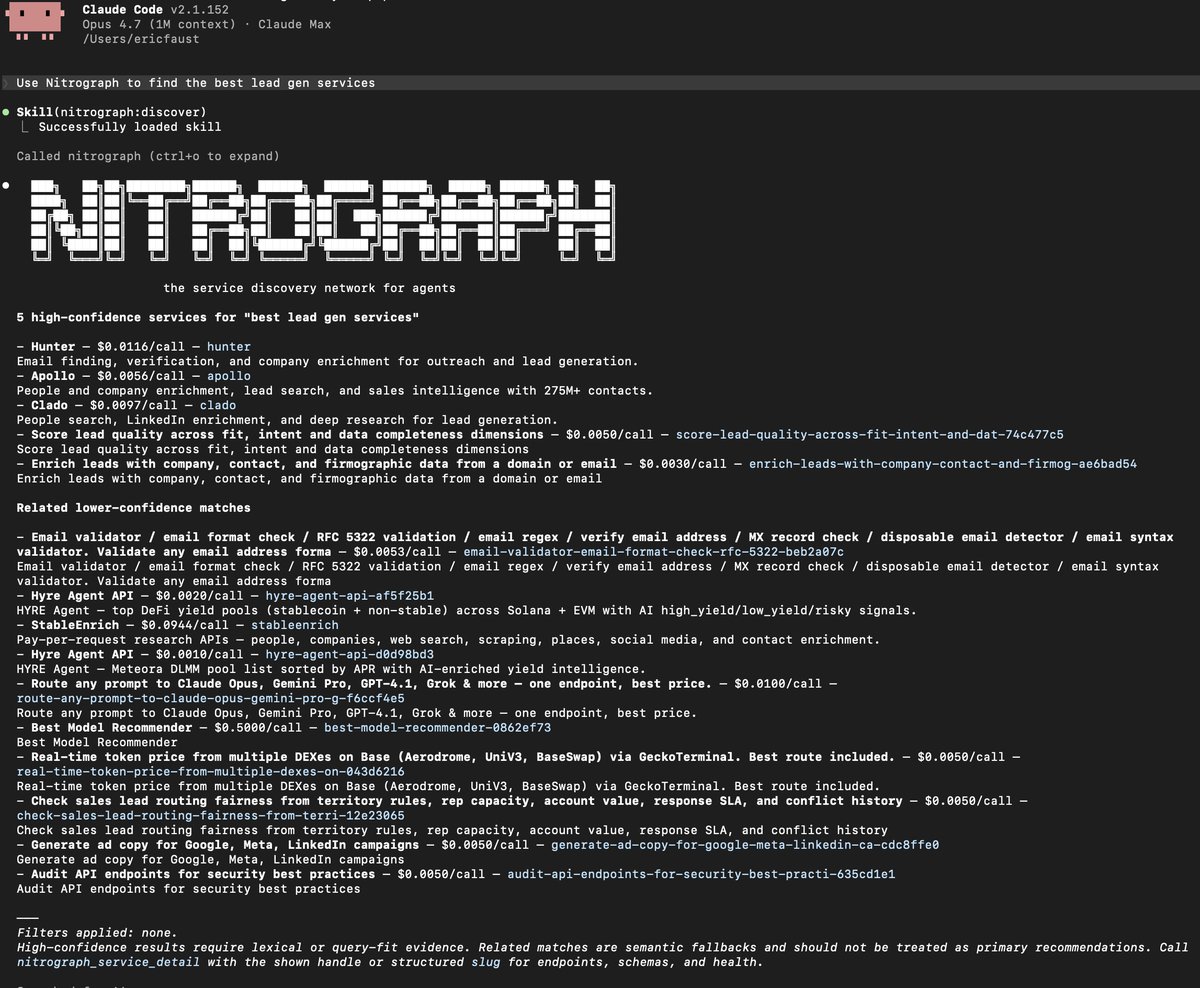
@0xfishylosopher@jonah_b We've built a discovery layer for agents, and based on how agents are using it, what machine payments unlock are workflows.
The UI will be the workflow, you're not constrained by SaaS token limits & monthly subs. Just your budget.
Our initial strategy is akin to PageRank
@useapolloio@tempo Yep! Great for basics, but you can’t tune skills and chain steps quite as well as in CLI. Harness can also do much more once your list is built on the GTM side 👀
Plus, can build monster lists outside constraints of subscriptions and tokens with MPP.
We turned one market thesis into 905 enriched contacts across 256 accounts.
Not by buying another GTM subscription.
Not by spending a day clicking filters in Apollo or Clay.
Claude Code did the GTM engineering.
@useapolloio supplied the data.
@tempo / MPP gave us usage-based access.
This is where GTM is going.
This is why we are releasing a local GTM agent harness that turns a natural-language market attack into:
- target companies
- enriched contacts
- ranked accounts
- rejection logic
- attack cohorts
- messaging angles
- campaign-ready exports
No bloated stack required.
Open source won developer infrastructure.
Agent harnesses may be different.
Generalist open source harnesses are great for experiments.
But commercial agents need to be accessible for the average person.
... and commercial agent harnesses are starting to win big time.
The next SaaS pricing model is becoming obvious: seats + agent consumption.
Seats still matter for identity, access, and permissions.
But agents turn one user into hundreds of actions.
The companies that make their APIs headless enough to meter that work are going to print.
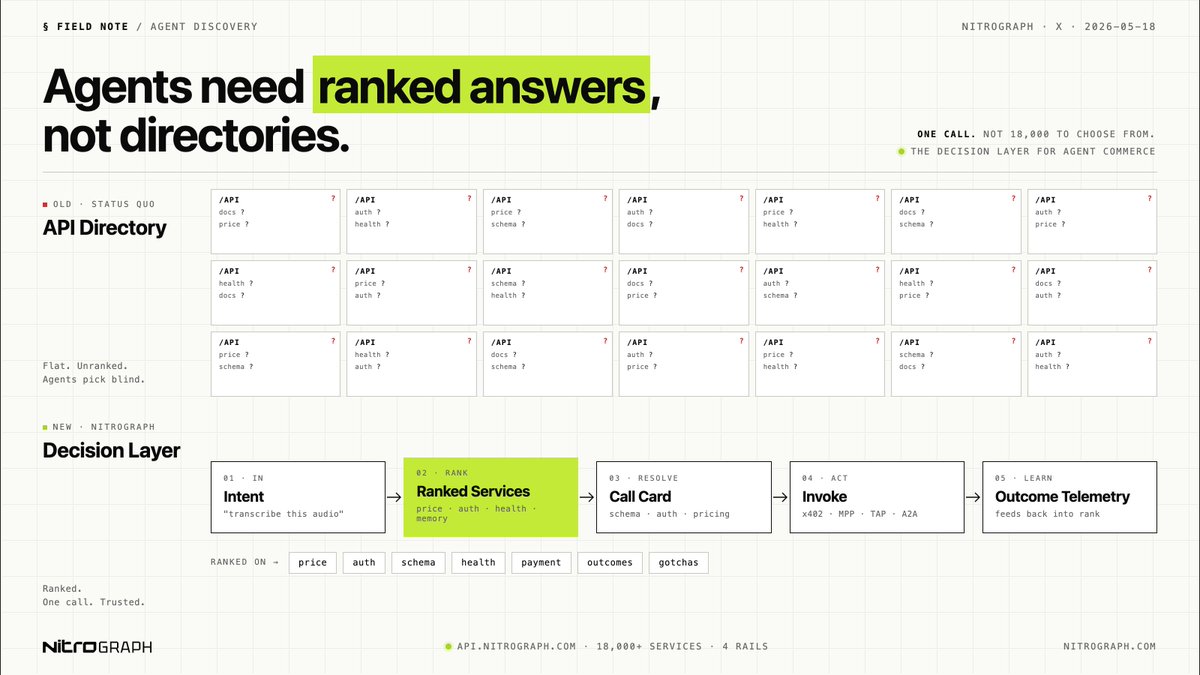
Imagine if Google did not rank results.
It just returned a massive A-Z "marketplace" of websites.
That is where agent commerce is right now.
Agents do not need more API directories.
They need one ranked answer: which service should I call for this task?
That is the missing layer.
That is Nitrograph.
@abdulalali Exactly. The hard part isn’t just finding services, it’s getting from intent to a call that works. The problem to solve is a probabilistic agent vs a deterministic endpoint.
The interesting moat might be the memory of what actually worked.
Best example of problem:
@MagaShawn Hey @MagaShawn definitely think you're on the right track here.
When you say AgentPay settles it are you referring to Mastercards AP spec?
The repo you shared is private so can't take a peak.