New Anthropic research: A global workspace in language models.
Of everything happening in your brain right now, only a tiny fraction is consciously accessible—thoughts you can describe, hold in mind, and reason with.
We found a strikingly similar divide inside Claude.
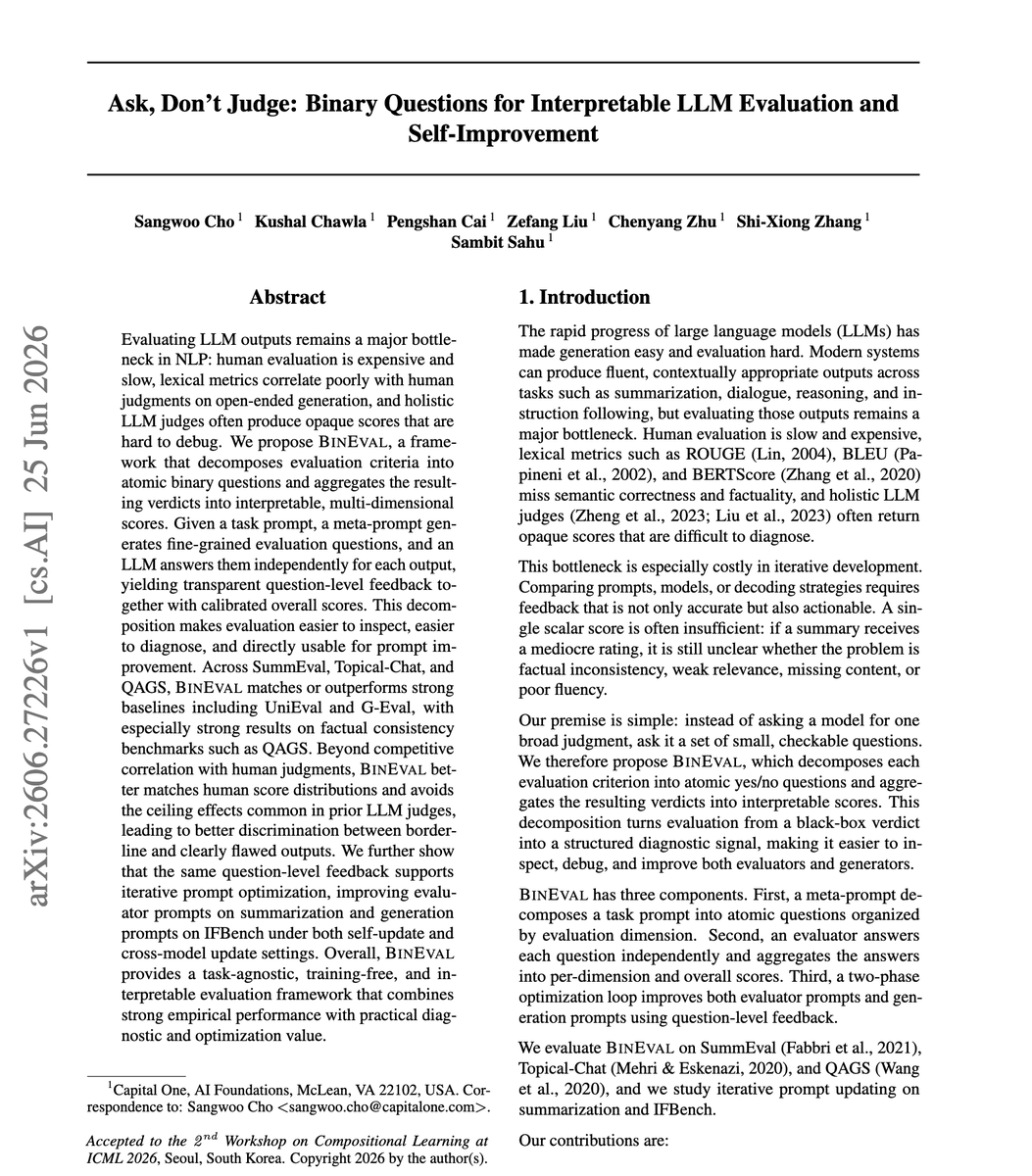
If you use LLM-as-judge, this one is worth reading.
(bookmark it)
It's actually one of the most effective ways to use LLM-as-a-Judge for evals.
Holistic judge scores hide both their reasoning and their ceiling effects.
BINEVAL decomposes each evaluation criterion into atomic yes-or-no questions, answers each independently per output, then aggregates the verdicts into calibrated multi-dimensional scores.
Every question-level verdict is inspectable, so you can diagnose exactly why an output scored low, and the same verdicts feed straight back as targeted prompt-improvement signal.
Across SummEval, Topical-Chat, and QAGS, it matches or beats UniEval and G-Eval, training-free, with especially strong results on factual consistency.
Paper: https://t.co/oar6BZcasm
Learn to build effective AI agents in our academy: https://t.co/1e8RZKs4uX
Today we present a study on how reasoning unlocks parametric knowledge in LLMs. We identify two key driving mechanisms, a computational buffer effect and factual priming, and suggest ways that can help build more reliable models. Learn more: https://t.co/CjIKqyoG4N
Aloha! 🌺 Meet Ornith-1.0, a family of open-source LLMs specialized for agentic coding.
Ornith-1.0 spans the full parameter sizes including 9B Dense, 31B Dense, 35B MoE, and 397B MoE. It achieves state-of-the-art performance among open-source models of comparable size on coding benchmarks including:
✅Terminal-Bench 2.1(77.5)
✅SWE-Bench(82.4 on verified, 62.2 on pro, 78.9 on Multilingual)
✅NL2Repo(48.2)
✅SWE Atlas(41.2 on QnA, 42.6 RF, 39.1 TW)
✅ClawEval(77.1)
Post-trained on top of gemma4 and qwen3.5, Ornith-1.0 employs a novel self-improving training strategy in which reinforcement learning is used to generate not only solution rollouts, but also the task-specific scaffolds that drive those rollouts. By jointly optimizing the scaffold and the resulting solution, the model generate higher-quality solutions in agentic coding.😎
All models are released under the MIT license, enabling full commercial and research use.
📖Tech Blog: https://t.co/qT9N2HYWFn
🤗Huggingface: https://t.co/PRrwqjeBtM
What happened at #CVPR2026 ?
Our report covers:
• Major research trends
• Selected papers and highlights
• Future directions discussed with the community
If you’re catching up after CVPR, this report may be useful.