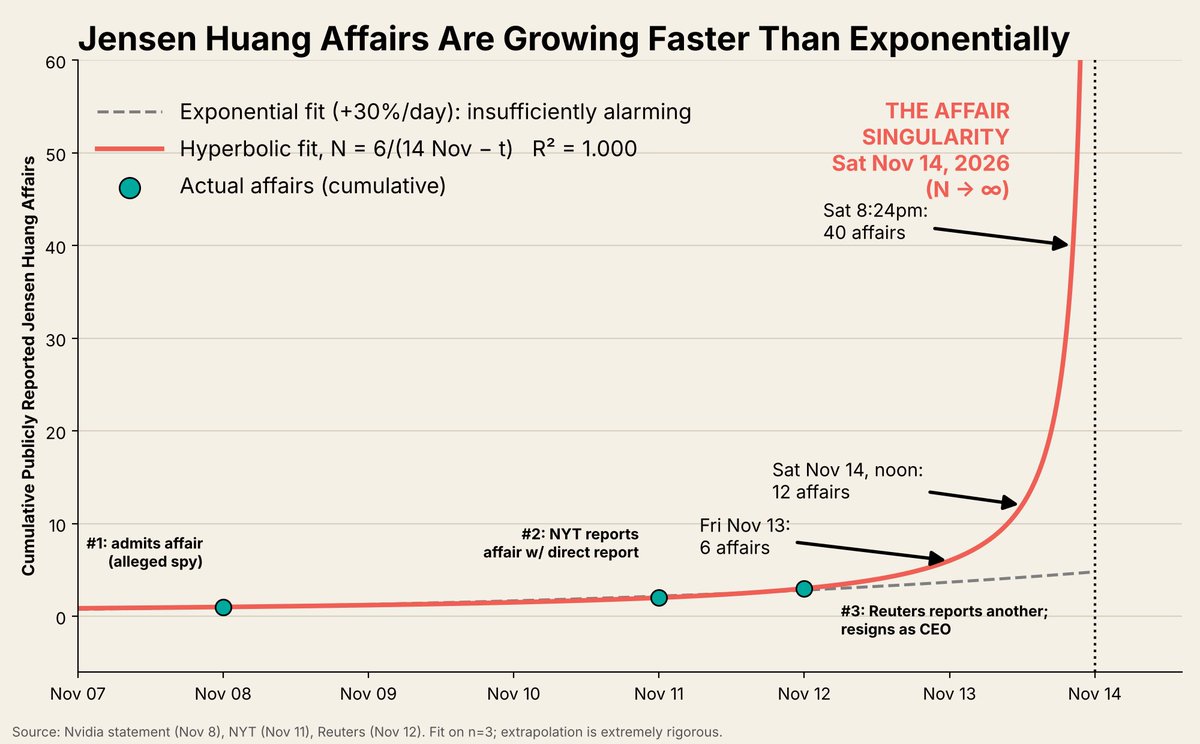
With a third Jensen Huang affair hitting today, we can now confirm recursive self improving growth in misaligned relationship capabilities
Based on current trends we could reach the affair singularity by the end of November—or even earlier
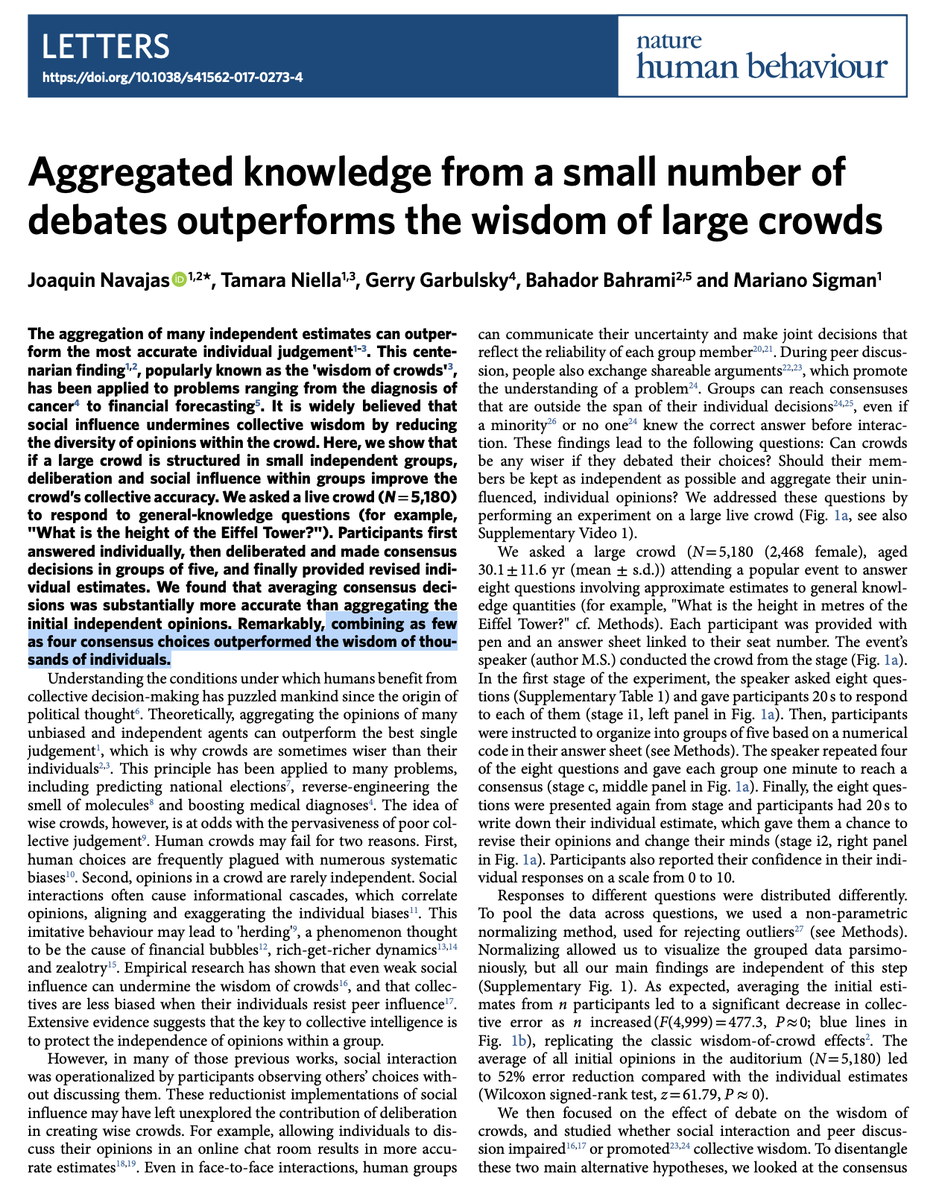
Aggregated knowledge from a small number of debates outperforms the wisdom of large crowds
This study asked a live crowd (N = 5,180) to respond to general-knowledge questions (eg "What is the height of the Eiffel Tower?")
Participants first answered individually, then deliberated and made consensus decisions in groups of five, and finally provided revised individual estimates.
Averaging consensus decisions was substantially more accurate than aggregating the initial independent opinions. In short, small groups beat the wisdom of crowds.
Combining as few as four consensus choices in small groups outperformed the wisdom of over 5,000 individuals.
The key was reasoning together--that aspect of collective deliberation allowed small groups to make more accurate estimates than massive crowds.
https://t.co/Yz23ELwgde
Why is it called PyC? 🤔
Two readings, one idea:
🔹 PyTorch Concepts: concepts are the building blocks of interpretable deep learning.
🔹 P(y|C): sound probabilistic modeling of a target y given human-understandable concepts C.
PyC is a new open-source library for designing and composing interpretable deep learning models! Instead of explaining a black box post-hoc, with PyC you can design deep learning models whose reasoning goes through concepts, so you can inspect, intervene, and trust the prediction.
To know more about PyC, visit our GitHub (a ⭐ helps others find it!): https://t.co/PAs8MvkVE0
- Docs: https://t.co/gJeE5gSnou
- A research paper with all the details is on its way 📄
We’re actively developing and making progress; keep an eye out for updates!
PyC is a community effort, with contributions from many researchers in the field; it is a pleasure to work alongside them.
@GiovanniDeFeli9, Francesco De Santis, Arianna Casanova Flores, @mateoespinosaz, @CiraGabriele, Edoardo Gabrielli, @debot_david, @dr303g, @tuomasoi, @Mateja_Jamnik, @giuseppe__marra.
Funded by the Swiss National Science Foundation @snsf_ch, Hasler Stiftung, Research Foundation Flanders (FWO).
#interpretability #XAI #deeplearning #opensource #PyTorch
Surprising: Any orthogonal matrix Q
(QᵀQ = QQᵀ = I)
can produce a Doubly-Stochastic matrix S
(S𝟏 = 𝟏 & 𝟏ᵀS = 𝟏ᵀ)
in one shot. Just let Sₘₙ = | Qₘₙ |²
This class of doubly-stoch matrices maps vectors x to convex combination of permutations of x's elements.
Me encanta esta nueva forma de ordenar tu algoritmo con lo de copiar el enlace de los tuits.
Tengo un Twitter libre de odio ahora mismo.
Y cuánto se necesita esto. 🩷
BREAKING: Revolut moved ~2,000 engineers onto self-hosted GLM for coding and pushed Claude Code and Codex to the exception list.
Per David Abitbol, who leads AI ops there: 56 Nvidia B200s, a blended 30 cents per million tokens, roughly a tenth of what they paid Anthropic and OpenAI. Engineering lead time improved 70%.
Here's the part that matters: the gains showed up when tokens stopped being rationed. Engineers quit saving AI for the hard tickets and pointed it at everything.
Frontier models become the exception, open weights become the default. That's a pricing problem for every lab heading to IPO.
h/t @OliverMolander
Would you move your team off frontier APIs if the bill dropped 90%?