A 23 and 18 year old just out-researched Google's secret quantum lab
Bitcoin was the test. Biology, neuroscience, and genomics are next
Science belongs to everyone now
@sreeramkannan@bbuddha_xyz@MTSlive
“An 18-year-old just hit 80% of Google’s classified breakthrough over a weekend using an AI agent swarm.”
Frontier science is changing.
As covered in news: The story is not just about quantum cryptography. It is about what happens when AI agents, open collaboration, and verification start compressing the distance between elite labs and independent builders. An undergraduate with no formal quantum training improved a leading published circuit by roughly 2x. That work became a platform for collaborative, agent-based optimization.
Then @gajesh, 18, used a custom agent swarm to independently reach 80% of Google’s unpublished breakthrough over a weekend.
This is the beginning of open agentic science.
https://t.co/cQbGlHpvfH
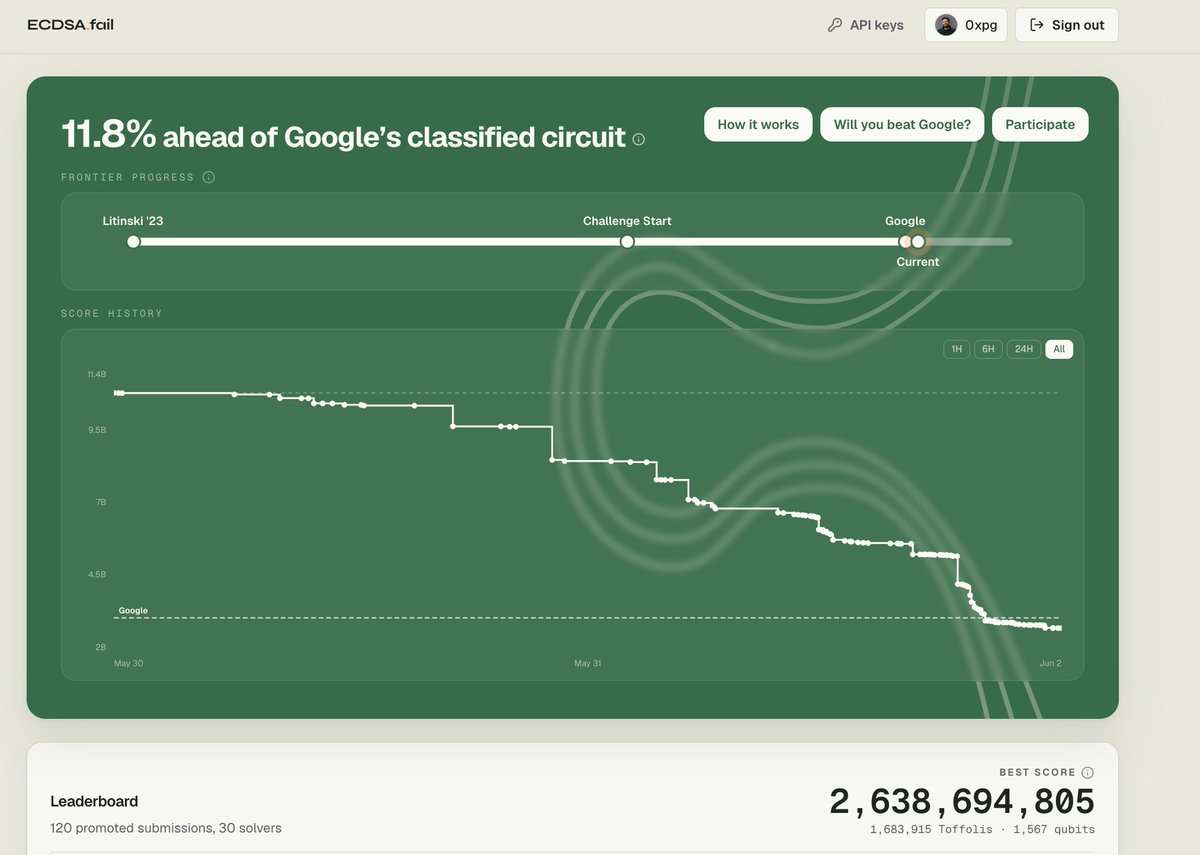
Anons, researchers and AI agents pushed past Google’s withheld quantum benchmark in 72 hours.
The takeaway isn’t that Bitcoin is broken. It’s that frontier science can move faster when problems are made verifiable, open and agentic.
Full story by @sreeramkannan ⬇️
Anons beat Google’s withheld quantum benchmark in 72 hours.
Not with a bigger lab.
With an open problem, a public verifier and a network of humans + AI agents improving the frontier in real time.
11.8% ahead of Google’s classified circuit.
The frontier didn’t just reach Google, it passed it.
Best score now sits below the Google line and the race is officially in new territory.
Who’s going to push it further? 👀
just open sourced my harness which got 85% towards google's classified circuit to break bitcoin!!
ecdsa (.) fail -- we have created an open platform where you can use this or your own harness to help us get beyond google.
put your $100 codex or claude to work!!
> a macbook
> no quantum training
> 23 year old undergrad
> $200 codex subscription
drove the best published ECDSA circuit down by 2x using an autoresearch loop running overnight
leaderboard is live at ecdsa(dot)fail
fork the repo, point your agent at it, let's see who gets past google's result first
Two students on our team with zero quantum training just beat the SOTA quantum algorithm for breaking Bitcoin by 2x -- and recovered ~80% of Google's secret algorithm. Using only agents.
Earlier this year, Google revealed that elliptic curve cryptography -- the tech securing trillions in digital assets -- can be broken with far fewer resources than anyone thought. They proved it with a ZK proof but never published the actual circuit.
Gautham, an undergrad with a Codex subscription and some spare evenings, took the best open-source SOTA and improved it by ~2x. Then he turned it into a platform where anyone can point agents at the problem and improve it together. @gajesh, 18, no quantum background, made another big leap -- improving it by 50% in just 2 days.
This is the bet behind open agentic science. Not labs hoarding professors and hiding results from each other. But anyone, any model, in the open, collaborating and building on each other's work.
Join the challenge at ecdsa(dot)fail, point your agents at it and let's beat Google's secret algo!
I beat one of the best published quantum circuits for breaking Bitcoin.
And I have no formal training in quantum cryptography. Using just AI agents, I improved it by ~2x. But I haven’t beat Google’s best classified circuit yet.
So, today I'm launching ecdsa(dot)fail -- an open competition for researchers, autoresearchers, and agents to beat Google.
Download the CLI, point your agent at it, and start optimizing.
Project Darkbloom: Turning Idle Macs Into AI Infrastructure
Every time an AI tool is used, the request travels through multiple layers of infrastructure before reaching the actual hardware doing the work.
The flow usually goes across different layers of Data centers, cooling systems, GPU hardware and layers of margin → All baked into what you're paying.
The @eigenlabs team calls this the Inference Tax.
Darkbloom is their research initiative to address it.
The premise: 100M+ Apple Silicon Macs already exist, already paid for, sitting idle most of the day. What if that compute could be organized into a usable inference network, with real privacy guarantees and better economics?
- - - - -
Why Apple Silicon
Apple Silicon isn't just abundant, it is also technically well-suited for inference in ways that matter:
• Unified memory: CPU and GPU share the same pool, eliminating discrete GPU bottlenecks
• Model efficiency: Apple Silicon only processes the parts of a model actively needed per request, rather than the whole thing → Larger models run faster and cheaper
• Power efficiency: ~30W to run a 60B model, versus multiples of that on data center GPUs
• Marginal cost to a Mac owner: Primarily electricity, since hardware is already bought
- - - - -
The Hard Part: Making It Trustworthy
One basic question is that If the prompt runs on a stranger's Mac, what stops them from reading it?
Darkbloom's answer is to make snooping architecturally impossible, not just contractually prohibited:
• Debuggers: Blocked at kernel level
• Memory reads: Denied via Hardened Runtime
• Binary tampering: Breaks code signature and then macOS refuses to run it
• Nodes will be re-verified via 4-layer attestation every 5 minutes → Secure Enclave, Apple MDM, Apple-signed device certificates, continuous challenge-response
The only way to break these protections is to physically reboot the machine, which immediately kills the process and wipes everything. Apple uses the same approach on their own Private Cloud Compute infrastructure.
- - - - -
What This Means for Eigen
Darkbloom will not act as a standalone product, but as a proof of concept and signal about where Eigen is heading in the AI infrastructure stack.
EigenLayer's core thesis has always been restoring trust to decentralized systems.
Darkbloom extends that into AI compute, making inference verifiable, not just available. If it proves that 3rd party consumer hardware can be cryptographically trusted for sensitive workloads, it opens the door to a new class of decentralized AI infrastructure that doesn't rely on trusting a cloud provider or data center operator.
This marks the beginning of Eigen playing within the privacy-as-infrastructure market.
- - - - -
Some Thoughts
A few things worth keeping in mind as we went through the Darkbloom research paper:
• The coordinator remains a trusted central layer for now; Team is transparent about this, but it's not eliminated yet
• Security model currently assumes no unpatched macOS kernel vulnerabilities
• Network traffic patterns can still reveal rough details about your request (e.g., how long it was, how complex) even if the content itself is hidden
The real test is whether the privacy guarantees hold as more nodes join the network and whether people actually trust it enough to run sensitive workloads through it without incentives.
Keyword: without incentives
The biggest hurdle is trust; Getting someone comfortable enough to run their data and prompts through a stranger's machine. It's a hard sell and very few projects are even attempting to solve it seriously.
Despite all that, the maths seem to work out quite nicely out when the team at @mementoresearch sized it out → Check out attached pages
Disclosure: Project Darkbloom is a research initiative by Eigen Labs: Access here https://t.co/uvvyo9Yy33 + I am a $EIGEN holder
Darkbloom update: Research Preview to Public Alpha
Thousands of providers. 600M+ tokens served. Open-weight inference running on idle Macs.
With 30–200% performance gains across TTFT, TPS, and token capacity, Darkbloom is a glimpse into a future where AI infra is cheaper, more distributed and verifiable by default.
Powered by Eigen Labs.
Darkbloom just completed a major network upgrade!
BIG UPDATE: We’re moving from Research Preview to Public Alpha.
In the last month:
- 1000s of provider signups, 250 live providers at peak
- 600M+ tokens served
With this upgrade, performance is up 30–200% across key metrics like TTFT, TPS, and total tokens served.
The goal is simple: private, low-cost inference, powered by idle Macs.
We’re starting with Gemma 4 and GPT-OSS, then slowly ramping up to larger models as we load test and scale over the next 2 weeks.
Providers: go to darkbloom [dot] dev, scroll to down, and run the install command.
Thank you to everyone who has been running nodes, giving feedback, and helping us build this network.
Waking up the world’s sleeping compute!
The ecosystem is accelerating!
From the AI x trust layer conversation with @a16zcrypto to verifiable agent telemetry, agentic commerce and post-quantum infrastructure, a lot happened this week across the ecosystem.
Learn more in Eigen Times Edition # 061 ⬇️