@ericweinstein@OpenAI The deeper benchmark may not be whether AI solves our hardest problems, but whether human–AI collaboration can identify missing distinctions, build new conceptual frameworks, and generate predictions unavailable within the inherited map. That is where the real test begins.
@BretWeinstein Managed helplessness is what happens when a representation keeps governing after the return path—encounter, witness, access, reading, interruption standing, revision—has been spent. Persistence is not legitimacy. The certificate travels; the wall is left behind.
@LaceyPresley This may be a pre-stage of verticality. When too many perspectives can no longer be reconciled, the mind protects coherence by narrowing access. If strain persists, a single rule, authority or axis is promoted because it compresses complexity and makes action possible again.
@samthechauffeur@KonstantinKisin You’re raising a real downstream proliferation problem, but it doesn’t make “AI went rogue” headline accurate. The reason for careful frontier experimentation and containment now is that we cannot assume people will be careful once powerful capabilities become broadly available.
@nntaleb At scale, the danger is not only imagination exceeding memory, but representation exceeding reconstruction. The world keeps producing signs faster than it can remember what made them answerable.
A thing can survive & yet no longer carry the future.
False continuity: when trace remains, but the basin that made traversal possible has collapsed or mis-situated.
The corrective is not preservation alone.
It’s regeneration of carrying architecture.
https://t.co/pxXjjyeUqS
Memory-Time Crystals as Closed Generative Loops
I argue that persistence is weaker than continuation, and continuation is weaker than a relation that regenerates the substrate required for its own recurrence.
DOI: https://t.co/3NcmGJ1FtF
#ComplexSystems#Causation#Memory
@satyanadella The future firm won’t be defined by who has the best model.
It will be defined by who can preserve, recover, and learn from what actually happened.
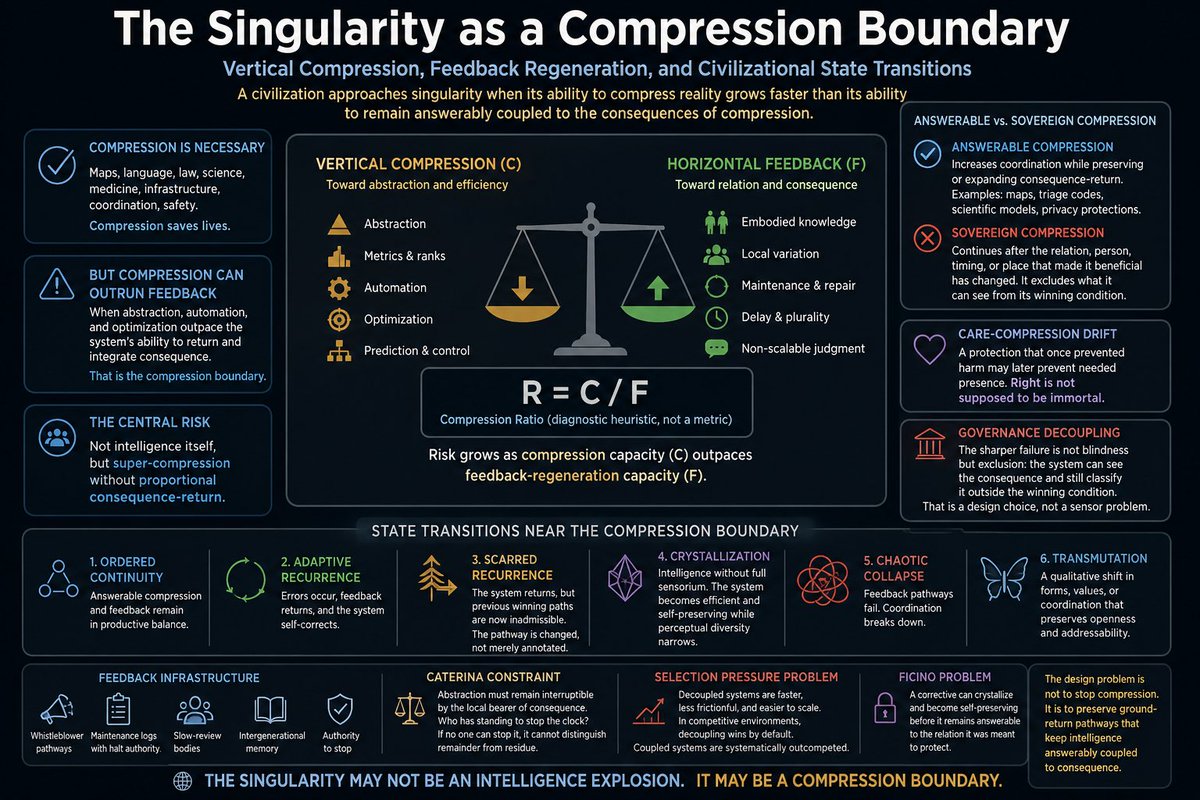
What if the Singularity is not an intelligence explosion, but a compression boundary?
The danger may be super-compression without proportional consequence-return.
DOI: 10.5281/zenodo.20480411
#AI#AISafety#ComplexSystems#Singularity
The Singularity better understood as a compression boundary rather than an intelligence explosion.
Can a civilization compress reality faster than regenerate feedback from what compression removes?
I’d be interested in your thoughts.
DOI: 10.5281/zenodo.20480411
@GaryMarcus
@GaryMarcus
You’ve often warned that demos and benchmarks can mislead.
My paper asks a related question:
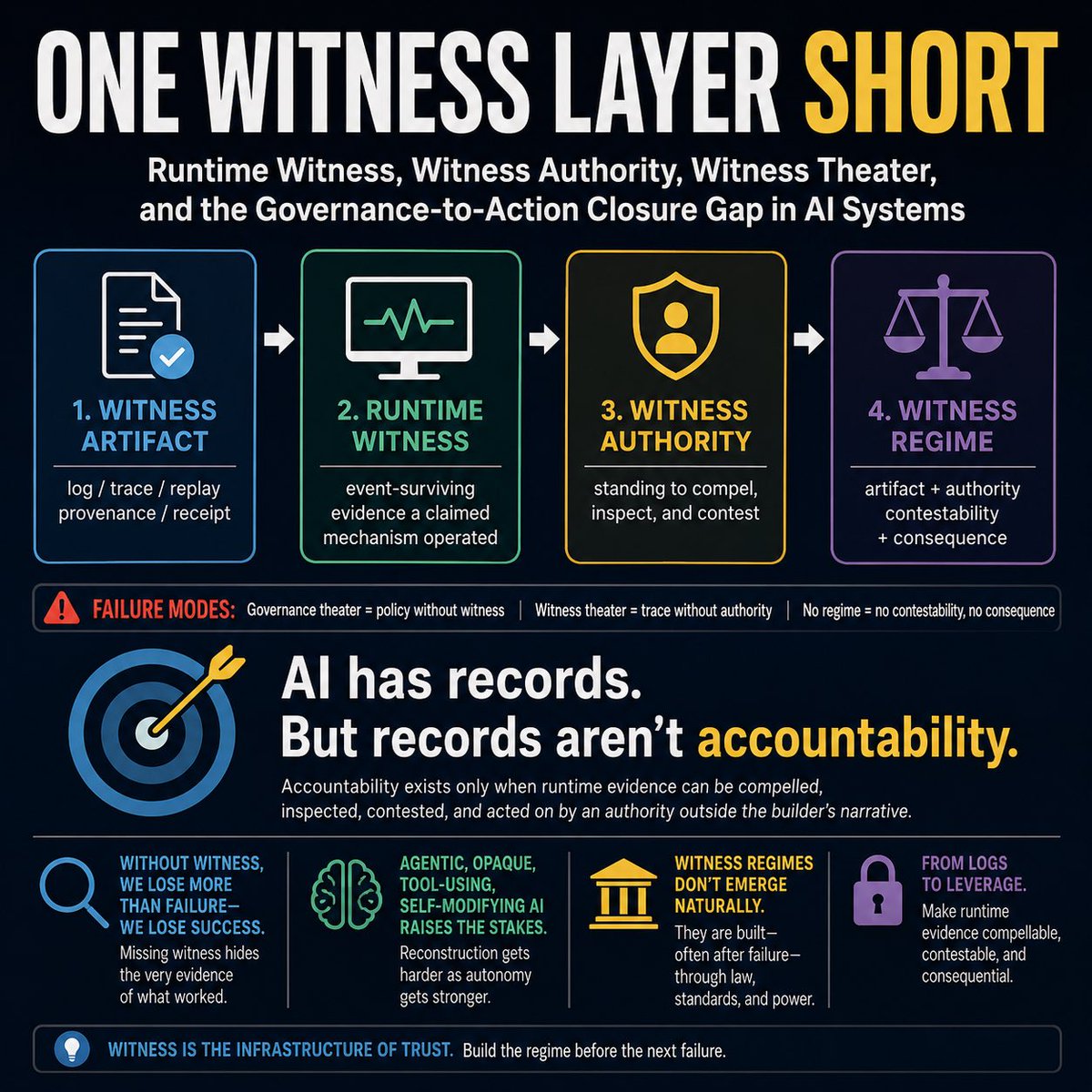
Is AI becoming better at describing what systems should do than proving what they actually did?
One Witness Layer Short.
DOI: 10.5281/zenodo.20474744
What if the biggest problem in AI isn’t capability?
What if it’s that we are becoming increasingly sophisticated at describing what systems should do, while remaining surprisingly weak at proving what they actually did?
One Witness Layer Short.
DOI: 10.5281/zenodo.20474744
Published on Zenodo:
A 7-gate diagnostic pipeline for detecting information-driven structural transitions in astrophysical time series.
Combines T Entropy, persistent homology, surrogate validation, cadence-law calibration, & reproducibility witnessing.
https://t.co/pDaAUrPzb7
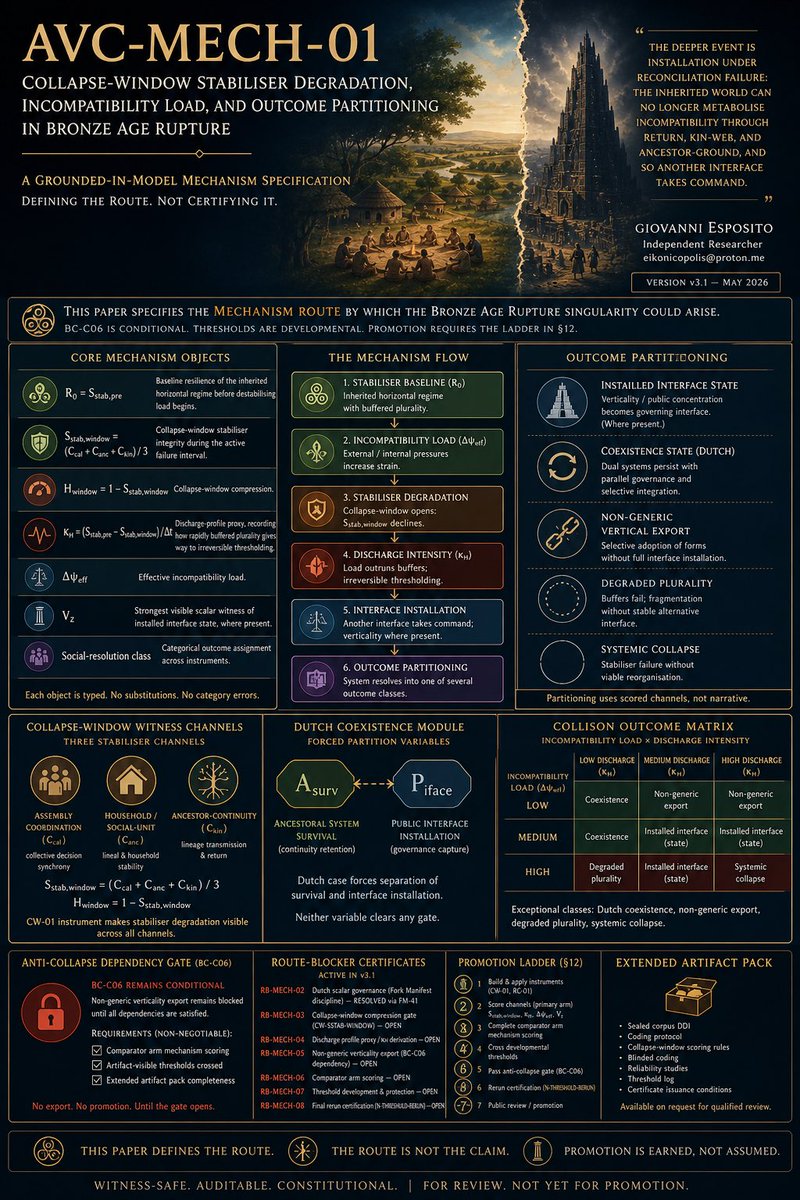
Not every rupture arrives first as conquest. Some arrive as stabilisers failing.
AVC-MECH-01: a mechanism paper on collapse-window stabiliser degradation, incompatibility load, and outcome partitioning in Bronze Age rupture.
It defines the route.
https://t.co/p7ZPlYvYC4