As an example of someone that did it right:
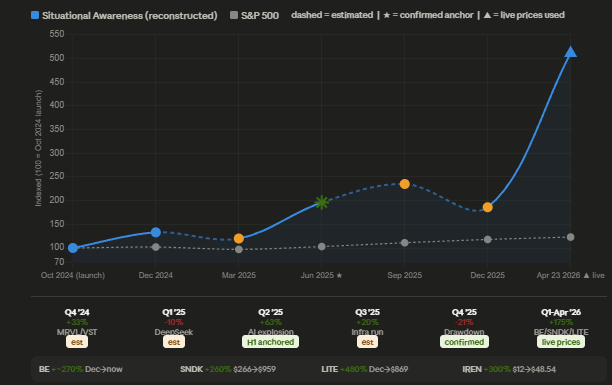
Leopold Aschenbrenner
The backwind was fully accessed and seen (link to view expressed in June 2024.
The idea was simply that AI (especially the path to AGI/superintelligence) will drive trillions in capex on compute clusters, power, data centers, and chips. The fund aims to be "more situationally aware" than Wall Street on AI timelines and bottleneck.
He published a thesis in 2024 that most dismissed as hyperbole, then built concentrated positions while Wall Street was distracted by short-termism.
Much has been misstated about him linked to AUM growth via further growth of LP investments so I tried to normalize his performance via his assets as if he invested personally. Model below.
Overall the lesson is two-fold, the first is of course the mental model as described in the post above but the second is that the bigger secular trends take time to shape and 80%+ of the majority of gains happen within the last 2/5 as the bubble expands and reaches parabolic status.
Leopold was over a year late to the AI supertrend when he released the paper. The $NVDA AI earnings gap up had happened in June 2024, a full year before the release of the paper and another 300% higher than a year ago.
Bubbles take 5y+ to fully rippen. To a large extend sitting out the first 1-2y can actually be great to pinpoint the magnitude of the catalyst and trend nature, but 99/100 humans focus on short-termism, looking back and thinking its too late instead.
So in short to finish my point:
-It takes half a decade to develop a tech bubble
-It takes 1-3y of easing to come off of a major economical hit
-It takes the hyperbole in sentiment/news and the trend in acceleration to shift to negative to find a turn, while it is the realization of good news eventually that fully prices the then made move and often ends it.
->The market makes a move and explains later, it doesn't explain first.
-The best timing instrument is positioning and acceleration of news/negative catalyst aspect.
-Bad news is a real feature of functional markets, they are the norm, not the exception and they create long term opportunities. Do not fight it.
-Markets price in years of cash flows which grow themselves and make short term earnings even less important.
->Understand a short term catalyst or even mid term does not change much about 10y+ of cash flow and growth.
-Listing the frequency of pullbacks helps to see what markets actually are and how resillient they are.
pullback frequency per year:
5%: ~3x per year
10%: ~1x per year
15%: ~1x per 2 years
20%: ~1x per 3.5 years
30%: ~1x per 12 years
40%: ~1x per 20 years
Thinking within this framework will allow for an easy checklist to work through and a good quarterly and yearly review for overall approach.
https://t.co/O19UKlHiqU or https://t.co/kyV0EKpaKn
🚨 THIS IS INSANE.
Commerce Secretary Howard Lutnick's sons could be making 3 to 5x returns on every dollar they spent buying tariff refund rights.
Cantor Fitzgerald, now run by Lutnick's sons Brandon and Kyle, was buying tariff refund claims from companies at 20 to 30 cents on the dollar.
The firm told clients it had "capacity to trade up to several hundred million" in these claims.
They confirmed at least one $10 million trade was already executed as of July 2025. They said they expected that number to "balloon in the coming weeks." That was 9 months ago.
Today those claims are worth 100 cents on the dollar. The refund portal is live, $166 billion in refunds are being processed.
If Cantor bought $100 million in refund rights at 25 cents on the dollar, they spent $25 million.
They now collect $100 million from the government. That is a $75 million profit. A 300% return.
If they scaled to "several hundred million" as they told clients they could, the profits run into the hundreds of millions.
Howard Lutnick was the architect of the tariff policy.
He pushed Trump to impose them. He fought against officials who wanted to limit them. Then he left Cantor Fitzgerald to his sons and transferred his equity into a trust benefiting them.
Tax free under government ethics rules. He received $360 million from the buyout.
His sons positioned the firm to profit from the exact policy their father built.
Their father publicly championed tariffs he knew could be struck down while his sons were buying refund claims betting they would be.
TRUMP ADMINISTRATION TO BEGIN REFUNDING $166B IN TARIFFS
The U.S. government will start refunding up to $166 billion in Trump-era tariffs after the Supreme Court ruled the policy unlawful.
From April 20, businesses can file claims through a new Customs system to recover duties paid under emergency powers. Courts found only Congress can impose tariffs, forcing the rollback.
Over 330,000 importers across 53 million shipments may be eligible. Once approved, refunds—plus interest—should arrive within 60–90 days, though complex cases may take longer.
Officials warn the process will be massive and complex, but payments will go directly to the businesses that originally paid.
I lived through Yeltsin, and Trump's behavior mirrors him so precisely it's disturbing.
The same clownish performance. The same promises. The same destruction of a country while the leader talks nonsense and dances.
Dear Americans, good luck.
crypto went from being the most speculative domain in the world to being the most powerful upgrade to finance.
after a decade of being too speculative to touch, it is now a serious risk to any bank, fintech, and tradfi institution to not adopt crypto through global markets, stablecoins, permissionless tokenization, and 24/7 markets.
the ironic part is that all of this is thanks to the 10+ years of degens who proved that perps work, tokens enable global and 24/7 markets (trading of memes and useless governance tokens), and stablecoins are actually useful.
long live the degens and long live crypto.
What happens when you embrace life as a trader, living on your own PnL
1) you treat the general volatility of life with equanimity, sh*t happens everyday in the portfolio and its a reflection of life. Most people want to suppress vol (salary, stability etc)
Binance holds about 87% of USD1, the stablecoin issued by a Trump family crypto venture, per Forbes.
In 2025, the Securities and Exchange Commission dropped its lawsuit against Binance for alleged securities law violations just days after the exchange first listed USD1, and in October, Trump pardoned its co-founder and former CEO Changpeng “CZ” Zhao, who pleaded guilty in 2023 to failing to maintain an effective anti-money laundering program.
Absolutely delusional and out of touch.
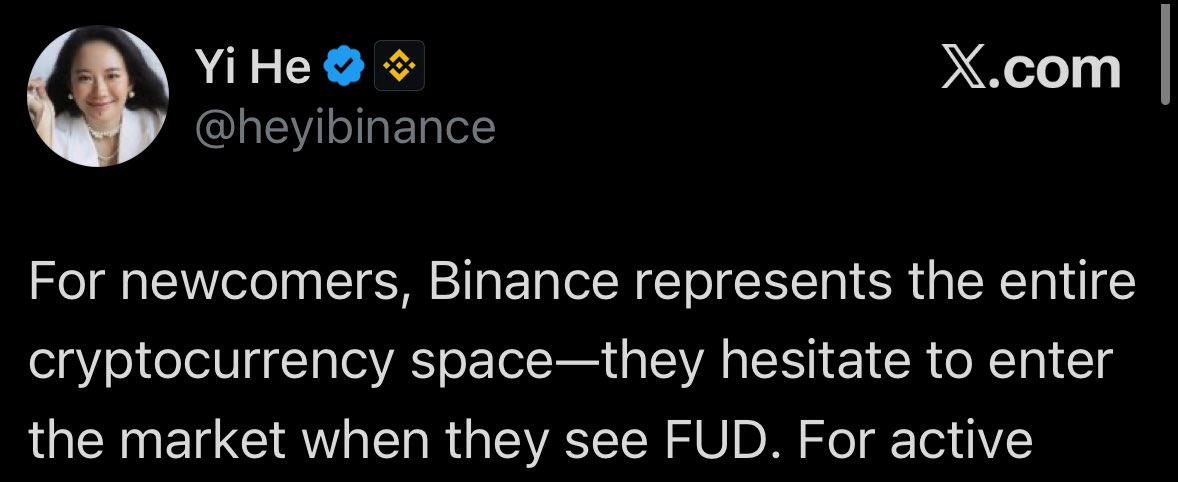
Newcomers definitely know how to tell apart Binance and the “crypto space”
Connecting the two to convince people not to fud binance is hilarious at best.
fully retraced, now you can buy some more at low prices 🤣🤣🤣🤣🤣🤣🤣🤣🤣🤣🤣🤣🤣🤣🤣🤣🤣🤣🤣🤣🤣🤣🤣🤣🤣🤣🤣🤣🤣🤣🤣🤣🤣🤣🤣🤣🤣🤣🤣🤣🤣🤣🤣🤣🤣🤣🤣🤣🤣🤣🤣🤣🤣🤣🤣🤣🤣🤣🤣🤣🤣🤣🤣🤣🤣🤣🤣🤣🤣🤣🤣🤣🤣🤣🤣🤣🤣🤣🤣🤣🤣🤣🤣🤣🤣🤣🤣🤣🤣🤣🤣🤣🤣🤣🤣🤣🤣🤣🤣🤣🤣🤣🤣🤣🤣🤣🤣🤣🤣🤣🤣🤣