Continuous sunlight is scarce on the Moon unless you know where to look. 🌑
The lunar poles contain "peaks of eternal light," areas bathed in near-continuous sunlight. Power Tower mounts on Blue Moon MK1's top deck and extends solar arrays to 26 meters total height to capture that energy and deliver sustained power for Moon Base operations.
Check out this video of Power Tower during a successful deployment in an analog lunar environment.
The infrastructure era of lunar exploration starts now.
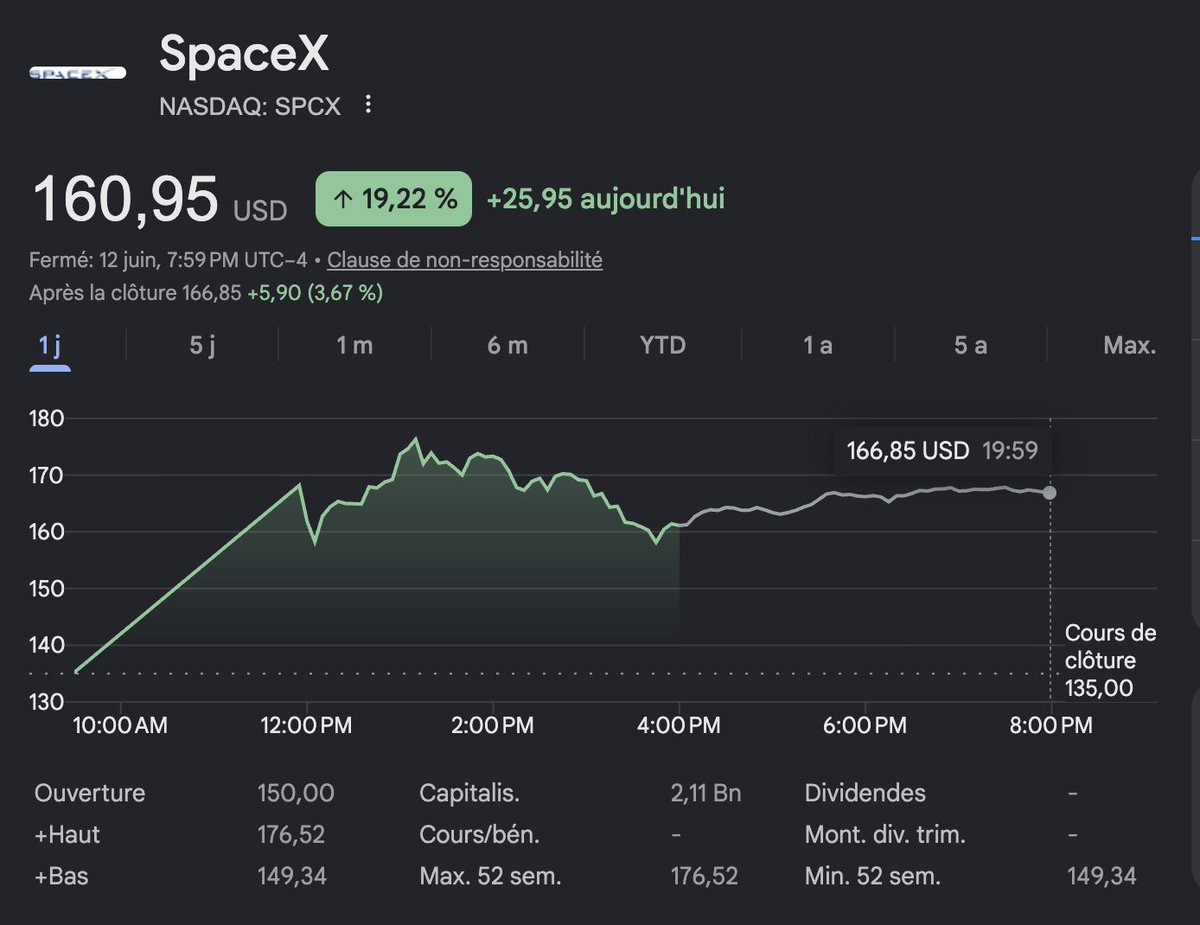
SpaceX a clôturé son premier jour de cotation à 2 100 milliards de dollars, +19%. Tout le monde regarde le chiffre. Personne ne regarde ce qu'il price réellement.
Laissez-moi vous dire ce que le marché vient d'acheter, et pourquoi je pense que cette boîte vaudra 30 à 50 trillions d'ici 5 ans.
D'abord, le symbole. Cette IPO est un référendum. D'un côté, 20 ans de discours sur la décroissance, la sobriété, la redistribution, la fin de l'histoire gérée par des comités. De l'autre, un homme qui a dit "je vais rendre l'humanité multiplanétaire", que tout le monde a traité de clown, et qui vient de créer la plus grosse entreprise cotée de l'histoire en partant d'un entrepôt à El Segundo. Le marché a voté. Le wokisme avait des départements RH, SpaceX avait des fusées. Les fusées ont gagné.
Ensuite, la mécanique économique, parce que c'est là que tout le monde se trompe. Les analystes valorisent SpaceX comme une entreprise de lancement plus Starlink. C'est comme valoriser Internet en 1995 sur le marché du fax. Starship ne réduit pas le coût du kilo en orbite de 20%, il le divise par 100. Et chaque fois dans l'histoire qu'un coût d'infrastructure est divisé par 100, ce n'est pas le marché existant qui grossit, ce sont des industries entières qui naissent. Le coût du calcul divisé par 100 a donné Internet, le smartphone, l'IA. Le coût de l'orbite divisé par 100 va donner une économie spatiale complète.
Faisons la liste de ce qui devient rentable quand le kilo en orbite coûte le prix d'un billet d'avion. Les data centers orbitaux, avec énergie solaire continue et refroidissement gratuit, au moment exact où l'IA fait exploser la demande énergétique terrestre. La fabrication en microgravité de semi-conducteurs, de fibres optiques, d'organes imprimés impossibles à produire sous gravité. Le tourisme orbital de masse, puis les hôtels lunaires, qui passeront du fantasme au business plan exactement comme la croisière de luxe au 20ème siècle. Le transport point à point terrestre, Paris-Tokyo en 40 minutes. L'industrie minière des astéroïdes, dont un seul corps de classe M contient plus de métaux que tout ce que l'humanité a extrait depuis le néolithique. Et Mars en ligne de mire, pas comme destination touristique, mais comme le plus grand projet d'infrastructure jamais entrepris, avec tout ce que ça implique de demande en énergie, matériaux, robotique, IA.
SpaceX ne participera pas à ces marchés. SpaceX possède le péage d'entrée de tous ces marchés. C'est AWS, mais pour la civilisation. Apple vaut 3 500 milliards en vendant des rectangles de verre sur une seule planète. Le premier monopole d'accès à une frontière infinie à 30 ou 50 trillions dans 5 ans, ce n'est pas de l'exubérance, c'est une simple règle de trois sur l'expansion du marché adressable.
Et maintenant, la partie que je préfère. Ce futur n'a pas besoin de bureaucrates. Il n'y a pas de comité consultatif en orbite. Pas de commission Théodule sur Mars. Chaque dollar de cette nouvelle économie sera créé par des ingénieurs, des techniciens, des soudeurs, des pilotes, des entrepreneurs. Les diplômés en gestion de la norme vont devoir apprendre un métier utile, et franchement, c'est une excellente nouvelle pour eux aussi : construire est infiniment plus fun que contrôler.
Parce que c'est ça, le vrai signal d'aujourd'hui. Pendant 50 ans on nous a vendu un futur rétréci : moins d'énergie, moins d'enfants, moins d'ambition, gérer le déclin proprement. Et là, d'un coup, le plus gros actif financier du monde est un pari sur l'abondance, l'expansion et l'aventure. Le pessimisme vient de passer en position vendeuse sur lui-même.
Le futur sera méga fun. Il y aura des hôtels avec vue sur la Terre, des honeymoons en orbite, des gamins qui diront "papa, c'était comment avant les fusées réutilisables" comme on dit "c'était comment avant Internet". Et quelque part dans les années 2030, un humain marchera sur Mars en livestream devant 5 milliards de personnes, et ce jour-là plus personne ne se souviendra du nom d'un seul de ses détracteurs.
Achetez de l'optimisme. C'est encore sous-valorisé.
Google DeepMind researcher argues that LLMs can never be conscious, not in 10 years or 100 years.
"Expecting an algorithmic description to instantiate the quality it maps is like expecting the mathematical formula of gravity to physically exert weight."
Jesse, Steve, Laddy, and Vlad….such an incredible feeling to welcome you aboard Integrity after a nearly 700,000 mile journey. Forever thankful for your service to our crew and the nation.
NASA has 32 cameras on the Artemis II spacecraft. The top science priority during the Moon flyby was the four astronauts looking out the window and talking about what they saw.
NASA's lunar science lead confirmed it. What the crew says out loud about the Moon's surface matters more to the science team than anything the cameras capture. NASA trained this crew in Iceland's volcanic highlands and at an impact crater in Labrador, Canada, teaching them to read rock textures and spot geological details at 25,000 mph.
There's a reason NASA trusts human eyes over cameras. In 1972, Apollo 17 astronaut Harrison Schmitt was walking near a small crater called Shorty when he scuffed the dirt with his boot. The soil underneath was orange. Schmitt was the only trained geologist to ever walk on the Moon, and he got so excited he blurred most of his own photos. That orange soil turned out to be tiny glass beads from a volcanic eruption 3.64 billion years ago, one of the biggest finds of the entire Apollo program. A boot and a pair of trained eyes caught what no camera did.
For this flyby, NASA sent the crew a final list of 30 surface targets. They killed all the cabin lights to cut window reflections. They worked in pairs, rotating every 55 to 85 minutes, calling out craters and lava flows while scientists at Johnson Space Center analyzed everything in real time. Pilot Victor Glover reported that the Moon's south pole, where NASA wants to land astronauts by 2028, looked "more jagged" than the north with much steeper terrain. One observation from a human eye at 4,070 miles could shape where the next crew touches down.
At 6:44 PM Eastern, Orion slipped behind the far side and went radio silent for 40 minutes. Four people, completely cut off from every other human alive, the Moon blocking every signal back to Earth. The last time humans experienced that was December 1972.
They broke the all-time distance record on the way. Apollo 13 held it for 56 years at 248,655 miles from Earth. Artemis II passed that mark and kept going to 252,760. Jim Lovell, who commanded Apollo 13 and held that record his whole life, died last August at 97, eight months before these four beat it. Before he died, Lovell recorded a message for the crew. "Welcome to my old neighborhood," he told them. "Don't forget to enjoy the view."
The crew named two craters during the flyby. One for their spacecraft, Integrity. The other, Carroll, for Commander Reid Wiseman's late wife, a nurse who cared for newborns and died of cancer in 2020 at 46. Wiseman has raised their two daughters alone since. When Jeremy Hansen read the name to Mission Control, his voice broke. The crew hugged. Wiseman and Koch wiped tears. Then they got back to work, because they still had hours of Moon left to map with their eyes.
@ARCRaidersGame the fact that a stella game is a stupid fucking pitch dark no light raid when I’m selecting a normal mode makes no sense. Instead of releasing arc that shoot lasers, maybe you all can focus on quality improvements that are not brain dead slop. There goes my kit
If you're under 53 years old, you have never once been alive while a human was farther than 250 miles from Earth. Tonight, four astronauts are heading 252,000 miles out. That's a thousand times farther than any person has gone in your lifetime.
The 250-mile ceiling is where the International Space Station floats. Every astronaut since December 1972 has been stuck in that zone. Spacewalks, science experiments, cool photos from orbit, sure. But nobody left the neighborhood.
The last crew to go farther was Apollo 17. December 1972. Nixon was president. The internet didn't exist. Cell phones were 11 years away. The youngest member of that crew is now 90 years old.
The farthest any human has ever been from Earth is 248,655 miles. The Apollo 13 crew set that number in 1970, and they didn't mean to. Their oxygen tank blew up, and the emergency route home took them farther out than anyone before or since. Tonight's crew will break that record on purpose.
And the crew itself. Victor Glover becomes the first Black astronaut to leave Earth's neighborhood. Christina Koch becomes the first woman. Jeremy Hansen, a Canadian fighter pilot, becomes the first non-American to do so. When they come home, they'll slam into the atmosphere at 25,000 mph, faster than any human has ever traveled.
The Moon's south pole has ice. Water ice, sitting in craters so deep that sunlight hasn't hit them in billions of years. A 2024 NASA study found way more of it than anyone expected. You can split water into hydrogen and oxygen, which gives you rocket fuel, breathable air, and drinking water, all made on the Moon instead of hauled up from Earth. George Sowers at Colorado School of Mines calculated that Moon-made fuel could shave $12 billion off a single trip to Mars. The Moon is a gas station on the road to Mars.
NASA Administrator Jared Isaacman announced last week a $20 billion plan to build a permanent base at the South Pole over the next seven years, with landings every six months. China is developing its own lunar lander and spacesuit, aiming for a crewed landing by 2030. The Artemis program has burned through $93 billion so far, and the first actual surface landing is penciled in for 2028. There's a real question of who gets there first this time around.
Harrison Schmitt walked on the Moon in December 1972 as part of Apollo 17. He's 90. Asked about it this week, he sounded pretty relaxed. "Mars is attainable," he said. "We're humans. That's what we've always done."
Ahahahaha. Elon fucking cooked up self driving and still most don’t believe it’s real. I love this shit. I thought it was trash 2 years ago but now I’m sitting here laughing, shaking my head daily.
That crazy son of a bitch did it, man.
Just got through the DC gauntlet. Still haven’t touched the steering wheel or pedals today. Started in Raleigh. Multiple downpours, daytime, night time. Doesn’t matter.
It just cooks through everything
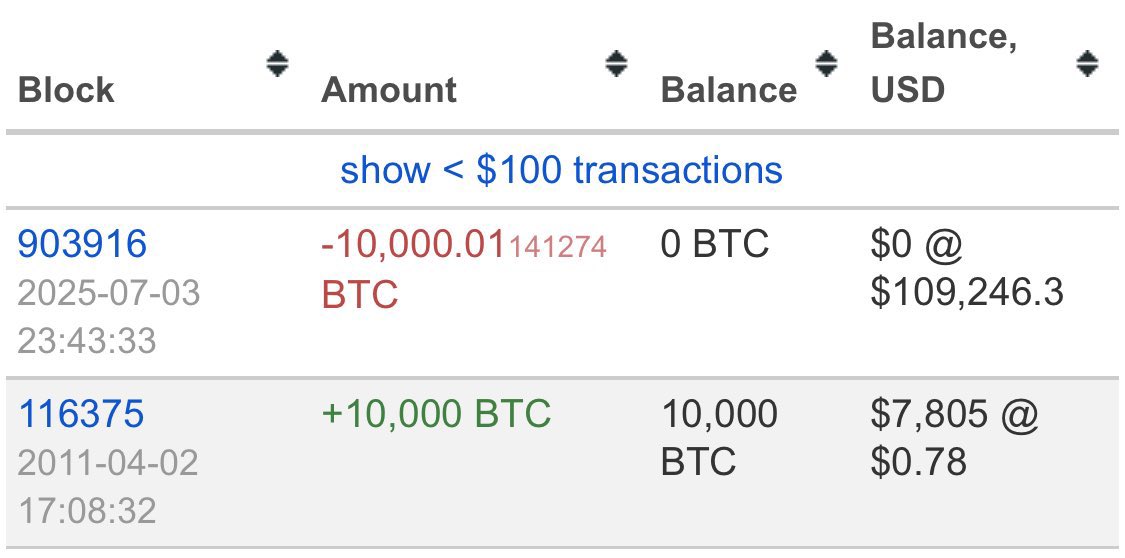
Imagine the balls it takes to not only hodl what is now $1.1 Billion worth of Bitcoin for 14 years from a $7800 cost basis, but to just send it all out with a single click and no test transaction.