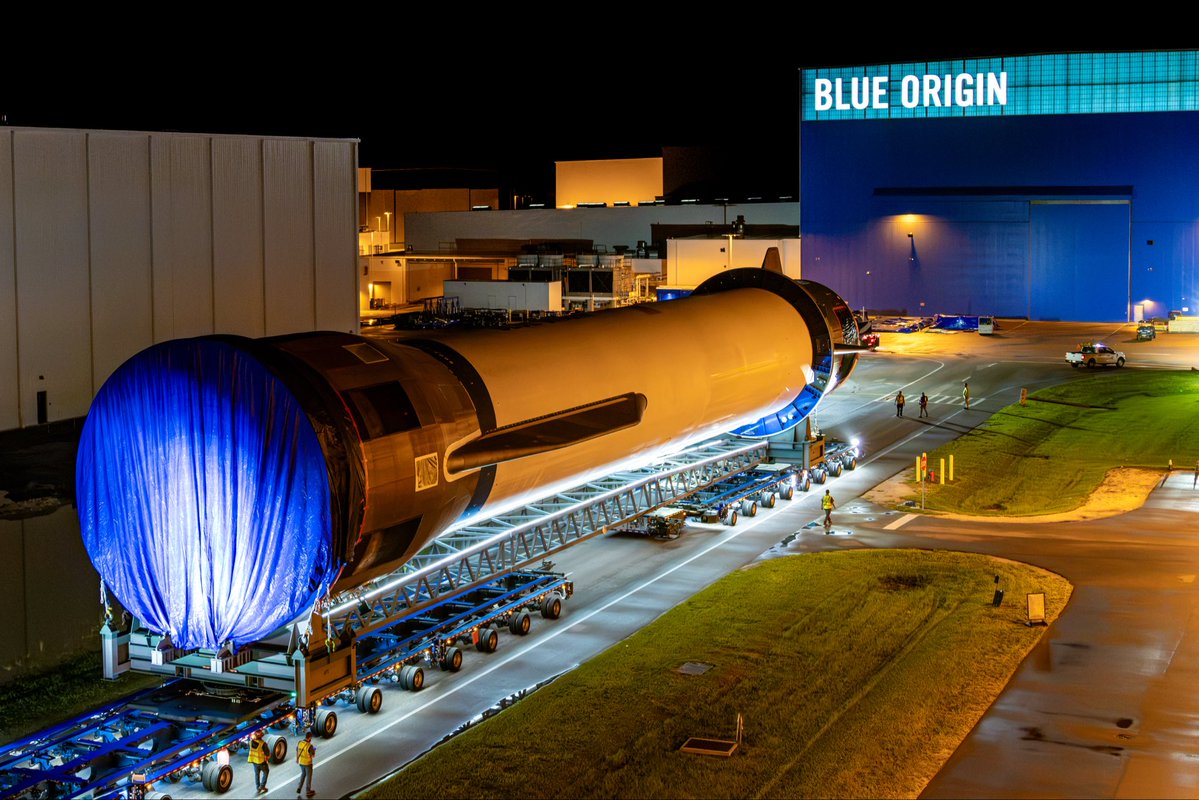
Thanks for the ride, Pegasus! GS2 arrived in Mississippi this morning. We’re wrapping up work on the B-2 test stand at @NASAStennis and will shift to preparing this vehicle for its hotfire test.
As Star Trek celebrates 60 years this week, voyage into the philosophy and future of spaceflight. In Part 2 of Rod Roddenberry's conversation on Ascending Node, the focus turns to what is happening in spaceflight technology today at Blue, and what that means for the future.
Listen now: https://t.co/AxM81Y9m0m 🖖
The next GS2 is loaded up and now preparing to head to @NASAStennis for vehicle hotfire testing, the first of our second stages to be tested at the historic B-2 stand. Proud to test at Stennis, where Mississippi has powered American spaceflight for decades. The Blue team and our @NASA partners have been hard at work preparing the stand for testing.
Welcome to Rocket Park, home of New Glenn and Lunar Permanence 🚀🌕
This week, we hosted the @NASAArtemis III crew — Astronauts Randy Bresnik (@AstroKomrade), Luca Parmitano (@astro_luca), Andre Douglas (@Astro_AndreD), Frank Rubio, and backup Bob Hines (@Astro_FarmerBob). The crew got an up-close look at where New Glenn and our lunar landers come to life, then headed to LC-36, where we will launch our MK2 Earth Orbit Rendezvous demonstration vehicle in support of the Artemis III mission.
The team has been busy transporting all modules that were removed from the Vehicle Access Tower back to the pad to prepare for re-stacking. We designed and installed floors, pneumatics and electrical panels, and backbone piping on the modules. And we're moving the elevator to the side of the Vehicle Access Tower, freeing up significantly more floor access for our new CONOPS.
Ahead of Labor Day, I want to thank all of Team Blue for your hard work and give a shoutout to the team at the pad for their dedication to our return to flight.
The Moon is, on average, 238,855 miles away. Our MK1-101 Endurance team just made it feel closer.
Across two weeks of simulations, our team rehearsed key mission phases, including launch and separation, lunar orbit insertion, lunar orbit operations, and landing. The training also included checkout and software-emulated use of @NASA’s Stereo Camera for Lunar Plume-Surface Studies (SCALPSS) payload system, providing the team with hands-on experience operating a key science instrument on Endurance.
Each sim builds the coordination, confidence, and readiness needed for our mission to the lunar surface.
Mars just got a little closer.
Blue Origin is honored to have been selected by @NASA to help build the first dedicated communications network at the Red Planet. Our Mars Telecommunications Orbiter (MTO), built on the Blue Ring platform, will create new pathways for science while delivering multiple payloads to the orbit of Mars, driving discovery today and preparing for the next chapter of human exploration.
Learn more: https://t.co/o7pMX9RDEX
https://t.co/9slNoEXsFS
Before the first human steps on Mars, we have to build the road.
Honored that Blue Origin has been selected by @NASA to deliver our Mars Telecommunications Orbiter (MTO), built on Blue Ring and in production now in Huntsville. MTO will enable science, carry payloads, and help lay the foundation for human exploration.
Proud of Team Blue. We’re going to Mars.
Breaking ground today on our new Payload Processing Facility on the Eastern Range - the first ever built to support an 8.7‑meter fairing. Thank you to @USSF_SSC, @USSpaceForce, and @SLDelta45 for the partnership. At 120,000 square feet, the PPF will house four payload processing bays, two encapsulation bays, and a multi‑manifest area supporting National Security Space Launch, civil, and commercial missions. This facility expands our Space Coast footprint across Brevard and Orange Counties and supports continued job growth alongside our more than 4,500 employees in the region.
Honored to be with @POTUS and @NASAAdmin to congratulate @Astro_Reid, @AstroVicGlover, @Astro_Christina, and @Astro_Jeremy on their Congressional Space Medal of Honor. Their journey beyond the Moon is a testament to American excellence and our nation's enduring drive to explore. Being up next for Artemis III is a privilege, and our team is hard at work every day to make this mission a reality.
"Star Trek inspired me to do this."
Rod Roddenberry has heard it from strangers, scientists, and engineers alike... people who found their calling because of a show his father created.
But for Rod, it's more than nostalgia. It's proof of what great storytelling can do—make you see the world, and your place in it, from a completely different perspective.
On this episode of Ascending Node, Rod shares those stories and what it means to carry that legacy forward.
🖖 New episode out now: https://t.co/Q6zG0Egrzh
Team Blue and our partners at @NASAStennis have rapidly completed the structural design for the B‑2 test cell position, moving us toward second‑stage vehicle testing. Steel work is underway, tubing is being installed, cable harnesses are being built up, and the control room is getting its finishing touches. Next up: a GS2 makes its way to Mississippi.
🖖 Gene Roddenberry didn't just imagine the future for Star Trek; he worked with the science community to help make it believable.
On the next episode of Ascending Node, his son Rod joins us to talk about that legacy, how he's carrying it forward, and how Star Trek's vision inspires real engineers to go build it.
New episode coming soon!
🎙️: https://t.co/h0YWSOQ6nW
Your live view from the Moon: coming up!
Lunar Express's architecture will deliver multiple simultaneous 4K video links — from the lunar surface and orbit all the way to Earth — with the capacity to scale further. For the first time ever, humanity will witness a Moon Base being built live, brick by Moon-brick, in 4K high-definition.
Learn more about the Blue Ring spacecraft: https://t.co/66EDdlPvz7