On a mission to make money transferrable, interoperable, secure and accessible.
CEO at Kima Labs. Enabling seamless settlements of digital assets and fiat.
🚀 AEREDIUM × KIMA NETWORK
We’re excited to announce a strategic partnership with @aeredium — an institutional-grade blockchain focused on stablecoins, real-world assets, and cross-chain settlement infrastructure.
By connecting AEREDIUM’s trust layer with Kima’s settlement infrastructure, we’re strengthening the foundations for synchronized value transfer across banks, blockchains, stablecoins, and digital asset ecosystems.
The infrastructure layer just got a lot more powerful💪
More soon 👀
You cannot middleware your way to settlement finality.
Imagine a room full of very serious people: a consortium of banks, payment networks, infrastructure providers, technologists, and lawyers. Their mandate: solve interoperability.
Whiteboards fill up. APIs are mapped. Messaging layers proposed. Bridges debated. One more abstraction suggested to “normalize” everything. It all sounds reasonable and familiar.
For a moment, it feels like progress.
But something is missing - not because anyone is incompetent. Everyone is smart, experienced, and acting in good faith. They’re just solving the wrong problem.
What they really want isn’t connectivity. It’s certainty.
Outside that room, value already moves everywhere: banks, payment rails, enterprises, blockchains, stablecoins, tokenized assets. Each system settles internally. Almost none settle together.
So we connect them: orchestrate, reconcile, prefund, add buffers. This works, until it doesn’t.
You can’t middleware your way to settlement finality.
Every orchestration layer improves reach but multiplies states, failure modes, and rollback paths. At small scale, it’s manageable. At institutional scale, it’s structural risk.
The system doesn’t break loudly. It just becomes heavier.
The industry keeps reaching for a false choice: either (1) build a new unified ledger everyone must migrate to, or (2) accept fragmentation and coordinate harder. One is politically unrealistic. The other is impossible to stabilize long-term.
There is a third path.
You don’t replace systems of record. You replace how they settle with each other.
That’s what made PvP inevitable in FX and DvP non-negotiable in capital markets. Not elegance, but necessity.
What’s emerging now isn’t another ledger or more middleware. It’s a neutral settlement fabric that preserves ledger sovereignty while enforcing atomic execution. A transaction either completes everywhere, or nowhere.
Single-ledger finality without a single ledger.
This shift always sounds over-engineered, premature, excessive, until volumes grow, regulation tightens, and the cost of pretending orchestration equals settlement becomes impossible to ignore.
Atomicity doesn’t win because it’s fashionable. It wins because nothing else survives scale.
The first to feel this won’t be idealists. It will be central banks, payment providers, capital markets, and fintechs with no room left to absorb reconciliation.
This isn’t a crypto story. It’s a settlement story.
And that’s exactly what @KimaNetwork is about.
💥 Big news: $USD1 is now live on Kima!
With the launch of Kima SDK v1.5, we’ve integrated USD1, the next-gen USD-backed stablecoin, into our settlement layer.
What this means:
🔗 Swap $USD1 with $USDT, $USDC, $EURC across Ethereum, Solana & Base
🏦 On-ramp via SEPA → $USD1 directly, no friction
⚡ Cross-chain settlement with compliance & atomic finality
🛡️ No bridges, no custodians. Just protocol-level interoperability
For users, institutions, and builders, this unlocks a more powerful way to connect TradFi and DeFi seamlessly.
👉 Swap $USD1 with $USDT, $USDC, $EURC across Ethereum, Solana & Basees it: https://t.co/5JUzjDcvvN
The projection refers to on-chain transactions on Cardano’s mainnet, not just L2 counts.
These numbers assume strong adoption by ecosystem apps - wallets, DeFi platforms, and commerce/payment solutions - which will use Kima’s cross-chain and fiat connectivity to drive real liquidity and payments through Cardano.
Once those partners and developers integrate at scale, Cardano could realistically see tens of thousands of new mainnet transactions daily, powering real-world use cases and value flows.
Over the past few months, I’ve been revisiting foundational books that shaped how we think about systems, power, coordination, and risk. Works like Where Wizards Stay Up Late, Seeing Like a State, Skin in the Game, and others.
My goal isn’t nostalgia. It’s to surface timeless insights and apply them directly to the evolution of money today, particularly the role of stablecoins and the future of financial infrastructure.
This is the first post in that series.
------
𝐏𝐫𝐨𝐭𝐨𝐜𝐨𝐥𝐬, 𝐍𝐨𝐭 𝐏𝐥𝐚𝐭𝐟𝐨𝐫𝐦𝐬: 𝐖𝐡𝐚𝐭 𝐭𝐡𝐞 𝐁𝐢𝐫𝐭𝐡 𝐨𝐟 𝐭𝐡𝐞 𝐈𝐧𝐭𝐞𝐫𝐧𝐞𝐭 𝐓𝐞𝐥𝐥𝐬 𝐔𝐬 𝐀𝐛𝐨𝐮𝐭 𝐭𝐡𝐞 𝐅𝐮𝐭𝐮𝐫𝐞 𝐨𝐟 𝐒𝐭𝐚𝐛𝐥𝐞𝐜𝐨𝐢𝐧𝐬
𝘉𝘰𝘰𝘬: 𝘞𝘩𝘦𝘳𝘦 𝘞𝘪𝘻𝘢𝘳𝘥𝘴 𝘚𝘵𝘢𝘺 𝘜𝘱 𝘓𝘢𝘵𝘦 𝘣𝘺 𝘒𝘢𝘵𝘪𝘦 𝘏𝘢𝘧𝘯𝘦𝘳 𝘢𝘯𝘥 𝘔𝘢𝘵𝘵𝘩𝘦𝘸 𝘓𝘺𝘰𝘯:
The internet wasn’t built by companies. It was built by a neutral protocol -- TCP/IP -- that quietly outcompeted every centralized alternative.
Key lesson:
TCP/IP didn’t succeed by offering more functionality. It succeeded by doing one thing exceptionally well: delivering packets with minimal assumptions. It removed the need for trust, intermediaries, or central coordination, and in doing so, became the foundation for the modern internet.
What this means for money today:
Most of today’s stablecoin infrastructure, whether built by exchanges, payment fintechs, or bridges, resembles the early failed attempts at managed networks. Orchestration platforms try to “coordinate” value flows with APIs, reconciliation logic, and smart contract routing. These are stopgaps, not foundations.
Protocols eliminate complexity. Platforms route around it.
Managing stablecoin flows across chains, compliance domains, and counterparties isn’t an orchestration problem. It’s a settlement problem. And it requires a protocol-level solution.
@KimaNetwork is building the settlement protocol for digital value.
It delivers atomic, programmable, and jurisdiction-aware finality across wallets, blockchains, and financial institutions. No reconciliation. No custodial dependencies. No execution risk. Just finality, enforced by protocol.
Why this matters strategically:
Historically, value accrues at the base layer. TCP/IP, SMTP, Ethereum. These protocols became indispensable infrastructure. They allowed applications to scale without owning complexity. I believe the same pattern will play out with stablecoins and cross-ecosystem payments.
The right question isn’t: Which platform abstracts stablecoin complexity best?
The right question is: What becomes the TCP/IP of stablecoin settlement?
Our answer is @KimaNetwork .
@MerlijnTrader@chainlink https://t.co/FoL1cF8bBT
That history was already done last year by Kima as part of the digital shekel challenge. Direct non-chain P2P DVP without intermediaries.
🚀Kima Network at Bank of Israel’s Digital Shekel Challenge: Presenting Kima’s DvP Solution 🚀
We’re thrilled to share that @eitank, Kima’s CEO, and Dan Scheinmann, our CPO, recently presented Kima’s cutting-edge DvP solution at the Bank of Israel’s Digital Shekel Challenge! 🏦✨
Selected as one of the projects aiming to transform Israel’s financial ecosystem, we demonstrated how Kima enables seamless, secure, peer-to-peer transactions that instantly swap RWAs with CBDCs and fiat currencies—all without intermediaries, smart contracts, or vulnerabilities. 🔗💸
👉 Learn more about Kima’s DvP solution here: https://t.co/oMByN8KIbG
👉Watch this video about the Kima DvP approach here: https://t.co/BA9GiD3ucM
Banks clear $5T/day via Fedwire, yet a USDC payout still hops 3 rails before finality, locking capital and adding risk.
A vertical layer settles fiat/stablecoin in one atomic motion will cut risk like CLS did for FX. =>Kima
DM for a Unified Settlement primer. #wjgs@KimaNetwork
Cash in bank, USDC on-chain. Both forms of money.
Yet they clear on rails built 50 years apart.
The world needs them stitched together so a bank, a digital wallet and a bank account can settle in one atomic motion.
Hence @KimaNetwork .
#stablecoins#Payments
As featured in @Cointelegraph:
Kima joins the Mastercard Sandbox-as-a-Service platform to unlock direct atomic, real-time stablecoin card top-ups across 10+ chains -- no intermediaries.
Powered by our patented technology, Kima is the only blockchain-based settlement layer that fills the gap orchestration platforms leave.
Direct top-ups ⇒
⚡ speed | 🔒 lower risk | 👀 transparency | 💸 lower cost | 💰 higher margins
📖 Read more: https://t.co/RXTImVDiP5
Ready to pilot? Let’s talk.
#DeFi #Stablecoins #Fintech
6/ 👉 Read the ECB announcement: https://t.co/mXt94pUgkw
If you’re exploring programmable‑money pilots, reply or DM me. Let’s turn these use cases into live projects. #DigitalEuro#ProgrammablePayments
1/ 🚀 Excited to share that Kima is one of the 70 global innovators in the ECB’s Pioneers Partnership Program, piloting programmable payments in the digital‑euro sandbox. #DigitalEuro#CBDC
5/ Banks, fintechs and payment platforms: what conditional‑payment use case would you pilot first in a digital‑euro sandbox? Let’s discuss. 👇 #ProgrammablePayments
@KimaNetwork@ecb@KimaNetwork
is one of 70 global innovators in
@ecb
’s Pioneers Partnership Program - piloting programmable payments in the digital euro sandbox. Ready to show how CBDC can automate outcome‑based funding at scale, no smart contracts, no intermediaries, no oracles.
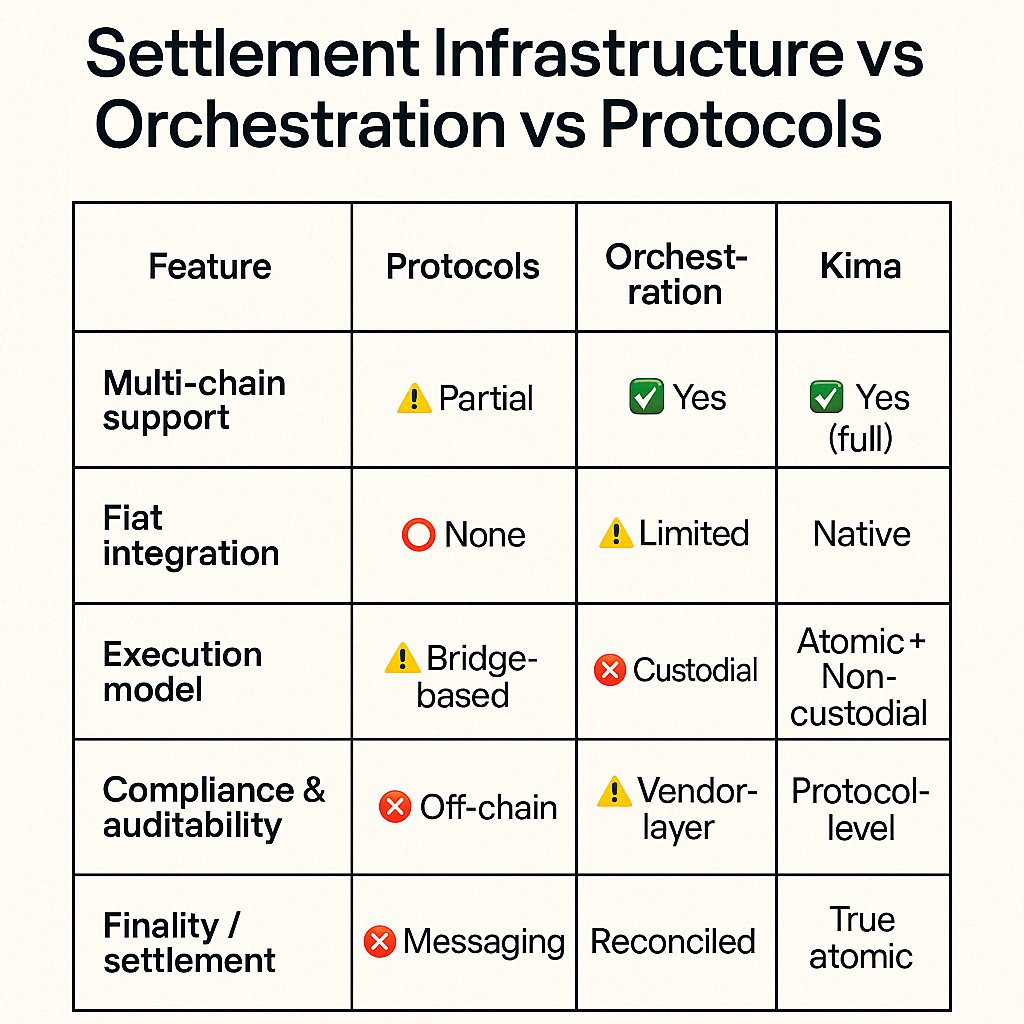
Not all interoperability is created equal.
Most platforms give you a nice API.
But under the hood?
•Bridges
•Wrapped assets
•Custody
Kima isn’t an orchestration layer.
It’s a settlement rail.
Here’s how the landscape actually compares 👇
🧵