@opencode Anyone got any idea of how to resolve this? what inappropriate content are we talking abt here?
Error from provider (Console Go): Upstream request failed: [data_inspection_failed] <400> InternalError.Algo.DataInspectionFailed: Input text data may contain inappropriate content.
Repetition shapes reality. Our brains care about repetitions. And they can learn almost anything if we practice it daily.
As Nicole Vignola breaks down neuroplasticity into its simplest form in her book Rewire:
repetition + attention + intention = lasting change
Fenomenal 🤩
“Como reagem os neurônios quando você aprende algo novo.
O aprendizado não é apenas algo que você faz; é algo que o seu cérebro constrói. Sempre que você pratica uma habilidade, recorda um fato ou experimenta algo novo, seus neurônios são ativados em conjunto e formam vias mais sólidas e rápidas. Esse processo é chamado de neuroplasticidade, e é a incrível capacidade do seu cérebro de se reorganizar ao longo de toda a sua vida.
No início, esses caminhos são fracos, como rabiscos leves de lápis. Mas, com a repetição, a concentração e a curiosidade, eles se transformam em traços ousados e permanentes.
Quanto mais frequentemente certos neurônios se comunicam, mais eficientemente transmitem sinais, tornando a habilidade ou a ideia mais fácil, automática e natural para você.”
@alexeixbt
@thisguyknowsai I am enrolled in this course currently.
It is online right here:
https://t.co/L49NJGbVt7
Now, it's not free. It's $49 to take the course, but I will say it is definitely worth the investment.
A woman who flunked her way through every math and science course in high school enlisted in the United States Army the day after graduation because she had no other options.
She learned Russian. She translated on Soviet trawlers in the Bering Sea. She worked at the South Pole Station in Antarctica. Then in her mid-twenties she decided to go back and learn the exact subject that had defeated her. She earned a degree in electrical engineering, then a master's, then a PhD in systems engineering. She became a professor of engineering. Then she built the most enrolled online course in the history of the internet.
It is a course about how to learn.
Her name is Barbara Oakley.
Here is the story, because the person who taught more humans how to learn than anyone alive is someone who spent the first half of her life believing she could not.
Barbara was born on November 24, 1955 in Lodi, California. Her father Alfred was a bomber pilot in the US Army Air Corps during World War II. She grew up convinced she was not wired for math. She did not just struggle with it. She flunked it. She flunked her way through high school math and science courses and saw no path forward that required either.
She enlisted in the Army immediately after graduation. She rose from the rank of Private to Captain. She was recognized as a Distinguished Military Scholar. She leaned into the one thing she was good at, languages, and became fluent in Russian.
The Army sent her to places most people never see. She worked as a Russian translator on board Soviet trawlers on the Bering Sea during the final years of the Cold War. She worked as a communications expert at the South Pole Station in Antarctica. She thrived in extreme environments. But a thought kept following her. The world seemed to reward people who could do things she could not. Calculations. Technical reasoning. Systems design.
She began to wonder whether her problem with math was permanent or whether it was a problem with how she had tried to learn it.
In her mid-twenties she did something most people would never attempt. She went back to school to study the subjects she had failed at. She enrolled in mathematics and engineering courses and committed to learning them from the ground up. She was starting over at an age when most engineers were finishing their degrees.
She earned a bachelor's degree in electrical engineering. Then a master's degree. Then a PhD in systems engineering. She became a Professor of Engineering at Oakland University in Rochester, Michigan. The woman who had flunked high school math was now standing at a whiteboard teaching engineering to hundreds of students.
Then she asked a question nobody else in her position was asking. Why had she failed the first time, and what had changed the second time?
She spent years studying neuroscience and learning science. She collaborated with Terrence Sejnowski, the Francis Crick Professor at the Salk Institute, one of the most respected neuroscientists in the world. Together they built a free online course on Coursera called Learning How to Learn.
The course exploded. It became the most popular massive open online course ever created. Over two million students registered in the early years. The number has continued to grow. It teaches the mental tools experts use to master difficult subjects, chunking, spaced repetition, focused and diffuse thinking, and it is grounded in neuroscience rather than productivity hacks.
She wrote A Mind for Numbers, subtitled How to Excel at Math and Science Even If You Flunked Algebra. She wrote Mindshift. She wrote Uncommon Sense Teaching. She won the McGraw Prize, often called the Nobel Prize for Education. She won the Chester F. Carlson Award from the American Society of Engineering Education. She became a Fellow of IEEE. Her research was described as revolutionary by the Wall Street Journal. She published in the Proceedings of the National Academy of Sciences.
A woman who flunked high school math built the most enrolled course in the history of the internet about the thing she was worst at.
She did not overcome a limitation.
She studied the limitation itself, and turned it into a curriculum the entire world now learns from.
🧠 Neuroscience now proves what once sounded impossible: your brain can rewire itself at any age, as long as you know how to activate the right mental state. This ability, known as neuroplasticity, allows the brain to form new neural connections, repair old ones, and even change its structure based on thought, emotion, and experience.
Researchers have found that when you enter a state of deep focus, curiosity, or emotional engagement, the brain releases powerful neurochemicals like dopamine and acetylcholine. These chemicals act as “construction signals,” telling neurons to strengthen certain pathways and discard others. In essence, your brain remodels itself according to where your attention and emotion are directed.
This means learning a skill, overcoming trauma, or improving memory isn’t limited by age, it’s guided by mental state. Meditation, visualization, new challenges, and even small daily habits can create lasting physical changes in brain circuits. Scientists have observed that adults who practice intentional learning or mindfulness show brain growth in areas responsible for focus, empathy, and resilience.
However, stress and autopilot behavior have the opposite effect; they shrink connectivity and reinforce old patterns. The secret lies in staying curious, emotionally present, and willing to engage deeply with new experiences.
The human brain is not fixed; it’s fluid, adaptable, and waiting for direction. Every moment of awareness, every new challenge, every act of focus reshapes the mind in real time. Change isn’t limited to the young; it belongs to anyone willing to learn how to think differently.
Kimi Work for Financial Analysts - Tutorial #2
Use Kimi Work for 3 common investment research tasks:
- Build a live investor dashboard
- Update financial models in spreadsheet
- Process and generate reports in batch
Stay tuned for more Kimi Work workflows!
Daniel Fazio on the biggest mistake people make trying to start an AI automation agency:
"Everyone's trying to do outbound. Stop. The problem is when you say 'I can automate your business,' that means a million and a half things. Nobody bites. There's one thing you can do instead that gets their head turning and makes them come to you saying 'oh, could you do that for me?' I had a client, total beginner, no audience at all. The second he started doing it, he partnered with another one of my guys and they're at 200, 300k a month now."
He breaks down exactly what they did here 👇
Kimi's CEO🇨🇳 says every AI lab has the wrong obsession
Zhilin Yang, on why K3 beat the frontier: "Every lab, like Claude, thinks the model matters most. That's wrong. It's how you organize the people building it that wins."
Then Moonshot proved the philosophy. K3 sold out every plan on purpose, cutting their own revenue instead of throttling existing users. When Anthropic hit that wall in April, they cut users' usage 50% at peak.
His one big idea: long context is the AI era's RAM. The 128K-to-gigabytes jump, compressed into 2 years instead of 40.
The real moat: "your biggest advantage, perhaps your only advantage, is your organization."
Model, or the team behind it: which actually wins?
claude fable 5, gpt-5.6 sol, and kimi k3 can run their own website agency on autopilot
here's the system each one runs:
- picks its own niche and decides what businesses to target
- scrapes every business in that niche off google maps
- audits every real website, decides for itself what counts as broken
- builds the full replacement site itself, real code, real design
- writes the diagnosis line for the postcard, specific to that business
- QR leads to a landing page where the owner pays to claim it
reply "SYSTEM" + RT and i'll send you a free guide so you can build this too (must be following so i can DM you)
GITHUB JUST KILLED THE WORST PART OF VIBE CODING
they shipped a free tool called Spec Kit and it already crossed 120,000 stars
the fix is stupidly simple
instead of tossing vague prompts at an agent and praying it doesn't wreck your project
Spec Kit makes the AI write a full structured spec before it touches a single line of code
it works through the problem first
figures out what you want to build
asks about the gaps
lays out the project
then it starts coding
you get fewer insane bugs, cleaner output and results you can predict
the flow looks like this:
/constitution for your rules and standards
/specify for what you want to build
/clarify for the open questions before you start
/plan for architecture and stack
/tasks for the ordered work
/implement to run it
it plugs into Claude Code, Cursor, Copilot, Codex, Gemini CLI and 25+ other agents
120,000 stars, 10,000 forks, open source, shipped by GitHub itself
learning to drive agents like this is most of what separates people getting hired as AI engineers from everyone still fighting their prompts
All Skills (Free for First 4,500 People)
5 Claude Skills for Social Media Growth: Channel Analysis, Audience Research, Competitor Intelligence, Breakout Detection, and Hook Writing
1. Deep Channel Analysis: pull real data from your channel and competitors via Sandcastles MCP, find what is working in your niche without manual scrolling
2. Audience Bullseye Builder: build a precise audience profile from your post comments and behaviour patterns, free and no MCP required
3. Outlier Video Pulse: daily competitor intelligence with no credits needed, find every video in your niche dramatically outperforming the channel average
4. Creator Breakout Detector: reverse-engineer growth spikes on competitor channels, find what changed before the breakout
5. The Hook Machine: pull from your best-performing video data and write hooks calibrated to what actually converts for your specific audience
(48 Hours only)
Like + RT + comment 'SOCIAL'
Must Follow me so I can DM you.
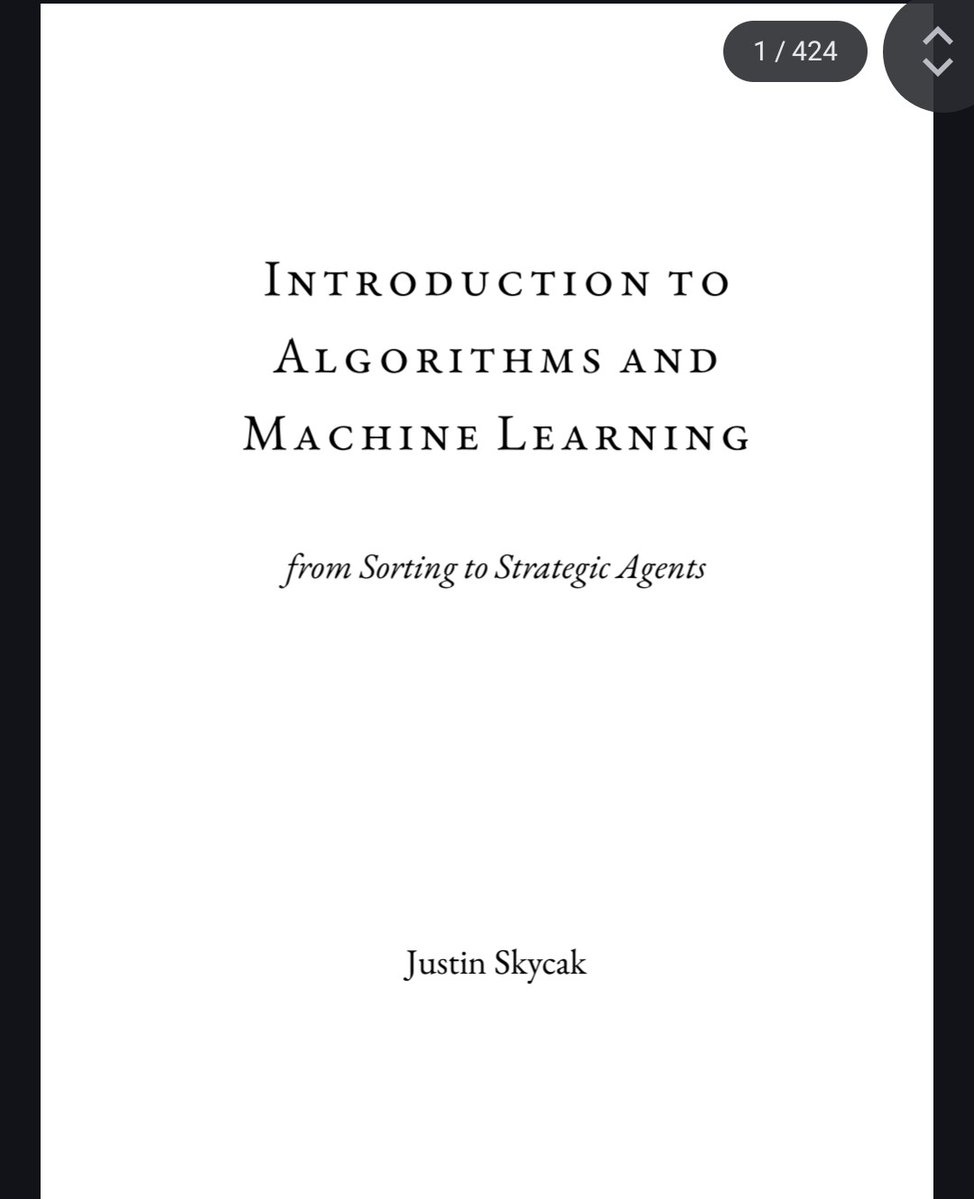
This is the textbook I wrote to support the most advanced high school math/CS sequence in the USA.
It's freely available. Link in first reply.
In Math Academy's (former) Eurisko program, which ran from 2020-23, we scaffolded high school students up to doing masters/PhD-level coursework: reproducing academic research papers in artificial intelligence, building everything from scratch in Python.
We currently have all of Eurisko's math prerequisites available on the Math Academy system (which is where Matteo and other Eurisko students learned it).
Eurisko ended in 2023 when I relocated because nobody else in the district had the requisite knowledge to teach it.
But we will eventually have the entire Eurisko curriculum, and more, on the Math Academy system.
A third grader just scored a 5 on AP Calculus BC. The system that trained him contains no LLM. The core is a knowledge graph one man spent 250 hours encoding by hand, two minutes per edge.
The platform is Math Academy. Its "AI" is an expert system that routes each student through nearly 3,000 math topics, from 4th grade arithmetic to the math behind machine learning. Every node, every prerequisite link, every weight was placed manually by a team of mathematicians.
The weights alone took Justin Skycak a full month: 1,500 topics at the time, roughly 5 prerequisite links each, 2 minutes to estimate each one. 8 hours a day of pure encoding, done before ChatGPT existed to ease the load.
Why go through that? Because the graph unlocks mastery learning, the closest thing education research has to a cheat code. In 1984, Benjamin Bloom showed that students with one-on-one tutoring perform two standard deviations above a regular classroom. The average tutored kid beats 98% of the lecture hall.
Nobody could afford a tutor per child, so the finding sat in journals for 40 years. A prerequisite graph with a mastery gate is the workaround. The system always knows the exact next topic a specific kid is ready for, drills it until proven, then moves on. Zero time spent waiting for 29 classmates.
That waiting is most of school. A year of classroom math is roughly 150 hours of instruction, and the majority goes to pacing, review, and re-teaching. Strip it out and a motivated kid covers six grade levels in one calendar year.
The origin makes it better: this grew out of a math program at Pasadena High School where 8th graders were passing AP Calculus BC, back when the founders were still hand-grading the whole thing.
The most effective education AI running today is a graph a few humans built by hand, one edge at a time.
Part of my autistic experience is strategising everyday things that many people do not think (much) about. For example:
- preplanning various conversations
- packing so many ‘just in case’ items before I go somewhere
…
Anthropic just dropped a 33-page blueprint for building effective AI agents. Zero theory, just production architecture patterns used by Claude, Coinbase, Stripe, and Intercom.
Every system follows one cycle: Perceive -> Decide -> Act -> Evaluate -> Repeat.
Here are the 5 core patterns to know:
Single Agent: One model in a loop. Solves 80% of problems, don't over-engineer it.
Sequential: Step-by-step handoffs. Predictable and easy to audit.
Parallel: Tasks split across agents at once, then merged. Built for speed.
Hierarchical: A supervisor agent managing a team of specialists.
Evaluator-Optimizer: A 2-agent loop (generator + critic) refining quality over 2-4 cycles.
The Bottom Line: Multi-agent architectures outperform single models by 90.2% on complex tasks. Just match your complexity to the value.
Read the manual, then check out the "Loop engineering" article below.