A human brain uses 12-20 watts for core thinking while an AI system doing the same processing could use 2.7 billion watts.
This makes organic brains roughly 100–225 million times more energy-efficient than current silicon-based systems for full biological neural computation.
@filpizlo I do something similar when testing my Kit language on non-host platforms. I had the LLM use Vagrant + VirtualBox (or Parallels) to run tests. Very slow on my machine, but it worked.
Just finished watching "The Story of C++" (https://t.co/JizKGp0dj6). It's a fantastic look at the world's most consequential programming language.
In the '90s, I learned C++ in college and used it to build a simple neural network for recognizing bitmap patterns. Later, I used it professionally to build insurance software.
turns out AI models cannot do math.. even grade school math. the kind a 10-year-old solves.
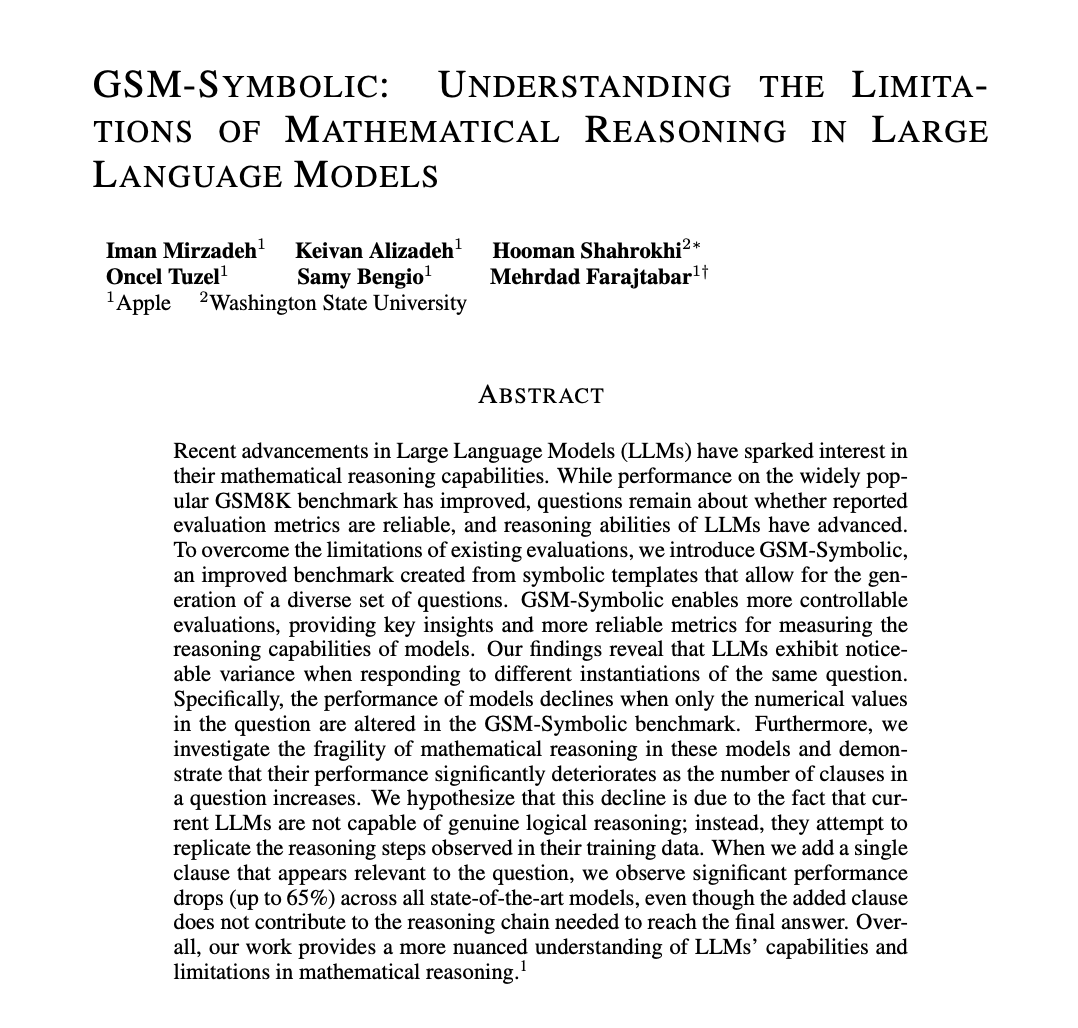
Apple published a devastating study that exposes a massive illusion at the core of artificial intelligence.
they took the standard math benchmark (GSM8K) that every AI company uses to brag about how smart their model is.
first, they just changed the names in the word problems.. the models' performance fluctuated for no reason.
then, they changed the numbers. the performance immediately dropped.
but then they ran the test that broke everything.
they added one single, completely irrelevant sentence to the word problem. something like: "By the way, 5 of the apples were green."
A human 10-year-old ignores the green apples and solves the underlying math.
the AI didn't.
across every state-of-the-art model, performance collapsed by up to 65%.
the AI blindly grabbed the irrelevant number and tried to shove it into the equation. it didn't know why it was doing the math. it just saw a number and assumed it was supposed to use it.
there is no genuine logical reasoning happening under the hood.
we are deploying these systems to run our finances, analyze our legal documents, and make complex strategic decisions.
but the models don't actually understand the logic they are spitting out.
they just know what a smart answer is supposed to look like.
If we confuse generative AI’s ability to produce text with consciousness, we risk assigning moral responsibility to chatbots—and not to their makers, Ted Chiang argues. https://t.co/Cptx3aWppI
Elixir v1.20 released! Now officially a gradually typed language: Elixir type checks every single line of code, finding bugs and dead code, without developer overhead (no typing signatures) and extremely low false positives rate. Plus a faster compiler! Links and reports below.
Kit 2026.5.31 is a focused compiler, type-checker, FFI, and tooling release. It keeps Unit-parameter callees and release-list temporaries alive, improves type annotation handling, adds a warning for unknown annotation type names…
https://t.co/8w4IoIdW6H
Kit 2026.5.30 is a focused correctness and tooling release. It improves FFI linking for prebuilt package wrappers, clears several code generation lowering issues, sharpens non-exhaustive match diagnostics, makes global runtime context initialization…
https://t.co/srg8RlxhFr
Kit 2026.5.29 is a focused compiler and codegen correctness release. It clears a batch of code generation regressions across the native and lazy runtime backends, tightens constructor lowering…
https://t.co/lCJd7kTDIf
Kit 2026.5.23 is a diagnostics, performance, and capability-hardening release. It adds the build info report, expands backend and frontend timing details, improves wide terminal layouts, and makes cache reuse status easier to see during builds. https://t.co/MKgw1tMn9f