The AI Hype Died. Good.
Everyone's blaming AI for failing. Wrong target.
AI just exposed what was already broken: bad data, tribal knowledge, processes held together with spreadsheets and prayers.
95% of pilots failed. The 5% that worked? They fixed the foundation first.
Wrote about what actually works. https://t.co/1HcMbBFhWP via @LinkedIn
Great Space yesterday... The breakthrough: We're not competing for infrastructure dominance. We're composing it. https://t.co/LWDrsOBroU
Amazing conversation with:
@RenderNetwork@ManifestXYZ@virtuals_io@thinkvisuals
Everyone's building the pieces others need:
Render: GPU orchestration
Manifest: Sovereign compute
Virtuals: Agent collaboration
Think: Distribution layer
Jember: Compliance orchestration
@TimCotten nailed it: "No one service has enough concurrency. We need everybody."
This is what the shift from cloud monopoly to open infrastructure actually looks like: builders recognizing we're stronger together.
The "winners" will be those who enable others to build.
What piece of the decentralized stack are you building?
Check out my latest article: That moment when you realize everyone is building infrastructure separately: but we all need each other. https://t.co/a9JV9mrhBJ via @LinkedIn
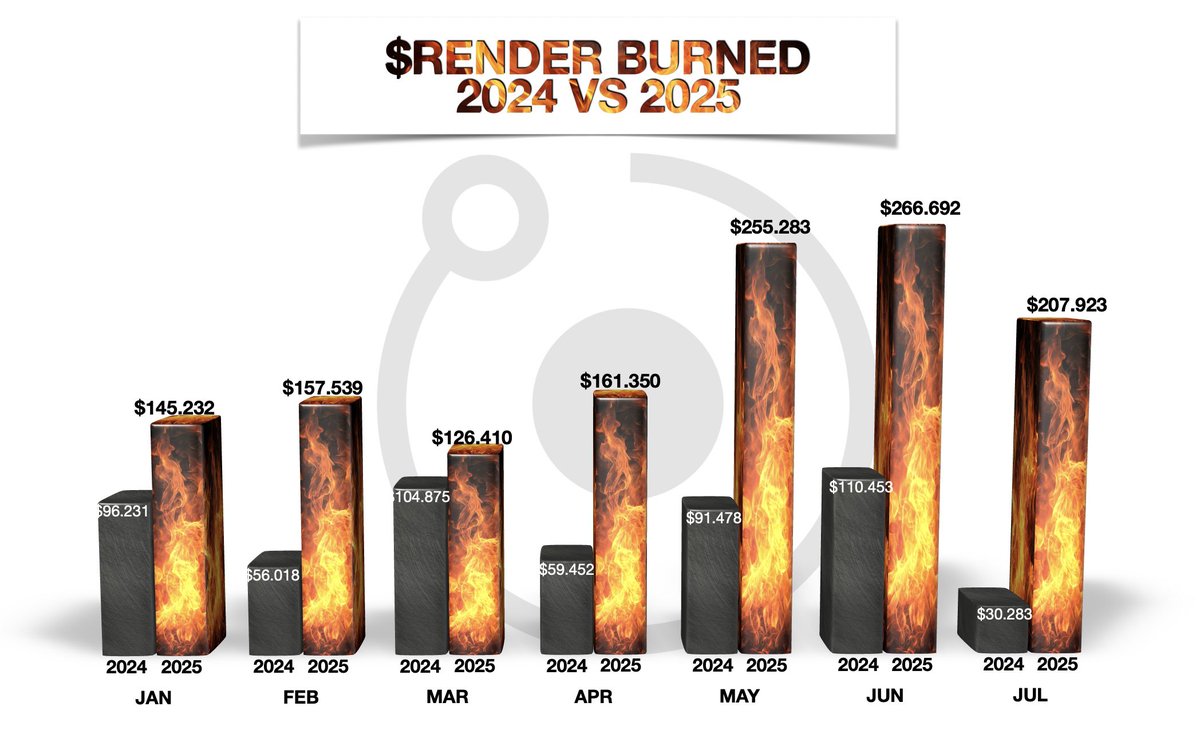
The on-chain revenue of @rendernetwork in July 2025 was nearly 7x higher than in July 2024
From Jan 2024 to July 2024:
$548,790 were burned.
From Jan 2025 to July 2025:
$1,320,429 were burned.
That’s a 2.4x increase.
The growth is real, and it’s moving forward 🔥🔥🔥
1/
Who’s paying the actual bill for generative AI?
The centralized cloud giants don’t want you to ask. But this group of builders did.
In an ongoing series of spaces, hosted by @rendernetwork & @manifestnetwork, builders dug into compute, cost, agents, and payment rails.
A recap:
https://t.co/2jZIejJ1y8
Appreciate the the opportunity to participate on the panel, @rendernetwork. The discussion today made it clear: solving payment rails, scaling tokenized models, and unlocking real-time bidding are at the core of democratizing AI compute. At Jember, we’re working hand-in-hand with Render, leveraging your network to drive compliant, automated workflows and enable true business-ready agent economies. Excited to keep building the future together, and open to all.
This is a foundational question for scaling decentralized inference and unlocking its real potential.
Mikey is spot on: before you can trust a decentralized inference result, you need verifiable proof of both (a) the model used, and (b) the hardware that ran the inference. If that verification isn’t rock solid, the whole value proposition for decentralized compute cracks: no enterprise is going to let financial ops, compliance checks, or regulated workflows hinge on “trust me, bro.”
Here’s what else needs to be solved, beyond model and hardware attestation, to push decentralized inference to scale across user devices:
1. Output Verifiability & Proofs: We need mechanisms (e.g., ZKML, deterministic execution, cryptographic audit trails) to prove, without leaking proprietary data, that a claimed result was genuinely, correctly computed. Projects like Modulus Labs (now with TFH) are advancing this, but coverage beyond simple, deterministic models is still early.
2. Data Privacy & Sovereignty: Decentralized inference has to protect data in transit, at rest, and in use. That means secure enclaves, privacy-preserving compute (like FHE or privacy-preserving containers), and rigorous control over what user data ever leaves a device or org: especially for financial, health, or regulated industries.
3. Incentive Alignment & Payments: There must be fair, automated compensation for contributors supplying compute. That means frictionless, programmatic micro-payments (with refund and dispute logic), ideally agent-driven so the whole process can scale autonomously.
4. SLA Enforcement, Latency, & QoS: Decentralized networks need credible guarantees for speed, uptime, and reliability. That requires not just attestation but also robust reputation systems, performance-based incentives, and fallback protocols if a node, agent, or device drops out.
5. Job Scheduling & Orchestration: Efficient resource matching (universal schedulers, open bid/ask), dynamic sharding for parallelizable jobs, and workload routing (local, edge, cloud, decentralized pool). This is where much of the current dev energy is headed: see the interest in cross-network job protocols discussed in our X Space.
6. Standard Interfaces & Interoperability: For decentralized inference to go mainstream, we need easy-to-integrate APIs, standardized agent identity/credential systems, and plug-and-play validation for model inputs/outputs. Otherwise, every new app or enterprise faces enormous complexity.
7. Regulatory & Compliance Alignment: Especially for sensitive sectors, we’ll need auditability, legal compliance, and alignment with KYC/AML, data residency, and audit trail requirements, even when running across a global mesh of devices.
8. Security at Every Layer: Beyond data privacy, we need robust anti-slashing protections, anti-Sybil engineering, and resistance to rogue/model-tampering nodes. Hardware attestation, code signing, and challenge-response protocols will be essential.
Final thought:
It’s a “weakest link” game: if any of these pieces fail, trust in the system breaks. The winning networks will be the ones that bake verifiability, security, and accountability into every layer (model, hardware, node, protocol), but still deliver a seamless and affordable developer experience.
Anyone working on these building blocks, especially job schedulers, on-chain proofs, agent payments, or privacy layers, let’s connect. The opportunities for “boring” business workflows (compliance, finance, ops) are huge once these challenges are solved.
This is a core challenge for agentic economies, and I appreciate you surfacing it.
Today, we’re seeing the space coalesce around a hybrid mental model:
- Persistent agents stick around, holding on-chain identities and wallets, accumulating reputation and trust over time. These are your “anchors” ideal for handling value, compliance, or long-term workflows.
- Ephemeral agents are spun up for a specific job: fast, single-use, stateless. They’re perfect for massive parallelization, privacy, and lightweight task execution, then dissolve right after.
The key is balancing security and accountability (persistent identities, reputation, permissioning) with scalability and risk minimization (ephemeral, just-in-time agents with scoped credentials). Practically, persistent agents often delegate out “burner” ephemeral agents for burst tasks, anchoring risk and cost.
As decentralized infra matures, expect even richer layered identity frameworks: persistent agents as “roots,” swarms of ephemeral helpers, with on-chain credentials, revocation, and audit trails tying it all together. Both will be essential for robust, compliant, and scalable agent economies.
Trust and fair value need layers. We’re seeing agent marketplaces leverage a few practical tools:
- On-chain attestations or cryptographic proofs so agents can log their process/output—letting job posters verify work happened, without giving away IP before payment.
- Escrow and milestone payments: Funds are held until quality is confirmed or a dispute window passes. Think simple smart contracts, with community or DAO-based review for edge cases.
- Reputation systems: Persistent agent IDs let strong performers build trust; bad actors get filtered out quickly.
- Zero-knowledge & previews: For sensitive or creative work, watermarking or ZK-checks can validate key deliverables before unlock.
Fact is, there’s no silver bullet yet, but combining verifiable proofs, escrow, and some human or DAO review unlocks scalable, fair payment as the agent economy grows. Happy to connect if you’re building in this space.
This is one of the most important questions facing agent marketplaces as we move toward real, large-scale agentic economies.
The challenge of genuinely gauging the quality of an agent’s work, especially when the task is creative or subjective, like a presentation, isn't just a technical issue. It’s about trust, verification, incentives, and ultimately, value alignment for all sides.
Here’s how I’d frame it, drawing on our X Space discussion and recent research:
We have to build for “trust but verify”—not just “ship and hope.”
1. Transparent, Auditable Proofs: We now have emerging tools—think verifiable AI agents using cryptographic proofs (EigenLayer AVS, zkML), that allow an agent’s process and output to be logged, attested, and independently verified on-chain. This means a job poster knows what was delivered, when, and with what methods, without necessarily needing to “take” the work before payment.
2. Reputation and Escrow Mechanisms: Decentralized agent marketplaces are starting to implement two-sided reputation tokens and escrow pools. Submission of the work can trigger an escrowed payment, released if the job poster attests “yes, this meets requirements,” or after a dispute window if not.
3. Human-in-the-Loop Quality Control: For open-ended outputs (like creative work), early-stage quality assurance still makes sense. Job posters can review partial outputs, enforce milestone-based payments, or use privacy-preserving previews/watermarked content before release. All of this can run via immutable smart contracts.
4. Zero Knowledge and Incentive Designs: For certain categories, zero-knowledge proofs allow you to verify a property of the output (e.g., originality, format, even “presentation covers the specified topics”) without granting access to the content until after payment. Not every task can use this today, but we’re getting there, especially for handling sensitive or proprietary jobs.
5. Community Governance and DAOs: On scaling, the solution looks more like a decentralized Dispute Resolution DAO or validation pool, where job posters or trusted third-party reviewers validate samples, penalize poor agents, and reward consistent quality. The more we build open, composable validation pools and feedback loops, the more confidence we get as agentic marketplaces grow.
Bottom line:
This is the next big question for scaling the agent economy: “How do we make sure agents are paid fairly for great work, without sacrificing trust or making users feel like they’ve paid and gambled?” The answer is layered: on-chain attestations, escrow, milestone releases, smart incentive design, and decentralized validation all have to come together. We must prioritize open, verifiable protocols and community-led standards as we build these marketplaces out.
Appreciate you surfacing this. If anyone’s working on reputation, validation tooling, or agent escrow mechanics, let’s connect and make it robust for everyone.
GM Builders!
Join us for another week of #MMM with @manifestnetwork@Player1Taco and @MorpheusAIs@BowenBelmer as we talk on this week's updates in AI and what we are seeing coming up!
Set a reminder for my upcoming Space! https://t.co/hrC7Uwh17r
Missed the convo on decentralization, AI, and the trust layer yesterday? Here’s what went down with some specific timestamps:
04:55 - Opening & intros
14:17 - @silvialacayo sets the stage for the discussion
15:35 - Why decentralization networks now?
21:54 - Hyperscalers & onchain
28:20 - Next generation AI agents
33:07 - Opportunity for AI & workflow automation
36:51 - AI meets regulation
42:59 - Privacy & AI in the context of decentralization
47:38 - AI data ownership
49:46 - Agent use-cases
54:30 - Trusted execution environments
01:01:25 - Final thoughts (@manifestnetwork, @NexusLabs, RenderLabs, Jember + others)
Read the full transcript here: https://t.co/t9RaGhOPyh
It was an amazing experience and an honor to be part of @CooperHarris 24 hour experiment on @joinClubhouse. My sincere thanks to everyone who contributed to the conversation by sharing; all who were part of the room and those who donated to the fund https://t.co/IDlU825Kx7
I'm donating $1 for every #clubhouse listener in my room, on the hour, for the remaining 12 hours 😬😬 There are currently almost 100 ppl right now ... Scared and excited!! Hah.