.@colinmckerrache:
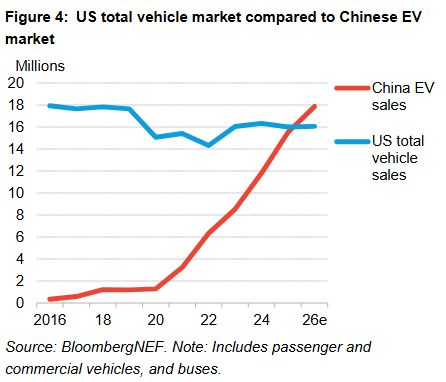
"This is still probably the wildest chart from our Electric Vehicle Outlook this year:
By Q4, China's EV sales will overtake total US vehicle sales of all types (gasoline, hybrid, battery electric combined).
Chart excludes low-speed models and 2/3-wheelers"
[BLOG✍️] Lee el artículo 'Déjà vu eléctrico y paridad de costes' publicado en nuestro blog por Oier Bolibar Mendizabal, CEO y Fundador de Plugeen Mobility Services.
¿Te ha parecido interesante? 🤔
🔗 https://t.co/gZHePGESXN
[BLOGA✍️] Irakurri ezazu Oier Bolibar Mendizabal Plugeen Mobility Serviceseko CEO eta Fundatzaileak gure blogean argitaratutako ‘Déjà vu elektrikoa eta koste parekotasuna’ artikulua.
Interesgarria iruditu al zaizu? 🤔
🔗 https://t.co/Nb1sgJPkS4
PSA: A "4 hour" battery is not "a battery that only lasts for 4 hours"
4 hours is the minimum time to fully discharge a 4 hour battery.
For a given amount of energy stored (MWh, kWh, Joules, etc.), longer duration batteries are cheaper.
A 2 hour, 4 MWh battery requires a 2 MW inverter and busbars, cooling, etc. capable of handling 2 MW.
An 8 hour, 4 MWh battery only needs a 0.5 MW inverter. It uses less copper, has lower cooling requirements, and costs less per MWh.
Some costs, like inverter capacity, scale with power (MW). Others costs, like active cell material, scale with energy (MWh).
Even the cells themselves get cheaper for longer durations. A 4C cell (15 min) has to be able to handle high discharge currents. That requires bigger current collectors and limits form factors.
Cells designed for longer durations (0.5C, 0.25C) can have thinner current collectors, less packaging, separators, etc. for a given amount of active material.
Batteries have historically been designed for mobile or EV applications where rapid charging and high power are prioritized. For grid storage, cost per unit of energy and longevity are more important.
Cells can be larger, they can use less copper and aluminum, integration is cheaper, more durable chemistries can be used, almost everything gets cheaper with lower C rates.
Grid batteries are going to get a lot cheaper as people design and manufacture batteries fit for purpose.
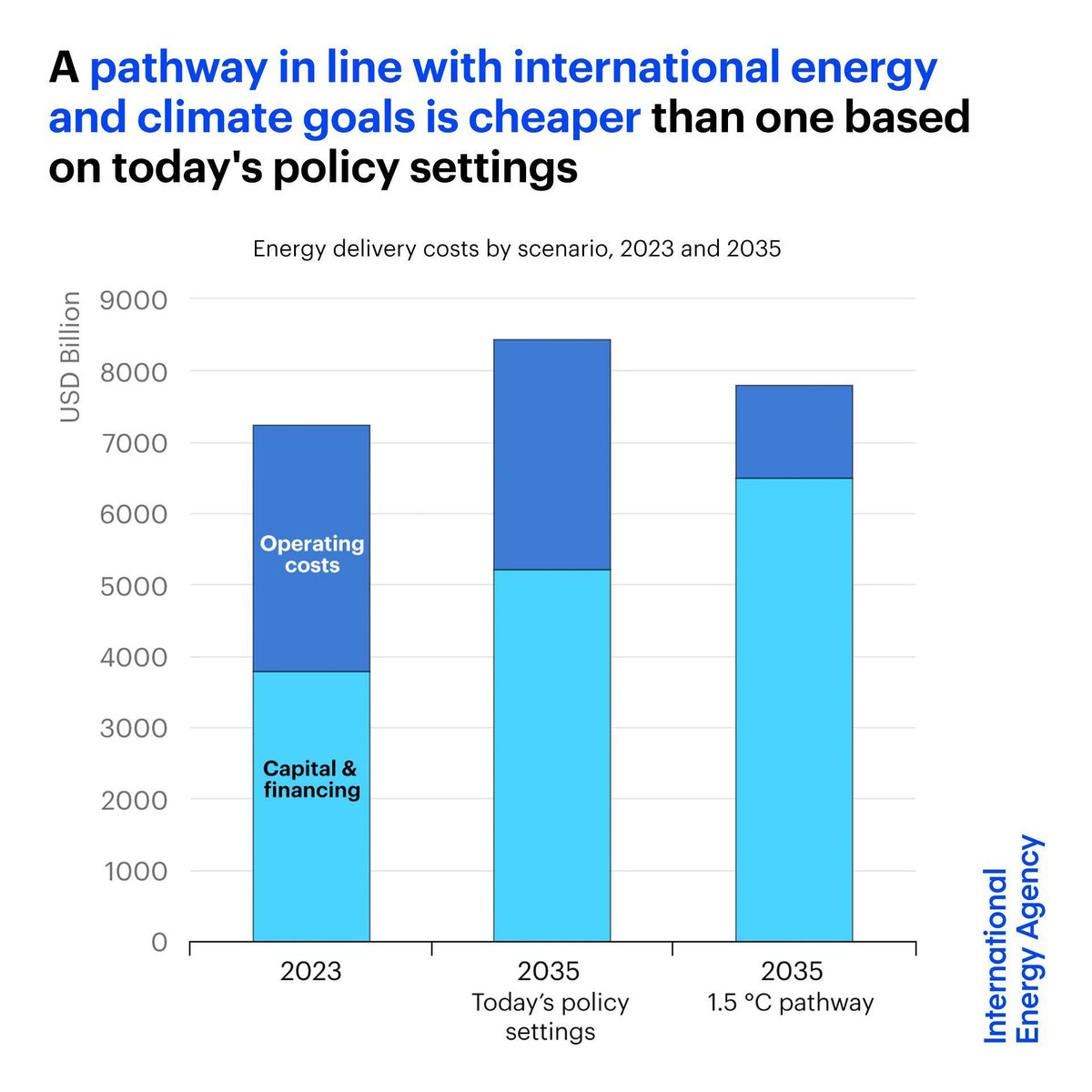
The transition to net zero emissions would mean lower energy costs globally than if the world continues on its current path.
Our report shows scaling up clean technologies is key for affordability, as well as efforts to cut emissions
Read more → https://t.co/FGEpxiFouq
@guardian@BusinessGreen According to the UN, fossil fuel companies are running a massive misinformation campaign to make countries slow down their renewables roll-out and clean energy transition (4/4)
via @guardian
https://t.co/b6mKVNswa1
Let's talk total impact: Over their lifetime, EVs have a fraction of the emissions of petrol cars—even on Europe's varied energy grids.
As we clean up our energy, the gap widens. It's not just the road ahead, it's the air above! 🌍
#EVrevolution#SustainableFuture#Climate#EVs
Batteries are often described as resource-intensive. With a 95% proven recycling rate and a 10yr life, over 50% of battery minerals mined today will still be in use in *130 years*. Add 5% performance improvement per cycle, and they will be delivering services *forever*. Boom! 1/2
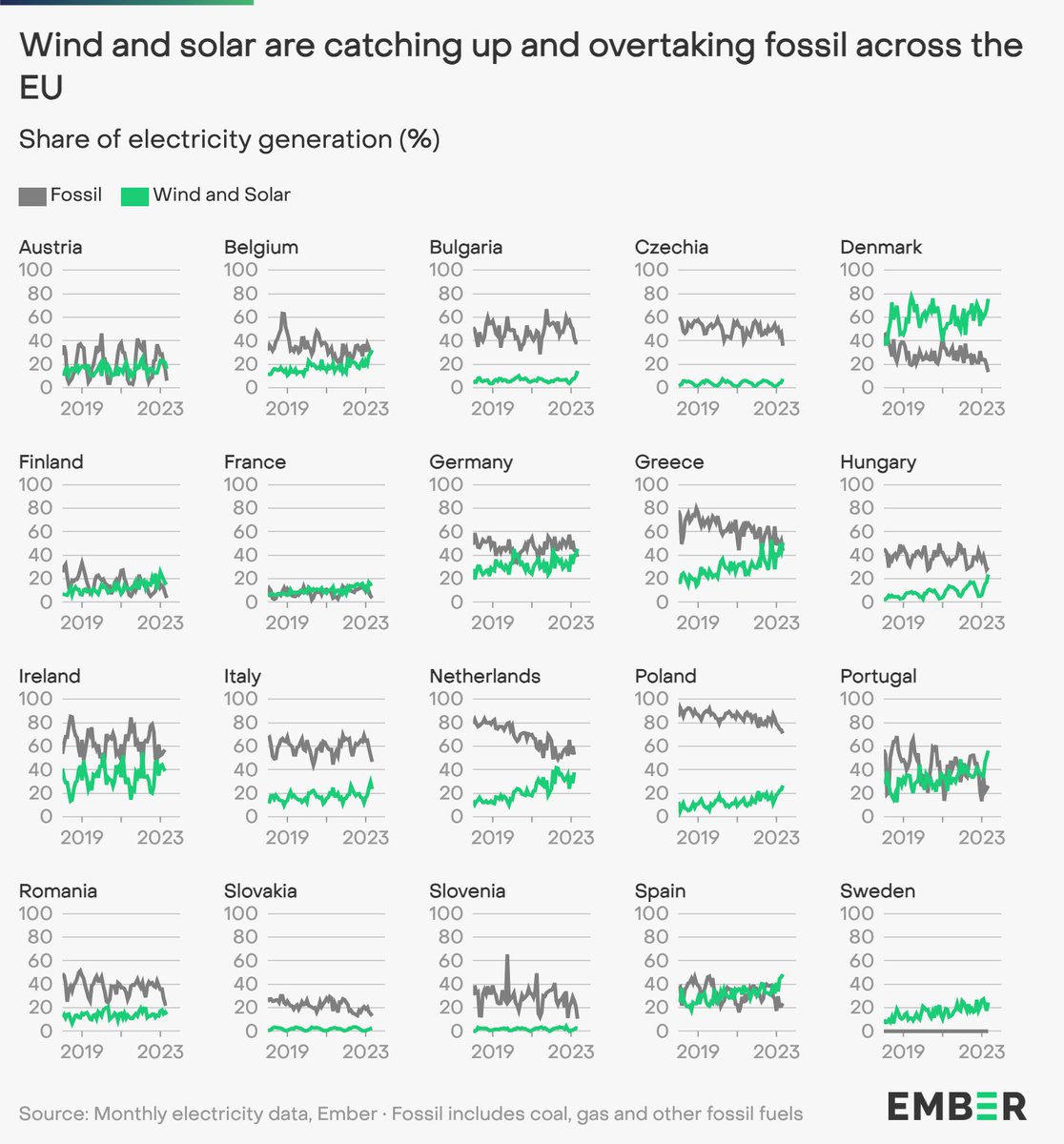
@pvmagazine 1. To opinions! Solar is the cheapest source of bulk electricity in many countries, and the quickest to deploy, and now you couldn't stop it being built if you wanted to.
The limits to PV build in most places are grid access, permitting, and sometimes installation labour.
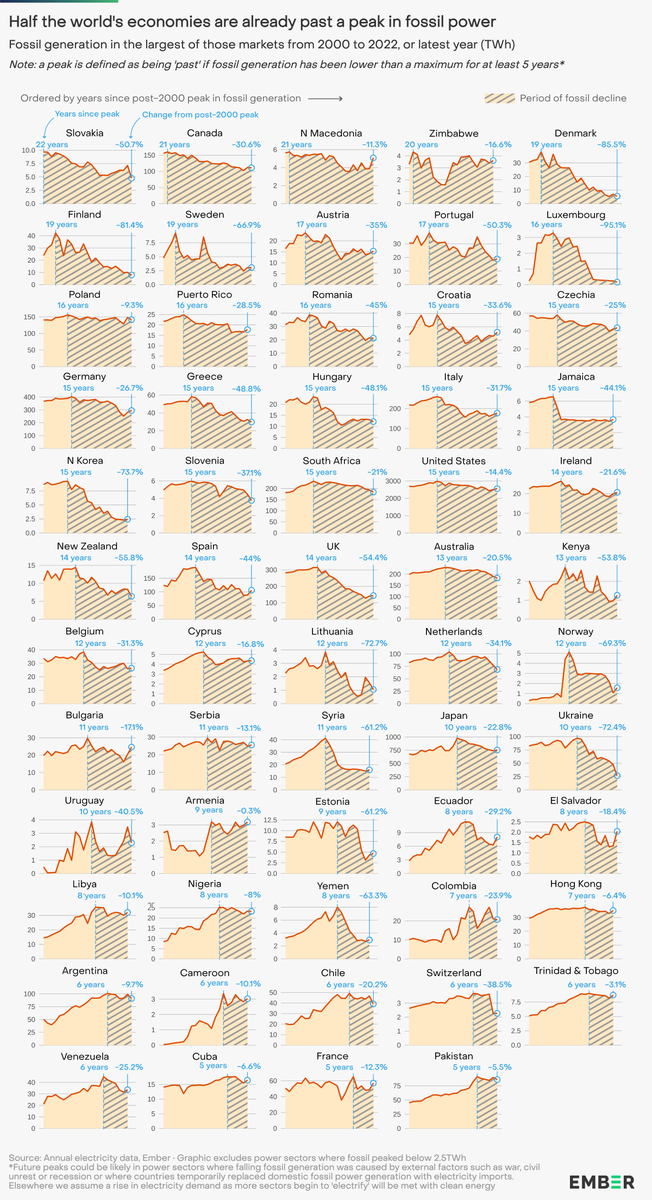
BREAKING | Half the world’s economies are past a peak in fossil power
New analysis by Ember finds that 107 economies are already at least five years past a peak in electricity generation from fossil fuels.
https://t.co/NPrGY6PzKN
Electric vehicles of all types are displacing 1.5 million barrels per day of oil usage. That’s nearly 3% of total road fuel demand.
Discover more in BloombergNEF’s Electric Vehicle Outlook 2023. https://t.co/pdmCkX5Avs
A més d'un li explotarà el cap si llegeix això. Si, els panells fotovoltaics es reciclen. Ja hi ha empreses que ho fan, i més que n'hi haurà en els propers anys. El mateix amb les bateries. https://t.co/oocpVbtE8e
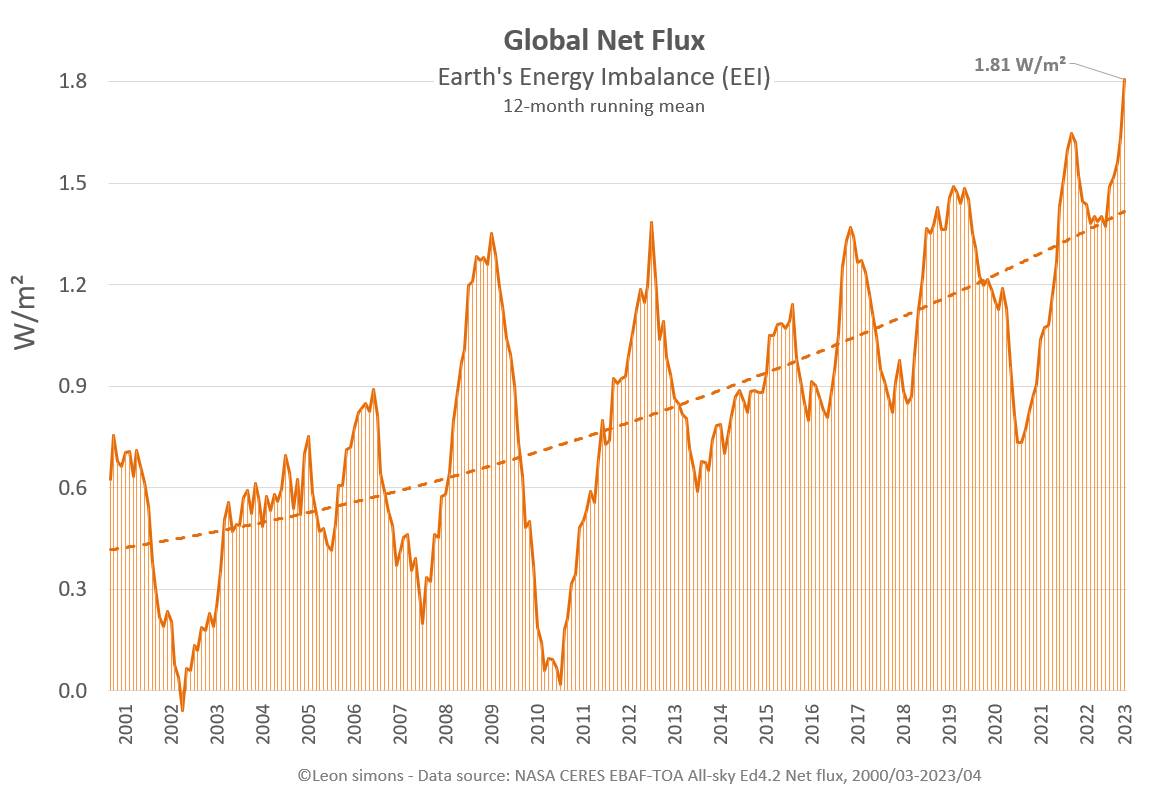
🔥📈BREAKING @NASA 📈🔥
The Earth Energy Imbalance from NASA satellite data broke through 1.8 W/m² (12-month mean)!
This is faster than I expeced.
More than many experts thought possible.
I called this the most important graph in the world.
A lot more heat is accumulating!


![FagorTaldea's tweet photo. [BLOG✍️] Lee el artículo 'Déjà vu eléctrico y paridad de costes' publicado en nuestro blog por Oier Bolibar Mendizabal, CEO y Fundador de Plugeen Mobility Services.
¿Te ha parecido interesante? 🤔
🔗 https://t.co/gZHePGESXN https://t.co/TTRDFlRjyd](https://pbs.twimg.com/media/GiSAiM7WIAAj4Z0.jpg)
![FagorTaldea's tweet photo. [BLOGA✍️] Irakurri ezazu Oier Bolibar Mendizabal Plugeen Mobility Serviceseko CEO eta Fundatzaileak gure blogean argitaratutako ‘Déjà vu elektrikoa eta koste parekotasuna’ artikulua.
Interesgarria iruditu al zaizu? 🤔
🔗 https://t.co/Nb1sgJPkS4 https://t.co/QA4iC9kyrm](https://pbs.twimg.com/media/GiR_QC6XAAAB5SO.png)