Dear researchers and PhD students! Which tools do you recommend for creating quality figures with high vector graphics in research papers? Thank you in advance! 🙌
#ResearchTools#PhDLife#phdvoice#AcademicTwitter
A man can be the head of his home and still listen to his wife. Leadership is not dictatorship.
A woman can be successful, independent and still submit to her husband. Those things are not opposites.
Wisdom and humility should be a constant in your home.
The Nigerian dad who insists his daughter finish medical school before marriage is not being controlling.
He watched his sister become a housewife with unfinished MBBS papers in 1987.
Some overreactions come from real memory. Ask before judging.
Today, we celebrate the American Worker — The GREATEST in the World! 🇺🇸
“For 250 years, their skill and hard work have built the greatest nation and most powerful economy on earth. To every worker, creator, retiree, and union member — thank you for leading America into its next 250 years.” — @Sonderling47
https://t.co/FEqAbNIuy9
Saddened to learn of the passing of my mentor, Prof. Alexey Glibichuk. A Princeton scholar & unique mathematician, he introduced me additive combinatorics at @mipt_eng@miptru. His letter solidified my PhD admission to the USA. A beautiful mind. RIP Prof. 🕊️ #MIPT#phystech#мфти
SpaceX is actively hiring world-class engineers/physicists for SpaceXAI, even if you have zero prior experience in AI. Smart humans figure it out fast.
Please send an email with ~3 bullet points demonstrating evidence of exceptional ability to [email protected].
Repeat This Daily:
I will remain focused on my goals. Even if I have a moment of difficulty, I will not give up. I know success comes with consistency. I know that I will make it. Things will get better. No problem or challenge will stop me. Everything I deserve is coming my way.
New course: Build agents that respond to users with not only plaintext, but custom UIs like charts, forms, and whiteboards, generated on demand and displayed right in the chat. This short course is built in partnership with @CopilotKit and taught by @ataiiam, co-founder of CopilotKit.
You'll learn three approaches: Your agent can pick from custom components you build, like charts and forms. It can compose new layouts from a set of building blocks you provide, like rows, cards, and text. Or it can incorporate existing third-party apps, like a whiteboard or a calendar, right inside the conversation.
Skills you’ll gain:
- Build agents that render custom components like charts and forms on demand
- Build an app where the agent and user collaborate on shared data, beyond just the chat window
- Place third-party apps like maps, calendars, and whiteboards right in your interface
Join and build agents that give users something to see and act on! https://t.co/lvMy0YdF3z
Naive RAG vs. Agentic RAG, explained visually:
Naive RAG breaks in 3 ways:
↳ It retrieves once and generates once. If the context isn't relevant, the system can't search again.
↳ It treats every query the same. A simple lookup and a multi-hop reasoning task go through the identical retrieve-then-generate path.
↳ And there's no verification. Whatever the retriever returns gets blindly trusted.
Agentic RAG fixes this by introducing decision-making loops at each stage.
Steps 1-2) A query rewriting agent reformulates the raw query. This goes beyond fixing typos. It makes vague terms precise, decomposes complex queries into sub-queries, and expands abbreviations.
Steps 3-5) A routing agent decides if the query even needs external context. If not, retrieval is skipped. If yes, a source selector picks the best backend for this specific query type.
Steps 6-7) The source selector routes to the most appropriate source. Vector DB for semantic search, web search for real-time info, or structured APIs for tabular data. The retrieved context and rewritten query are combined into the prompt.
Steps 8-9) The LLM generates an initial response.
Steps 10-12) A validation agent (Corrective RAG) checks whether the response is relevant, grounded, and complete. If it passes, it's returned. If not, the system loops back to Step 1 with a reformulated query.
This continues for some iterations until we get a satisfactory response or the system admits it cannot answer.
The reason it works is that each agent acts as a quality gate. The rewriter ensures retrieval precision. The router ensures the right source is queried. The validator ensures the output is grounded.
Individual failures get caught and corrected rather than silently propagated.
That said, the diagram below shows one of many blueprints of an Agentic RAG system. Production systems increasingly combine Corrective RAG, Adaptive RAG, Self-RAG, and hybrid search (vector + lexical with reranking) based on latency budgets and accuracy requirements.
👉 Over to you: What does your Agentic RAG setup look like?
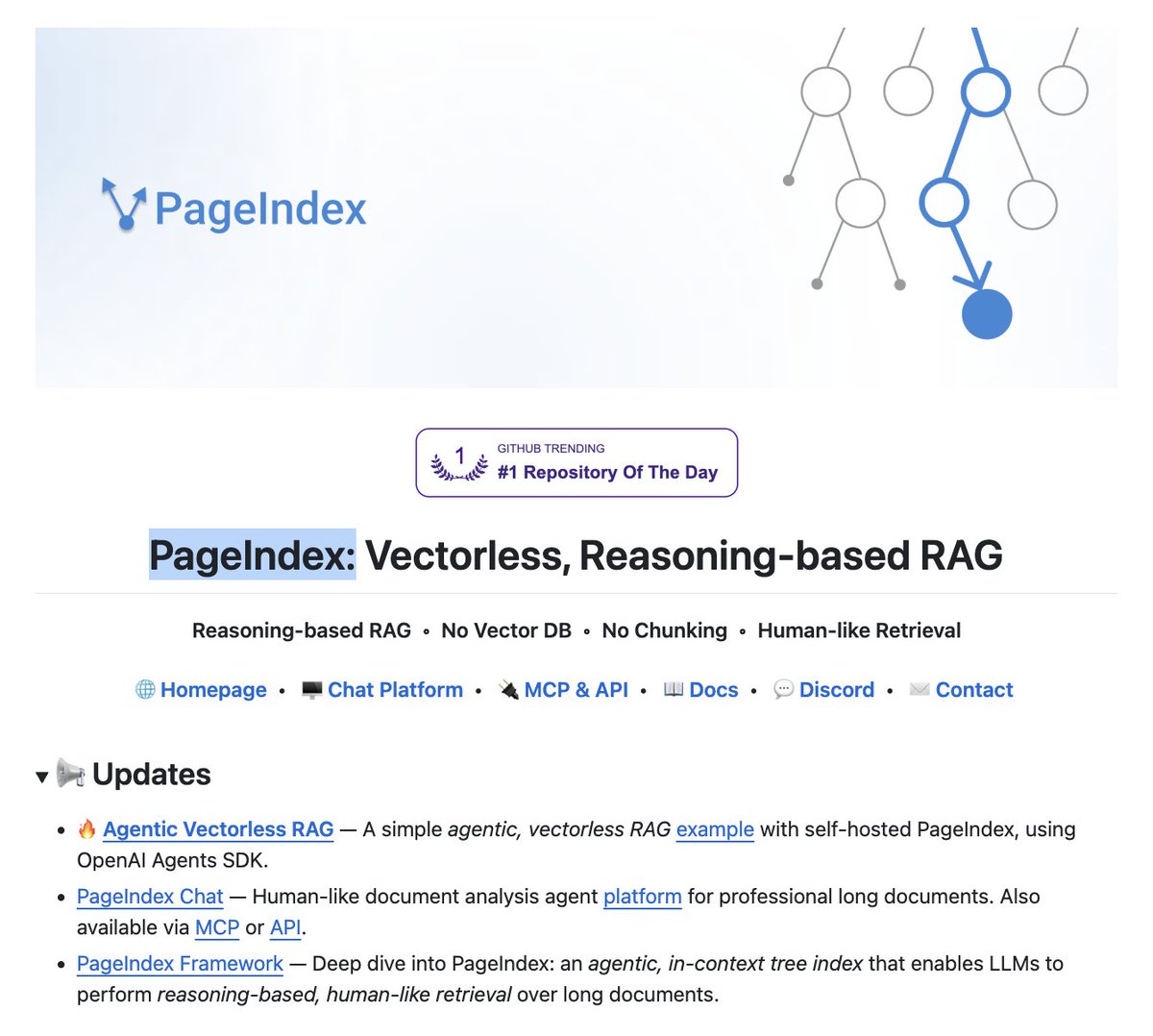
The entire RAG industry is about to get cooked.
Researchers have built a new RAG approach that:
- does not need a vector DB.
- does not embed data.
- involves no chunking.
- performs no similarity search.
It's called PageIndex. Instead of chunking your docs and stuffing them into pinecone, it builds a tree index and lets the LLM reason through it like a human reading a book.
hit 98.7% on financebench. beats every vector RAG on the leaderboard.
no embeddings. no chunking. no vector DB.
100% open source.
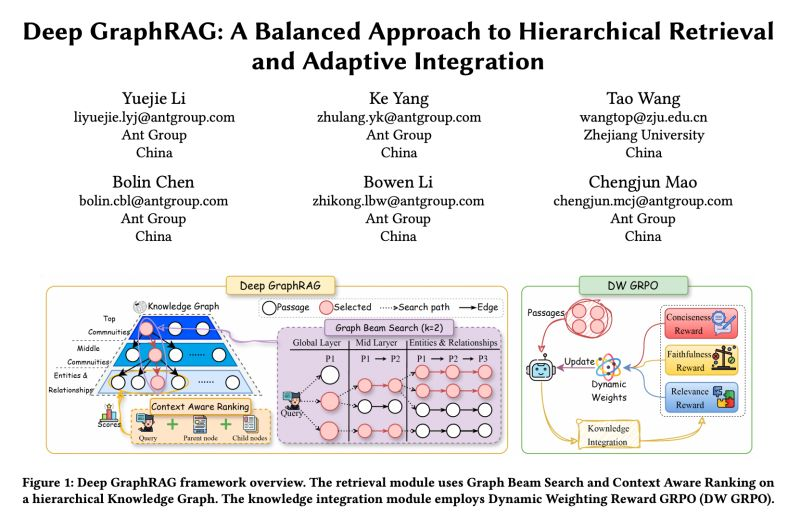
Deep GraphRAG: Hierarchical Graph Retrieval with Adaptive Re-ranking
RAG systems have a fundamental problem. Search broadly and you lose the detail. Search locally and you miss the bigger picture.
Most graph-based RAG approaches pick one and hope for the best. Researchers from Ant Group and Zhejiang University built Deep GraphRAG to stop making that trade-off.
The core idea: use a 3-level hierarchy to navigate a knowledge graph from the big picture down to the specific detail, with smart filtering at every stage, not just at the end.
The payoff is significant. On multi-hop reasoning tasks - the kind where you need to connect facts across multiple sources - it hits 45.44% exact match accuracy. That's vs 38.75% for the previous best and just 10% for standard local search. And it runs 86% faster than comparable recursive methods.
A compact 1.5B parameter model reaches 94% of what a 72B model achieves. Smaller, faster, more accurate.
The system builds a knowledge graph from text chunks, clusters entities into a 3-level community hierarchy using the Louvain algorithm, then retrieves top-down using beam search with pruning and re-ranking at each level.
The training uses Dynamic Weighting Reward GRPO (DW-GRPO) to avoid the common failure mode where reinforcement learning over-optimizes one metric at the expense of relevance, faithfulness, and conciseness.
The hierarchy does the heavy lifting. No trade-off required.
https://t.co/VhsMTjfDPP
#GraphRAG #RetrievalAugmentedGeneration #GraphAI #LLM #EmergingTech #Research
--
💬 ‘Well done! A useful, eclectic update’ - David Watson, IT Consultant.
Join readers from Amazon, Capgemini, Michelin, Neo4j & more
Subscribe to the Year of the Graph newsletter for quarterly updates and insights on all things #KnowledgeGraph, #GraphDB, Graph #Analytics / #DataScience / #AI and #SemTech 👇
https://t.co/7pg6gqWYvw