@SearchlightInst@plathiandc We all benefit when kids don’t go hungry. Better grades, less stress on family budgets, and we get to forgo much of the paperwork and admin burden of the current system. An efficient and reasonable proposal and great paper from @plathiandc
Yes- we have *got* to stop inventing weird tax workarounds that will just have to be fixed decades down the line. Slapping on a tax or exemption and assuming that will fix things is not good policy
There is no way out but through.
A lot of the slopulist trends we've seen over the past few years, fromthe Neobrandesian obsession with regulatory actions and lawsuits to "no tax on XYZ" mania, are attempts to avoid the reality that to do big things we are going to have to raise a LOT of revenue.
My suggestion is that instead of trying to invent weird workarounds, we embrace the challenge of figuring out what our biggest priorities, then writing highly ambitious legislation to achieve them while raising a ton of revenue to pay for them.
Which, by the way, is why we need a supermajority.
In his guest essay for the NYT today, @AJentleson makes the case for Democrats to look beyond narrow majorities, embrace heterodoxy, and build a lasting coalition that can not only pass bold legislation but fix broken institutions and restore faith in our democracy.
Important point in @SearchlightInst new piece pushing back on AI token taxes is that token taxes …. wouldn’t make the actual AI developers pay their fair share.
No need to reinvent the wheel, just close loopholes and tax billionaires + AI corporations at a fair level!
Some people think AI token taxes are the solution. Unfortunately, everything is not as simple as it seems. In my first post for @SearchlightInst: a token tax won’t cure all ills https://t.co/f7vGwllMU3
And they were only applied to non-USMCA qualifying goods. All within the same 24 hours as admitting the aluminum tariffs haven’t given a meaningful boost to domestic production. Oh boy.
It’s logical that Canadian imports would fall when a) prices on US-built cars are driven up by tariffs on inputs and b) there is too much uncertainty to do business in general. Tariffs on inputs into the US and the ping-pong tariffs hurt American businesses & trade too.
Not to mention that the aforementioned tariffs and quotas were in reaction to the last year of US tariff nonsense, so Canada didn’t need to retaliate against anyone else. Both input prices and retaliation are a direct result of the admin’s actions.
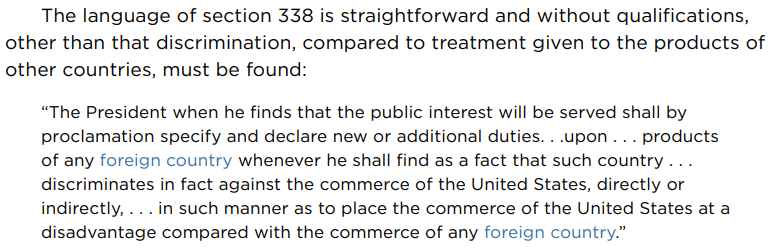
⁉️What is Section 338 of the Tariff Act of 1930, the newest tariff authority the Trump administration is using to impose 50% tariffs on Canada?
➡️Section 338 has not been invoked in 100 years & requires strong proof of discrimination against American goods.
➡️It was designed as a retaliatory tool specifically to counter discrimination against US trade by other countries...
...such as when an importing country treated US products less favorably than the products of other countries.
💡Section 338 can only be used in circumstances where a trading partner provides differential treatment for US goods that is detrimental to the US product & grants more favorable treatment to other countries.
🇨🇦The Trump administration claims Canada discriminates against American exports of cars, alcohol, & dairy.
🍻Note that for alcohol, it is most Canadian provinces & territories, not the federal government, that have halted the purchase, distribution, or retailing of US alcoholic beverages.
🐄In past USMCA negotiations, the Trump administration secured tariff-rate quotas (TRQs) for 14 Canadian dairy products, which allow a specified amount of a dairy product to be imported at a lower tariff rate, while imposing a higher tariff on imports beyond that threshold.
🥛The US enjoys an average annual trade surplus in dairy products with Canada of around $600 million since 2021.
🟢Even products covered by the USMCA could be subject to the Section 338 tariffs.
🔴But Canadian energy products, potash, fish, critical minerals, & some other products are exempted from the Section 338 tariffs.
🗓️The tariffs on Canada are set to take effect on August 19.
⚖️Courts would be rightly skeptical of a sudden finding of massive discrimination that warrants anything like reimposition of Trump’s “reciprocal” tariffs.
Finally found the time to read this paper in its entirety- both insightful as a researcher and (as someone who will be on the job market soon) gives me some very interesting food for thought. This is a common topic of discussion in my classes, and was a wonderful read!
Exploring past episodes of technological disruption in the US labor market, with the goal of learning lessons about the likely future impact of AI, from @ProfDavidDeming, Christopher Ong, and @LHSummers https://t.co/BJwBYQrqzL