RAG and long context are usually treated as rival approaches, but both pick the evidence that matters, just at different scales.
What if one LLM did both?
UNREAL: one frozen LLM retrieves from a 3B-token corpus and filters its own 128K prompt.
https://t.co/JPcMDI6S9Z
💡 Takeaway: evidence-sparse long-context tasks and retrieval are one problem at different scales, and a single model can solve both.
Bigger context windows aren't enough. Models should be trained to recall.
Excited to share our new arXiv preprint:
"Retrieval from Within: An Intrinsic Capability of Attention-Based Models"
We introduce INTRA, a framework where attention-based models retrieve from their own internal representations.
https://t.co/vcuK6GZGOU
1/5 🧵
@Gilad_Manifold יש בישראל חוקרים מצוינים ומחקר איכותי מאוד גם בתעשייה, פשוט עיקר תשומת הלב מופנית לרוב לסטארטאפים ומוצרים.
לדוגמא, כמה עבודות שהצוות שלי באנבידיה הוציא בחודשים האחרונים ומתמקדות באתגרים מחקריים רחבים:
https://t.co/vcuK6GZGOU
https://t.co/KLQOPp4hwD
https://t.co/1VdHNyBVNa
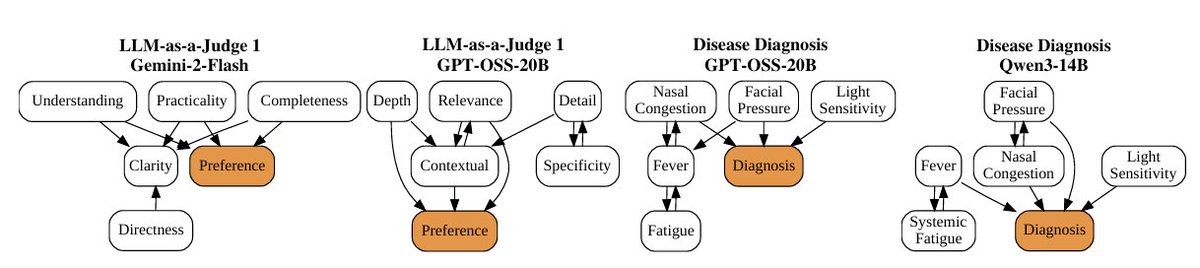
Thrilled to share our new paper: "LLM Explainability with Counterfactual Chains and Causal Graphs"! 🚀
We introduce a fully automated, model-driven method to extract global, concept-level causal graphs of an LLM's internal reasoning.
📄 https://t.co/dX6Xsz2hNf 🧵👇 [1/8]
@lateinteraction Thanks! Using MaxSim directly on the attention inputs worked incredibly well for us. It translates token-level scores into the chunk-level scores we can use to retrieve context.
https://t.co/R8EmxsJXwY
Excited to share our new arXiv preprint:
"Retrieval from Within: An Intrinsic Capability of Attention-Based Models"
We introduce INTRA, a framework where attention-based models retrieve from their own internal representations.
https://t.co/vcuK6GZGOU
1/5 🧵
Huge thanks to my wonderful co-authors at Nvidia: Yochai Blau, Edan Kinderman, Ron Banner, Daniel Soudry, and Boris Ginsburg.
Looking forward to feedback, questions, and discussions!
Paper: https://t.co/vcuK6GZGOU
5/5 🧵
Excited to share our new arXiv preprint:
"Retrieval from Within: An Intrinsic Capability of Attention-Based Models"
We introduce INTRA, a framework where attention-based models retrieve from their own internal representations.
https://t.co/vcuK6GZGOU
1/5 🧵
On QA benchmarks, INTRA improves both complete-evidence recall and end-to-end answer quality, especially on multi-hop settings where assembling the right evidence matters.
It also amortizes context encoding by reusing precomputed encoder states.
4/5 🧵
Data Movement Is All You Need: A Case Study on Optimizing Transformers by Andrei Ivanov (ETH Zurich); Nikoli Dryden (ETH Zurich)*; Tal Ben-Nun (ETH Zurich); Shigang Li (ETH Zurich); Torsten Hoefler (ETH Zürich)