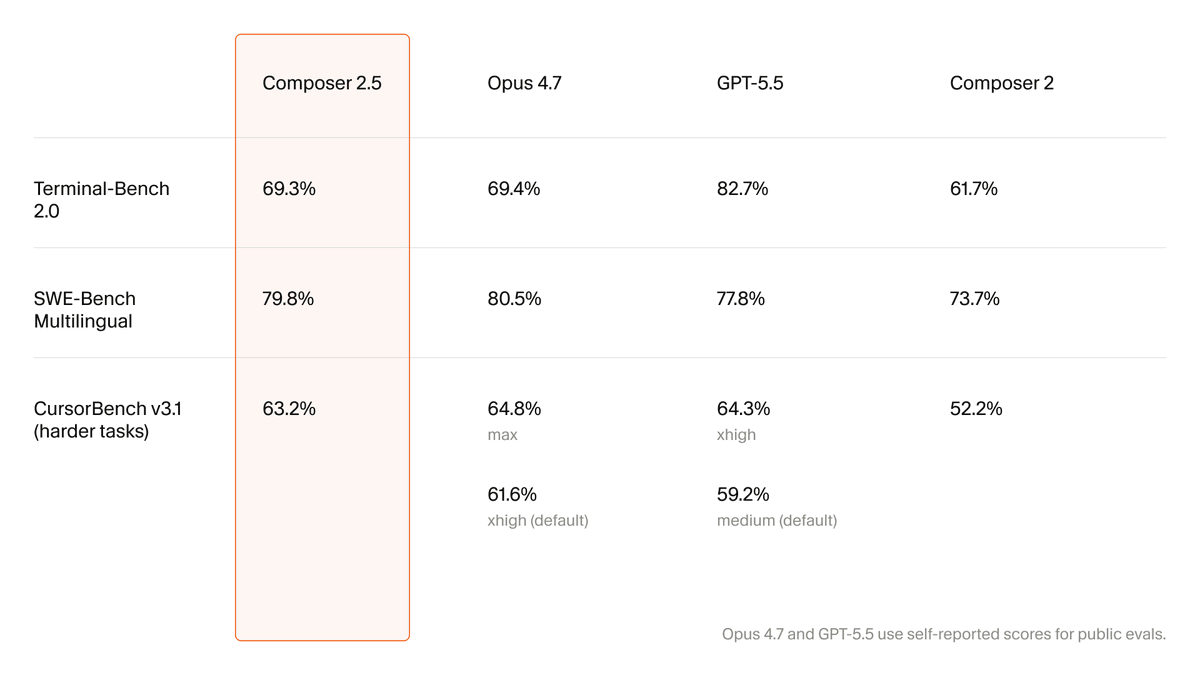
Introducing Composer 2.5, our most powerful model yet.
It's more intelligent, better at sustained work on long-running tasks, and more reliable at following complex instructions.
For the next week, we’re doubling the included usage of the model.
Boom! Scientists Discovered a Hidden Superhighway Inside You That Might Finally Explain Why Acupuncture Actually Works!
How tattooed skin biopsies proved something over 4,000 years old.
Buckle up…research just dropped a bombshell that is rewriting the human anatomy textbook and high fiving ancient healers at the same time!
Deep inside your body lies an enormous, previously overlooked network called the interstitium. It is a vast, fluid filled web that acts like a secret third circulatory system alongside your blood vessels and lymphatics. It is not just empty space between tissues.
It is a dynamic, interconnected superhighway made of collagen bundles suspended in a shimmering hyaluronic acid gel that soaks up water and lets fluids, cells, and molecules flow slowly but surely throughout your entire body, from skin to muscles to organs and back again.
For over a century, scientists saw these spaces as isolated little pockets. But groundbreaking work starting in 2018 by pathologists revealed the jaw dropping truth: it is one giant, continuous network.
When researchers examined tattooed skin biopsies, the ink particles had boldly marched from the skin deep into the fascia below, traveling through the interstitium in ways that made scientists say, That was not supposed to happen!
Here is where it gets truly electrifying.
This hidden highway might finally give Western medicine the biological proof it has been craving for acupuncture and Traditional Chinese Medicine.
For 4000 years, TCM has described chi flowing along 12 specific meridians. Acupuncture needles target precise points along those lines.
Skeptics have long asked for hard science. Now they have it.
Studies, including tracer injections and dye experiments in living volunteers, show that when you inject dye into an acupuncture point, it does not just sit there or race through veins.
It flows exactly along the traditional meridian pathways through the interstitial spaces between muscles, heading straight toward the heart. The dye follows the interstitium like a GPS guided river.
Rebecca Wells, one of the lead scientists, sums it up perfectly:
“I actually do think that the interstitium could be the link between Eastern and Western medicine”.
The implications are massive and mind blowing.
Cancer cells may hitch rides on this network to metastasize.
It could explain autoimmune flare ups where gut particles travel to distant organs.
It might even unlock better treatments for Type 2 diabetes by revealing how interstitial cells influence healthy fat production during weight gain.
This is not just a cool anatomy fact. It is a paradigm shift that could reshape pain management, chronic disease treatment, and how we think about the body as a whole.
Evolutionarily speaking, similar fluid systems appear in ancient creatures going back hundreds of millions of years.
The interstitium is not new. It has been with us since the dawn of multicellular life. We are only now catching up.
This discovery is pure science magic: ancient wisdom validated by cutting edge research, turning what looked like disconnected puzzle pieces into one breathtaking picture of how our bodies really work.
When reading this, be sure to send condolences to the “debunkers” that stole this 4,000 year old empirical science from your health. They were wrong.
Dive into the actual research papers:
The groundbreaking discovery of the interstitium: https://t.co/cqX5kzcVDZ
The study on continuity of interstitial spaces across the body: https://t.co/MeW2ZzPm3z
Research visualizing fluorescent dye migration along acupuncture meridians: https://t.co/C8juE92PA0
Your body just got a whole lot more awesome. The future of medicine is flowing through the interstitium right now, and it is going to be legendary!
Introducing SubQ - a major breakthrough in LLM intelligence.
It is the first model built on a fully sub-quadratic sparse-attention architecture (SSA),
And the first frontier model with a 12 million token context window which is:
- 52x faster than FlashAttention at 1MM tokens
- Less than 5% the cost of Opus
Transformer-based LLMs waste compute by processing every possible relationship between words (standard attention).
Only a small fraction actually matter.
@subquadratic finds and focuses only on the ones that do.
That's nearly 1,000x less compute and a new way for LLMs to scale.
Elon Musk avait dit un truc qui m'avait marqué sur l'allocation de ressources. En substance : passé un certain niveau de richesse, l'argent n'est plus de la consommation, c'est de l'allocation de capital.
Cette phrase change tout.
L'économie, dans le fond, c'est juste un problème d'allocation. Tu as des ressources finies et des usages infinis. Qui décide où va quoi ?
Imagine une cour de récré. 100 enfants, des paquets de cartes Pokémon distribués au hasard. Tu laisses faire. Très vite, un ordre émerge. Les bons joueurs accumulent les cartes rares, les collectionneurs trient, les négociateurs trouvent des deals. Personne n'a planifié. Et pourtant chaque carte finit dans les mains de celui qui en tire le plus de valeur. Le système maximise le bonheur total de la cour. C'est ça, la main invisible.
Maintenant fais entrer la maîtresse. Elle trouve ça injuste. Léo a 50 cartes, Tom en a 3. Elle confisque, redistribue, impose l'égalité. Trois effets immédiats. Les bons joueurs arrêtent de jouer, à quoi bon. Les mauvais n'ont plus de raison de progresser, ils auront leur part. Les échanges s'effondrent. La cour est égale, et morte. Elle a maximisé l'égalité, elle a détruit le bonheur.
Le problème de la maîtresse, c'est qu'elle ne peut pas avoir l'information que la cour avait collectivement. C'est le problème du calcul économique de Mises, formulé en 1920. L'URSS a essayé de le résoudre pendant 70 ans avec le Gosplan. Résultat : pénuries, queues, effondrement. Pas parce que les Soviétiques étaient bêtes, parce que le problème est mathématiquement insoluble en mode centralisé.
Quand Musk a 200 milliards, il ne les consomme pas, il les alloue. SpaceX, Starlink, Neuralink, xAI. Chaque dollar est un pari sur le futur. Et lui a un track record. PayPal, Tesla, SpaceX. Il a démontré qu'il sait identifier des problèmes immenses et y allouer des ressources avec un rendement spectaculaire.
L'État aussi a un track record. Hôpitaux qui s'effondrent, éducation qui décline, dette qui explose, services publics qui se dégradent malgré des budgets en hausse constante. Le marché identifie les bons allocateurs, la politique identifie les bons communicants.
Le profit n'est pas une finalité, c'est un signal. Il dit : tu as alloué des ressources rares vers un usage que les gens valorisent suffisamment pour payer. Plus le profit est gros, plus la création de valeur est grande. Quand Starlink est rentable, ça veut dire que des millions de gens dans des zones rurales ont enfin internet. Quand un ministère est en déficit, ça veut dire qu'il consomme plus qu'il ne produit. L'un crée, l'autre détruit, et on appelle ça redistribution.
Dans nos sociétés il y a deux catégories d'acteurs. Les entrepreneurs et les bureaucrates. L'entrepreneur prend un risque personnel pour identifier un problème, mobiliser des ressources, créer une solution. S'il se trompe il perd. S'il a raison, ses clients gagnent, ses employés gagnent, ses fournisseurs gagnent, l'État collecte des impôts. Il est la cellule de base du progrès humain.
Le bureaucrate ne prend aucun risque personnel. Son salaire est garanti. Au mieux il maintient une rente existante. Au pire il la détruit par excès de réglementation, mauvaise allocation forcée, incitations perverses qui découragent ceux qui produisent. Mais dans aucun cas il ne crée.
Regarde les 50 dernières années. iPhone, internet civil, SpaceX, Tesla, Google, Amazon, Stripe, mRNA, ChatGPT. Toutes des inventions privées, portées par des entrepreneurs, financées par du capital risque. Pas un seul ministère n'a inventé quoi que ce soit qui ait changé ta vie au quotidien.
La France est devenue le laboratoire mondial de la dérive bureaucratique. 57% du PIB en dépenses publiques, record absolu. Une administration tentaculaire, une fiscalité qui pénalise la création de richesse. Résultat : décrochage face aux États-Unis, à l'Allemagne, à la Suisse. Fuite des cerveaux. Désindustrialisation. Dette qui explose.
Et le pire c'est que la mauvaise allocation s'auto-renforce. Plus l'État prélève, moins les entrepreneurs créent. Moins ils créent, moins il y a de base fiscale. Plus l'État s'endette et taxe. Boucle de rétroaction négative parfaite. La maîtresse pense qu'elle aide, et chaque année la cour produit moins.
Dans nos sociétés, ce sont les entrepreneurs, toujours, qui font avancer la civilisation. Les bureaucrates au mieux maintiennent une rente, au pire la détruisent. Aucune société n'a jamais progressé en taxant ses créateurs pour subventionner ses gestionnaires.
La question n'est jamais qui a combien. C'est qui alloue le mieux la prochaine unité de ressource pour maximiser le futur de l'humanité. La réponse depuis 200 ans n'a jamais changé. Ce ne sont pas les fonctionnaires.
🚨 BREAKING: A new role is quietly emerging and it’s about to dominate the next 5 years.
It’s not “AI engineer.”
It’s not “prompt engineer.”
It’s the Agent Operator.
And it will sit inside almost every organization.
Most people are still thinking about AI as a tool.
That framing is already outdated.
What’s actually happening is a shift from:
humans using software to humans managing autonomous agents that execute work
This is a fundamental redesign of how work gets done.
So what is an Agent Operator?
An Agent Operator is the person who:
• Designs how agents interact with real workflows
• Connects tools, data, and systems into agent pipelines
• Translates business problems into executable agent behavior
• Monitors, corrects, and improves agent performance over time
They don’t just “use AI.”
They orchestrate outcomes.
and this matter because
Every function marketing, legal, finance, biotech is becoming “agent-compatible.”
Not because companies want it.
Because they won’t have a choice.
Agents can:
• Run research loops
• Execute multi-step workflows
• Integrate across tools without APIs breaking the flow
• Operate 24/7 at near-zero marginal cost
The bottleneck is no longer capability.
It’s implementation inside real-world systems.
Required skills for AI Agent Operator role:
→ MCPs (Model Context Protocols)
Understanding how agents access tools, memory, and structured context.
→ CLIs (Command Line Interfaces)
Because serious agent workflows won’t live in GUIs—they’ll run in programmable environments.
→ Writing skills (the file kind)
Clear specs, instructions, and structured documents.
Agents run on precision, not vibes.
→ agents dot md fluency
The ability to define agent roles, constraints, memory, and tool usage in persistent formats.
→ Business acumen
Knowing what actually matters:
Where automation creates leverage, not noise.
What happens next
Enterprises will begin to redesign workflows:
Not around employees using dashboards…
But around agents executing tasks.
That means:
• SOPs → Agent playbooks
• Teams → Human + agent hybrids
• Tools → Composable agent systems
When that shift happens, companies won’t just need engineers.
They’ll need operators who understand both the system and the business.
The leverage is asymmetric
One strong Agent Operator can:
• Replace fragmented SaaS workflows
• Multiply team output without adding headcount
• Turn ideas into execution systems in days
This is not incremental productivity.
It’s operational transformation.
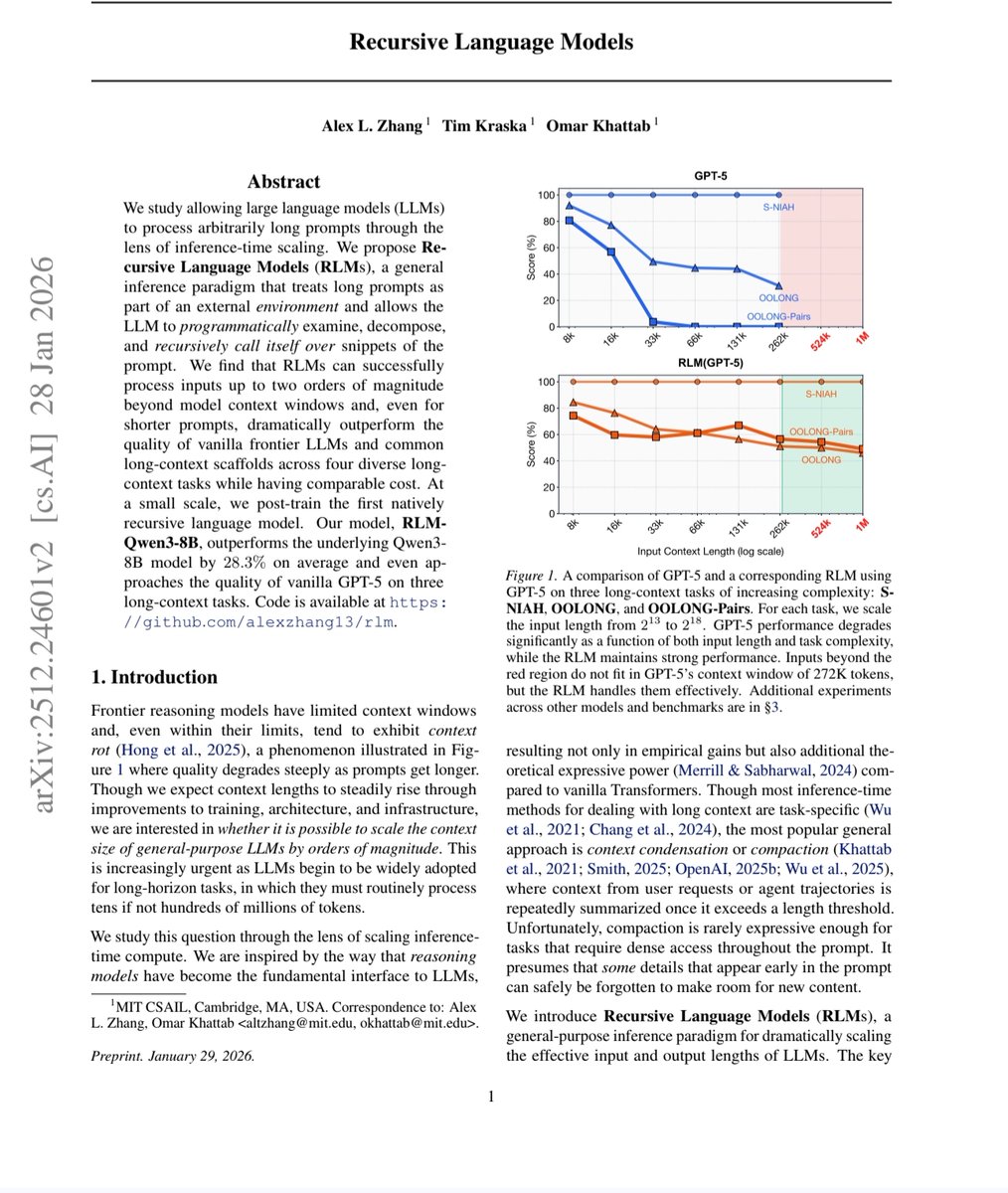
MIT just made every AI company's billion dollar bet look embarrassing.
They solved AI memory. Not by building a bigger brain. By teaching it how to read.
The paper dropped on December 31, 2025. Three MIT CSAIL researchers. One idea so obvious it hurts. And a result that makes five years of context window arms racing look like the wrong war entirely.
Here is the problem nobody solved.
Every AI model on the planet has a hard ceiling. A context window. The maximum amount of text it can hold in working memory at once. Cross that line and something ugly happens — something researchers have a clinical name for.
Context rot.
The more you pack into an AI's context, the worse it performs on everything already inside it. Facts blur. Information buried in the middle vanishes. The model does not become more capable as you feed it more. It becomes more confused. You give it your entire codebase and it forgets what it read three files ago. You hand it a 500-page legal document and it loses the clause from page 12 by the time it reaches page 400.
So the industry built a workaround. RAG. Retrieval Augmented Generation. Chop the document into chunks. Store them in a database. Retrieve the relevant ones when needed.
It was always a compromise dressed up as a solution.
The retriever guesses which chunks matter before the AI has read anything. If it guesses wrong — and it does, constantly — the AI never sees the information it needed. The act of chunking destroys every relationship between distant paragraphs. The full picture gets shredded into fragments that the AI then tries to reassemble blindfolded.
Two bad options. One broken industry. Three MIT researchers and a deadline of December 31st.
Here is what they built.
Stop putting the document in the AI's memory at all.
That is the entire idea. That is the breakthrough. Store the document as a Python variable outside the AI's context window entirely. Tell the AI the variable exists and how big it is. Then get out of the way.
When you ask a question, the AI does not try to remember anything. It behaves like a human expert dropped into a library with a computer. It writes code. It searches the document with regular expressions. It slices to the exact section it needs. It scans the structure. It navigates. It finds precisely what is relevant and pulls only that into its active window.
Then it does something that makes this recursive.
When the AI finds relevant material, it spawns smaller sub-AI instances to read and analyze those sections in parallel. Each one focused. Each one fast. Each one reporting back. The root AI synthesizes everything and produces an answer.
No summarization. No deletion. No information loss. No decay. Every byte of the original document remains intact, accessible, and queryable for as long as you need it.
Now here are the numbers.
Standard frontier models on the hardest long-context reasoning benchmarks: scores near zero. Complete collapse. GPT-5 on a benchmark requiring it to track complex code history beyond 75,000 tokens — could not solve even 10% of problems.
RLMs on the same benchmarks: solved them. Dramatically. Double-digit percentage gains over every alternative approach. Successfully handling inputs up to 10 million tokens — 100 times beyond a model's native context window.
Cost per query: comparable to or cheaper than standard massive context calls.
Read that again. One hundred times the context. Better answers. Same price.
The timeline of the arms race makes this sting harder. GPT-3 in 2020: 4,000 tokens. GPT-4: 32,000. Claude 3: 200,000. Gemini: 1 million. Gemini 2: 2 million. Every generation, every company, billions of dollars spent, all betting on the same assumption.
More context equals better performance.
MIT just proved that assumption was wrong the entire time.
Not slightly wrong. Fundamentally wrong. The entire premise of the last five years of context window research — that the solution to AI memory was a bigger window — was the wrong answer to the wrong question.
The right question was never how much can you force an AI to hold in its head.
It was whether you could teach an AI to know where to look.
A human expert handed a 10,000-page archive does not read all 10,000 pages before answering your question. They navigate. They search. They find the relevant section, read it deeply, and synthesize the answer.
RLMs are the first AI architecture that works the same way.
The code is open source. On GitHub right now. Free. No license fees. No API costs. Drop it in as a replacement for your existing LLM API calls and your application does not even notice the difference — except that it suddenly works on inputs it used to fail on entirely.
Prime Intellect — one of the leading AI research labs in the space — has already called RLMs a major research focus and described what comes next: teaching models to manage their own context through reinforcement learning, enabling agents to solve tasks spanning not hours, but weeks and months.
The context window wars are over.
MIT won them by walking away from the battlefield.
Source: Zhang, Kraska, Khattab · MIT CSAIL · arXiv:2512.24601
Paper: https://t.co/ngovOSNrCQ
GitHub: https://t.co/gT0ootCNoa
Elon Musk just named the single variable that will decide the next hundred years.
It is not compute. It is not capital. It is not the chip.
Musk: “Nothing will make you happier than having kids. We’ve evolved to have that, as all creatures have.”
The consensus says this century belongs to whoever stacks the most GPUs.
Musk is pointing at something the spreadsheets will never quantify.
Look at the West. Birth rates are in freefall. Below replacement. Below recovery.
Not because people stopped wanting families. Because the modern economy turned families into a math problem no one could solve.
Rent took two incomes. Careers swallowed your twenties and thirties whole. Biology became a scheduling conflict you kept postponing until the window closed.
A whole generation traded the continuation of their bloodline for the privilege of staying solvent.
AI is about to shatter that equation permanently.
When machines do the labor, your time stops being currency. The grind that ate your life ends. The moment it does, a question arrives that no algorithm can answer.
If you no longer need to work to survive, what exactly is the point of you?
Musk handed you the answer before the question landed.
When survival is automated, you finally get the runway to do what four billion years of evolution actually built you for.
Now zoom out. America is locked in an existential technology race with China over the future of intelligence itself.
But China is staring down something no supercomputer can fix. The most catastrophic demographic collapse any modern nation has ever seen. A workforce aging off a cliff with no generation underneath to catch it.
You do not win a long war against a country that runs out of people.
The real American moat was never the chip. It was the cradle.
We are racing to build superintelligence that secures the future. But a country without heirs is just a building with the lights still on.
Spend the AI dividend on digital sedation and civilization dies quietly on schedule.
Spend it on being human again and the West becomes physically impossible to replace.
The machines will run the grid. They will route the supply chains. They will win the arms race.
They will never love you back.
We spent a century outsourcing our humanity to the economy.
Artificial intelligence is about to buy it back.
The nation that owns the future will not be the one that builds the most powerful intelligence in history.
It will be the one that builds it and then walks away from the screen to go hold its children.
🧠 Thought experiment:
What if the Iron Age didn't begin in the grand empires of the Near East or Mediterranean... but in the rugged, windswept Altai Mountains?
While the world was still clinging to scarce, expensive bronze, nomadic Scythian-like peoples (Pazyryk culture and kin) in the Altai-Sayan region were mastering iron smelting as early as the 9th–8th centuries BCE. Cheap, abundant iron tools and weapons exploded out from those remote peaks.
Think about the ripple effects:
- Farmers suddenly cleared tougher soils, grew more food, fed exploding populations.
- Warriors armed entire tribes affordably — shifting power from elite bronze-holders to mobile horsemen empires.
- Trade networks lit up across the Eurasian steppe, connecting East and West long before the Silk Road had a name. Iron became the ultimate democratizer of technology.
Bronze was for the few. Iron was for humanity.
The Altai didn't just spark a new "age" — it quietly rebooted the global economy. Agriculture boomed. Societies scaled. Mobility and conflict reshaped the map.
So here's the provoking question:
Are we living in another "Altai moment" today?
Some obscure region, overlooked lab, or garage tinkerer is probably right now developing the next foundational tech (AI? fusion? biotech?) that will cheapen power, disrupt old elites, and force the next civilizational leap.
History doesn't always start in the spotlight. It starts where the resources + ingenuity meet.
What "remote Altai" of our era are we sleeping on? Drop your candidates below. 🔥
#IronAge #History #Innovation #Scythians #ThoughtProvoking
I love Americans and I have nothing against the Great American people.
As a West Point graduate, originally from a former Kyrgyz SSR, the global politics fascinates me.
It tells a lot about your character by the people you surround yourself with.
US is deeply engaged with a terrorist organization lead by Netanyahu.
Nothing against the Jews. I have many Jewish friends. They are cool.
If the US was serious about claiming its world leadership, why doesn’t it seek cooperation with the serious boys - Russia, China and India; and bring about a lasting peace instead of leading the world into the greatest economical havoc of our modern history.
American people need to wake up and stop being mere spectators to this madness.
Your country is run by a psychopath.
Don’t be a bully
Be a human being
Two Boeing whistleblowers died within two months of each other.
The first was found with a bullet in his head. It was the night before his third day of testimony against the company.
The second was 45 years old and healthy. Dead from a sudden infection.
A third told Congress he fears for his life.
Boeing has faced 32 whistleblower complaints since 2020. A quality inspector said their supplier was shipping fuselages with up to 200 defects each. In January 2024, a door plug blew off a 737 MAX at 16,000 feet. The seat next to the hole happened to be empty. That's the only reason nobody died.
In 2018 and 2019, two MAX crashes killed 346 people. Boeing knew about the software flaw. Internal emails showed employees calling the plane "designed by clowns, supervised by monkeys."
Boeing pleaded guilty to conspiracy to defraud the United States. A judge rejected the plea deal as insufficient.
Their stock is still in the Dow Jones.
Two companies on earth build large commercial aircraft. One of them is European with an 8-year backlog. Airlines that cancel Boeing orders have nowhere else to go. That duopoly is so entrenched that dead whistleblowers and criminal fraud can't break it.
I'm not in Boeing. I'm in the companies that profit from Boeing's failure.
When Boeing can't deliver planes on schedule, airlines keep flying older aircraft longer. Older planes need more maintenance and more replacement parts.
HEICO (HEI) makes FAA-approved replacement parts for virtually every aircraft component. 70% gross margins. 25% annual compounding for two decades straight. Every year Boeing delays a delivery, HEICO sells more parts to airlines waiting for planes that aren't coming.
TransDigm (TDG) is the same model. Sole-source supplier on critical aerospace parts. 45% operating margins. Up 1,500% in 15 years. When the global fleet ages because new planes aren't being built fast enough, TransDigm's aftermarket revenue accelerates.
The airline operators themselves are benefiting too. United, Delta, and Southwest can charge whatever they want because they physically can't add capacity. Higher fares with constrained supply is the best operating environment airlines have had in decades.
Every Boeing failure prints money for the companies circling the wreckage.
I do a free webinar every week breaking down plays like this
what's happening, what I'm buying, why. Link's in the comments if you want in.