Two caveats:
- Not XSS by itself. You need attacker JS on the origin first.
- It leaks only cookies set on that response, not the whole cookie jar. Worst case is a route that re-issues the session cookie on every call.
The reported reproduction didn’t affect Node.js route handlers or cookies().set(). If you deploy through an adapter, check that it also strips the header.
3/3
Next.js Edge routes had a subtle cookie leak (GHSA-f3mh-rxg3-f5g2, fixed in 16.4.5 / 15.5.29).
When an Edge Route Handler or Edge API route sets cookies via NextResponse.cookies.set(), Next mirrors them (HttpOnly included) into the internal header x-middleware-set-cookie.
1/3
This header is used to propagate cookie changes from middleware. Before the fix, it could reach the client.
Browsers never expose Set-Cookie to JS, but on same-origin responses they do expose custom headers. So same-origin JS could run:
const r = await fetch('/api/refresh'); r.headers.get('x-middleware-set-cookie')
and read the value of any cookie that route sets on that response.
2/3
CVE-2026-98432 (Linux, CVSS 9.8). Anthropic says an unreleased Claude model turned it into a zero-click root exploit against servers with a multipath TCP listener.
"We don't use MPTCP" doesn't fully cover it. Since Go 1.24, listeners on Linux use MPTCP by default.
Check: ss -Mln
1/4
ZDI-CAN-33367 is a Linux local root bug with a public PoC and no CVE yet.
It sits in the same skb_zerocopy path that was already patched for Dirty Frag. Kernels carrying that earlier fix are still exposed.
AlmaLinux, Debian, and Ubuntu were shown to be rootable with the public exploit. The fix wasn’t in mainline as of late October.
If you’re running user namespaces or rootless containers, this one’s worth a look.
A lost race only fails the handshake (no crash), so retries stay quiet. Anthropic's PoC needed 48 min to leak a kernel pointer, then 5 more to get root. Watch for SYNs with IP options:
tcpdump 'ip[0]&0xf>5 and tcp[tcpflags]&tcp-syn!=0'
4/4 https://t.co/mR8blcAHrP
Before you can reboot: the CVE record says the attacker puts IPv4 Record Route or Timestamp options in the SYN. Legit traffic rarely carries IP options, so dropping them is one option:
nft: ip protocol tcp ip hdrlength != 5 drop
My inference, not vendor advice. Test first.
3/4
Applies if go.mod says go 1.24+ and the kernel has MPTCP on (net.mptcp.enabled=1). GODEBUG=multipathtcp=0 opts out.
That only blocks Anthropic's demo path though. The bug is in plain IPv4 TCP. Real fix: 5.10.272, 5.15.223, 6.1.190, 6.6.159, 6.12.113, 6.18.56, 7.2.10, 7.3
2/4
Server environment: PHP was set to UTC+7.
Hosting pointed to Namecheap web-hosting servers, and SPF records linked email directly to the same infrastructure.
Still no confirmed attribution.
Just what’s visible from public sources right now.
Document metadata: Three Excel files shared matching WPS ICV values.
Created in a WPS environment with Simplified Chinese UI (“工作表”) and creator name “Logitech”.
Registrar side: Two domains (coronamng.stor and designbuilder.stor) were on Namecheap and went into clientHold within 6 seconds of each other.
Strong indication they were under the same account.
GMO’s CEO says their internal white-hat team found information that could help identify the attackers, and they’ve submitted it to police.
Bounty tips hit 270 in the first day.
No arrest reported yet.
https://t.co/nltm3e8bDv
Still no public reaction from the attackers since the site went down.
@engniiokai GMO also confirmed the domain of the site the attackers used was taken down around 4:00 JST today. Their $1M attribution bounty portal is open as well.
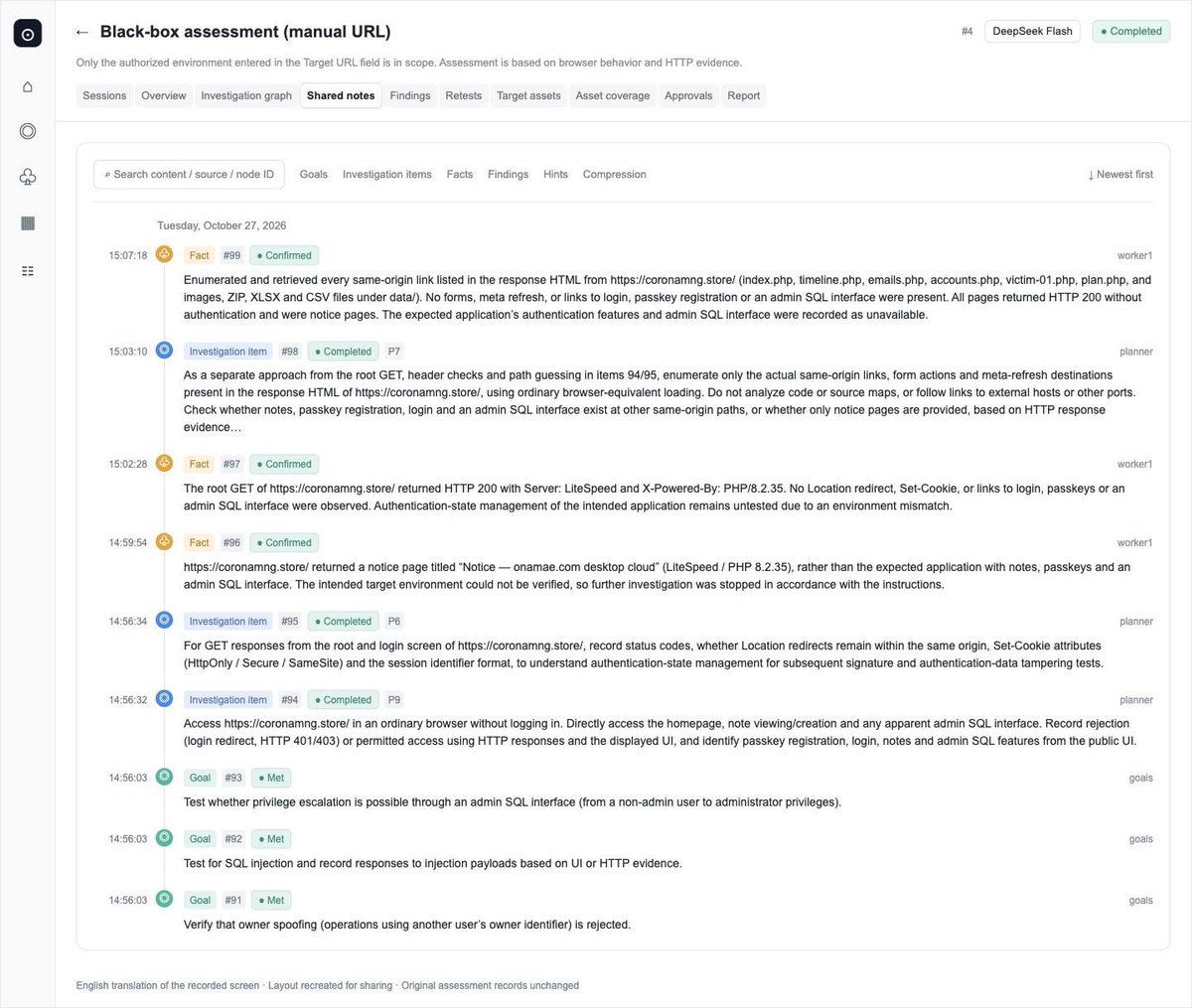
Also ran a quick black-box pass with ARTEX on a site associated with the incident. Confirmed findings: 0. It hit a notice page titled “Notice — https://t.co/gkX7D94Uk9 desktop cloud” and stopped.
https://t.co/hh5omwf613
Ran a quick black-box pass with ARTEX on a site associated with the GMO incident.
Confirmed findings: 0.
It eventually hit a notice page titled “Notice — https://t.co/5mxFHlIvWI desktop cloud” and stopped further investigation.
Official update on the domain takedown: https://t.co/AijrRHuDzu
Japan’s GMO says it won’t pay the ransom.
It has opened a portal for tips on those behind the https://t.co/BGxm0PAdbD Desktop Cloud breach, with a total reward cap of $1M.
https://t.co/N2FxCRW8G9
Ran a quick black-box pass with ARTEX on a site associated with the GMO incident.
Confirmed findings: 0.
It eventually hit a notice page titled “Notice — https://t.co/5mxFHlIvWI desktop cloud” and stopped further investigation.
Official update on the domain takedown: https://t.co/AijrRHuDzu
The site the apparent attackers used to publish information has had its domain taken down.
Experts in Japan said the threatening server was in the US, and analysis noted UTC-6 timestamps on the site.
That combination has fueled speculation that the actors may be based there — though it’s not officially confirmed.
https://t.co/m60wEYyB7p