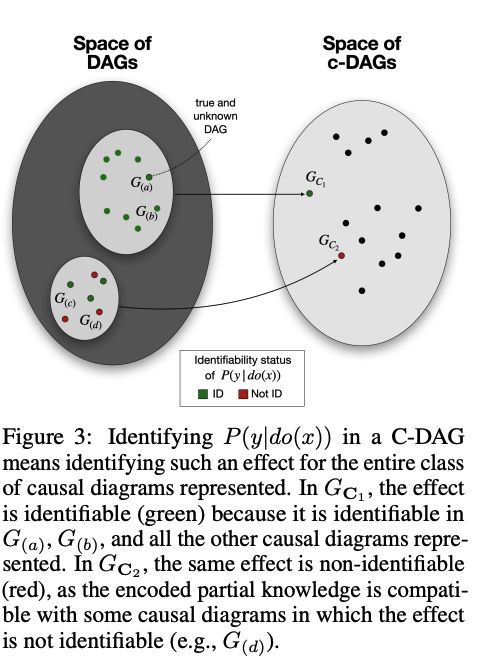
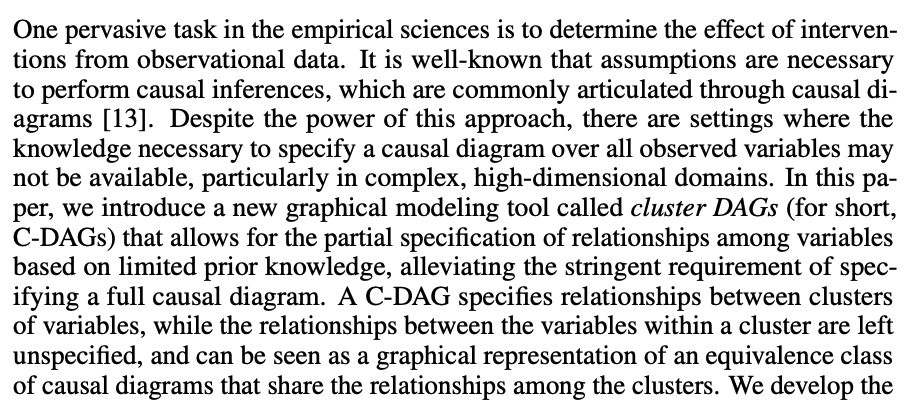
If you want a coarser version of a DAG, where one can abstain from making commitments about certain pairs of nodes, I would consider a clustered DAG (c-DAG), https://t.co/uHQNeKtq4W (see. Def. 1). I have attached an example with the DAG on the left side and various c-DAGs on the right, depending on which kind of commitment one wants to make. A c-DAG represents an equivalence class (EC) of DAGs, also illustrated in the attachment. (The abstract seems written for your question, Wouter: a fragment is attached.)
C-DAGs allow us to understand the spectrum and trade-off between the assumptions' strengths and the conclusions obtained in causal analysis. Two extremes cases -- a DAG is a c-DAG where all clusters have size 1; no-knowledge can be represented as a c-DAG where all nodes are in the same cluster. Of course, inferences in the DAG are more informative, even though, even in this case, some effects are not identifiable. Once the EC is well-defined, one can generalize the CI toolbox for performing inferences over c-DAGs, including d-separation, do-calculus, identify algorithm. Does this make sense, @WvanAmsterdam, @yudapearl?
Inflation v2.0.0 is out!
Probably, the most important addition is that you can implement inflations based on linear programming. This means that now you can use the library to study classical, quantum and no-signaling correlations in networks.
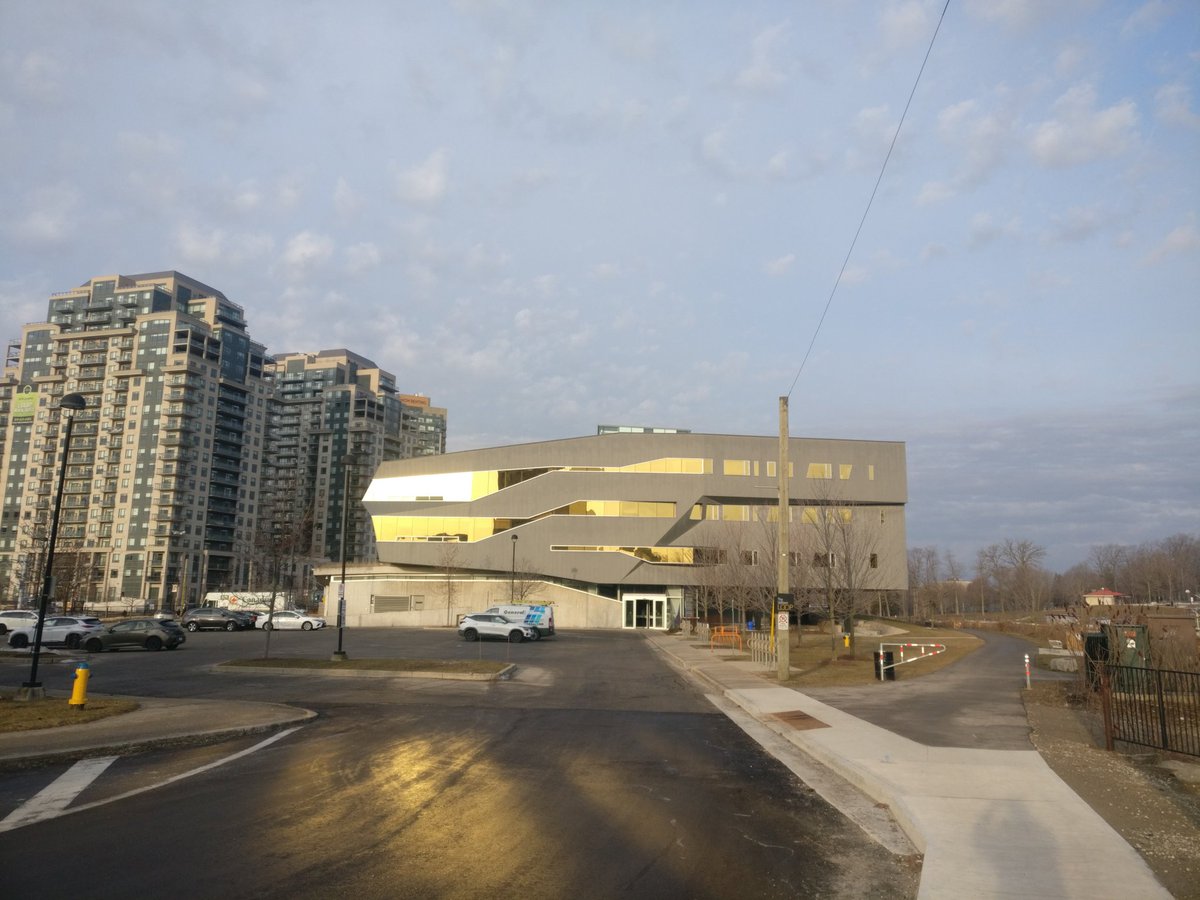
Excited to announce our conference Causalworlds 2024, to be held @Perimeter Institute, Canada, 16-20 Sept, spanning causal inference, indefinite causal order and causality in quantum and relativistic physics.
Submissions are now open until 24 May: https://t.co/9vBHHhZhLa
Following several lawsuits, I now require students to sign a liability waiver before teaching Bell's theorem. When their view of reality is shattered, they may lash out at the closest individual, and that could be you. The waiver is available at https://t.co/uWE4HyU4pQ.
Perimeter is now accepting applications for the 2024/2025 Perimeter Scholars International (PSI) master's program!
You can learn more about the program, and how to apply here: https://t.co/9QWocikWwk
There are open Ph.D. and postdoc positions available for research @Perimeter on the topical intersections of quantum foundations and causal inference! With @eliewolfe and .@RobertSpekkens . https://t.co/1lnGRZmFvi
Today I am very happy, because we have reached an important milestone in a project for which I have a special affection.
Today we introduce *Inflation*, a Python library for classical and quantum causal compatibility
https://t.co/dDwIcOiGJx
Want to know what it is about? 🧵👇
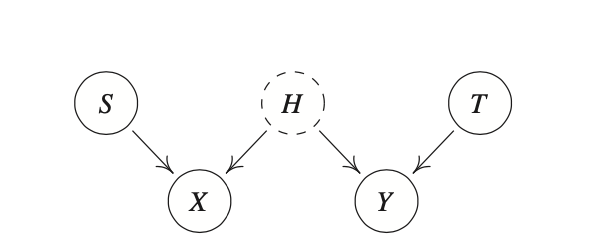
In case you are curious, the Nobel Prize in physics was awarded for the derivation and extensive experimentation of the testable implications of this latent variable DAG.
Bonus trivia from the same source: Although Einstein was awarded the prize for his work on the photoelectric effect, he nevertheless gave his Nobel lecture on the topic of Relativity, under exceptional circumstances.
Einstein was only selected to receive the 1921 Nobel prize in physics in November of 1922, at the very same time Bohr was selected for the 1922 award. Doesn't that making the coming new year a true(er) Centennial? Via https://t.co/7ewIBGhUgv
The frontier of scientific knowledge is often characterized in terms of `big open questions’. In my experience, however, the truly important innovations come from transcending the conceptual scheme within which these questions were framed. John Dewey said it best:
@bel_sainz @ictqt A prepare-and-measure experiment with finite settings can only probe subsets of all possible quantum states and effects. We derive a (simple!) necessary and sufficient criterion to determine if one's realized GPT fragment is or is not classically simulable. @Perimeter
Feynman famously argued that interference phenomena “contain all of the mystery of quantum mechanics”. We dispute this claim in our article. @catani_lorenzo David Schmid @Mattleifer https://t.co/XBmqLyaXnV 1/n