Some time back I did a set of three 'QLIC lectures' on contextuality at @QuantInfoULB, on how to render the central insight of the Kochen-Specker theorem noise-robust. The first two are up: https://t.co/8sivWqjuk5
#contextuality#lectures#quantum#nonclassicality
New paper on arXiv: https://t.co/4ujy2GiCnW
We showed that all sets of star-incompatible measurements are useful for steering-based (one-sided device-independent) randomness certification.
Joint work with @quaintum
Can you recognize the physicist standing between Dirac and SN Bose in this picture?
She is Purnima Sinha, one of the first women PhDs from India. Sinha was Bose's PhD student. Although Bose was famous for his theoretical work(Bose statistics), he was also a keen experimenter.
Sinha's project was experimental, it involved X-ray analysis of clay. Buying an X-ray machine was unthinkable in the budget available to Indian universities in the 1950s. But Bose had learned the DIY approach to building instruments from his teacher, the legendary J.C. Bose. He passed it on to Sinha.
Together, they built a X-ray machine from WW2 surpluses which were being sold as scrap in the footpaths of Kolkata. After successfully completing her PhD, Sinha joined a biophysics project in Stanford university on the origin of life.
On her return, she had a long and distinguished career in research in places including Geological Survey of India and JC Bose Institute.
Sinha also wrote on music, played a musical instrument herself, painted, sculpted and translated books. Her daughters Supurna Sinha and Sukanya Sinha, and her niece Sudeshna Sinha are all physicists.
Purnima Sinha passed away in 2015.
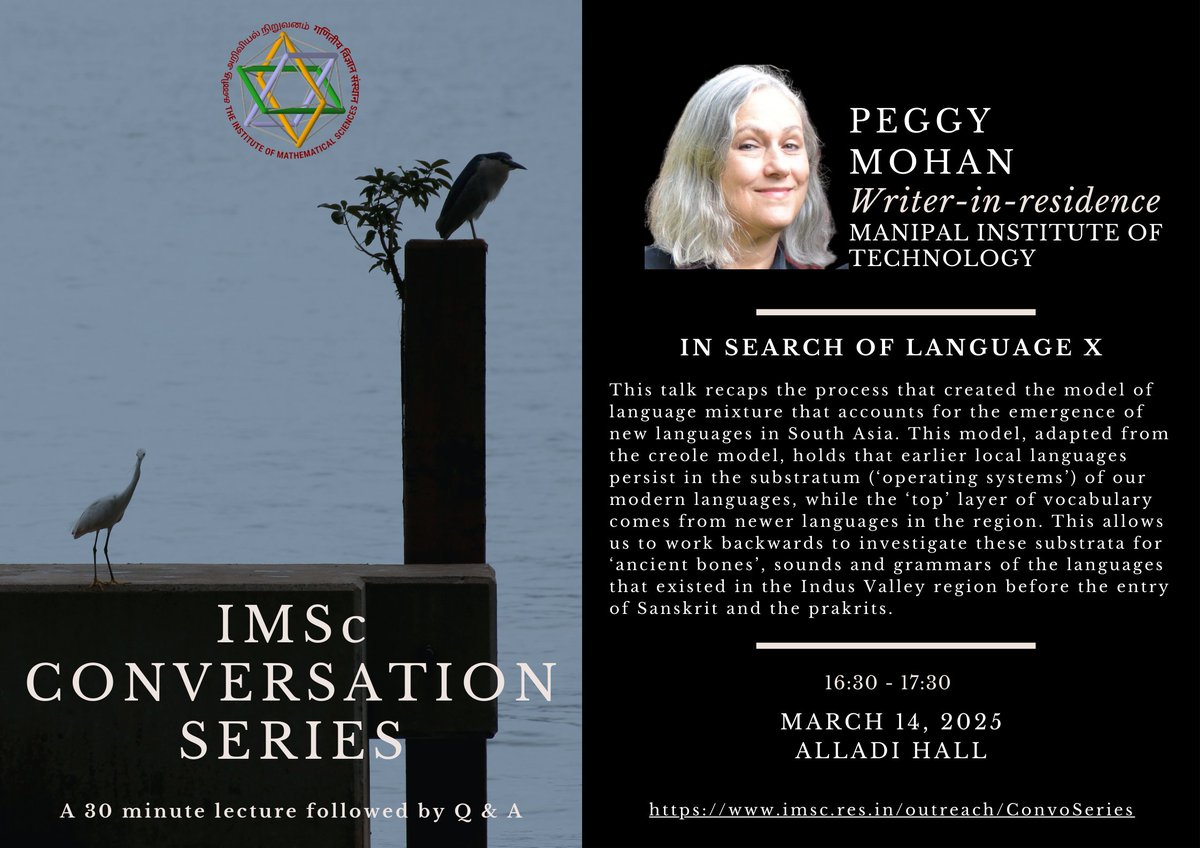
Announcing #IMScConvo "In search of language X" with Peggy Mohan (writer-in-residence, Manipal Institute of Technology) about the evolution of language on 14 March, 16:30, Alladi Hall, IMSc.
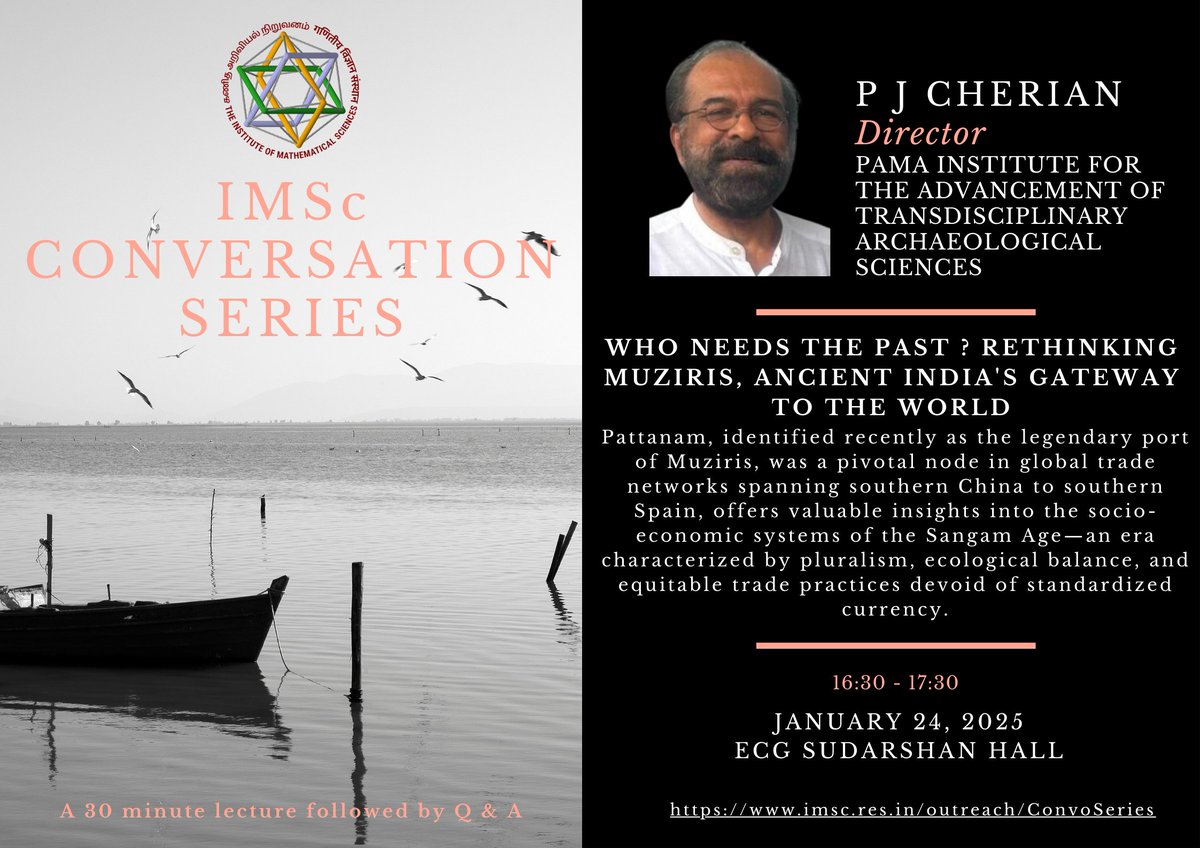
Announcing #IMScConvo: "Who Needs the Past? Rethinking Muziris, ancient India's gateway to the world" by P. J. Cherian (PAMA Institute for the Advancement of Transdisciplinary Archaeological Sciences) .
https://t.co/SEjs87BD0I
24 Jan, 16:30, Alladi Hall, IMSc
Interview with Thayyoor K. Radha, one of the earliest women of color at IAS (Princeton), about her life and career also discussing her time in Chennai and IMSc founder Alladi Ramakrishnan:
https://t.co/IdzhIjgt6W
“An artist needs to have control of every aspect of a painting. A writer needs to have control over every sentence in a novel. And you simply cannot have control over every sentence in a novel if all you gave was a pretty short text prompt.” —Ted Chiang https://t.co/oBrBYBAzRi
"When you give generative AI a prompt, you're making very little choices. If you use a 100-word prompt, you're making 100 choices.
If AI generates a 10k word story based on the prompt, it has to fill in for all the choices that you are not making." 5/
Sat with Ted Chiang at @NeurIPSConf lunch ytd & someone in AI brought up democratizing art-making.
It was a candid chat so I was like, hey, can I just say something?—I really hate the word "democratize" used this way. Just say "automating art-making." It’s more accurate. 1/
The reason is that, if d is a divisor of (positive) n, then n/d is also a divisor. Thus, for each divisor you can always find another and the total number is even… except when d = √n is an integer, because in that case d = n/d.
The proponents of generative AI (including in academia) are trying to sell you a lot of unbelievable sci-fi bullshit, but *this* is the actual main result of these technologies, entirely foreseeable and now plainly there for all to see. Just say no. https://t.co/wkUknPwFnd
Apple released a hearing aids feature for the AirPods Pro a while ago. I bought a pair for grandma, but then realized that the feature was geoblocked in India
So we at @_lagrangepoint decided to unblock it. It ended up involving a leaky microwave and building a Faraday cage: