In 2016, the world sent 338 tonnes of satellites and spacecraft into orbit.
In 2025: 3,193. Almost 9 tonnes a day.
For three years it barely moved. Then @SpaceX reusable Falcon 9s took off.
SpaceX alone now lifts more than everyone else on Earth combined: about 80% of it, mostly Starlink.
Why mass? Counting launches or satellites hides what each one carries: thousands of tiny satellites, or one heavy one.
@BasilHalperin@danielrock Population is the point.
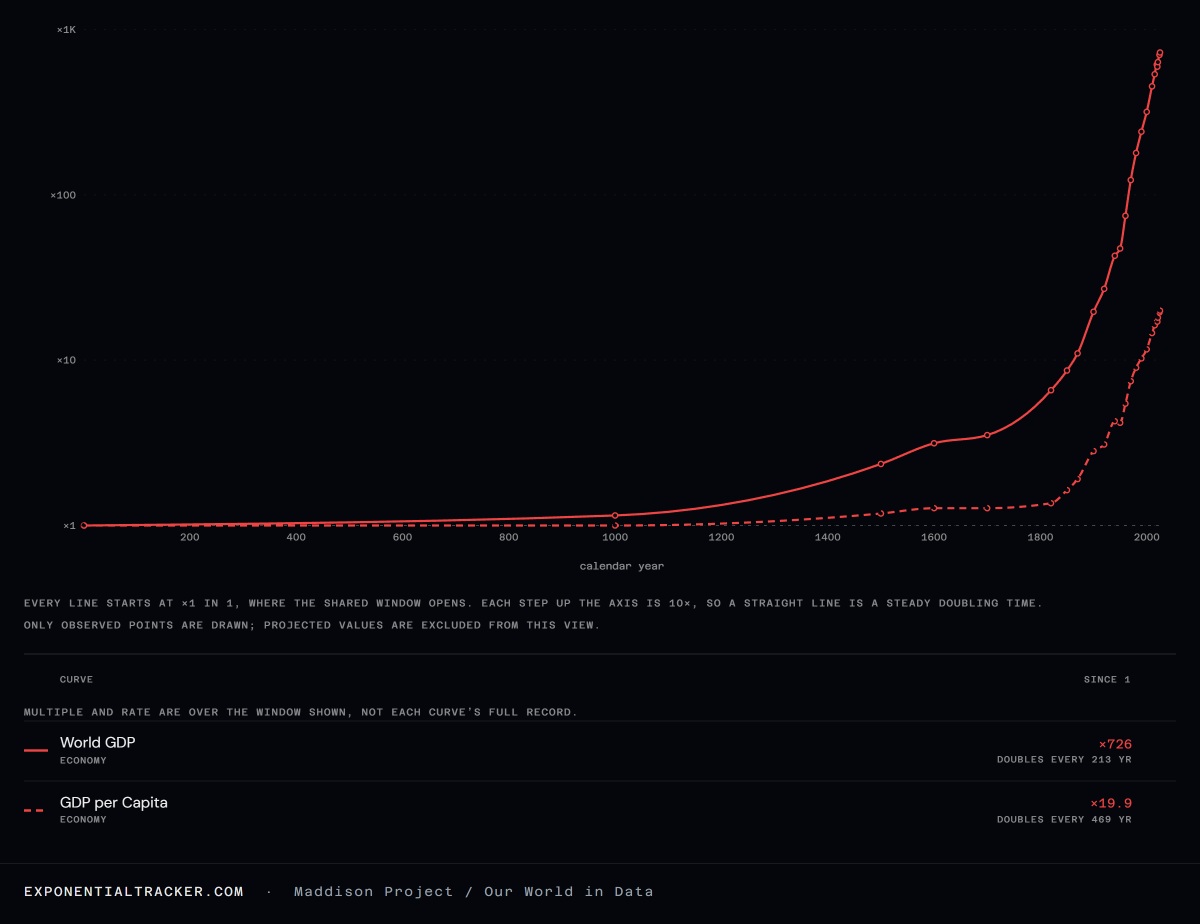
Solid: world output.
Dashed: output per person.
The gap between them is people. For most of history the loop was more people → more ideas → more people. AI adds minds without births. Once minds aren’t scarce, what is?
@kimmonismus Similar pattern on PubMed, just a bit later. Flat in 2022, down 6% in 2023 (partly covid papers fading), then +3% and +9% to a new record in 2025.
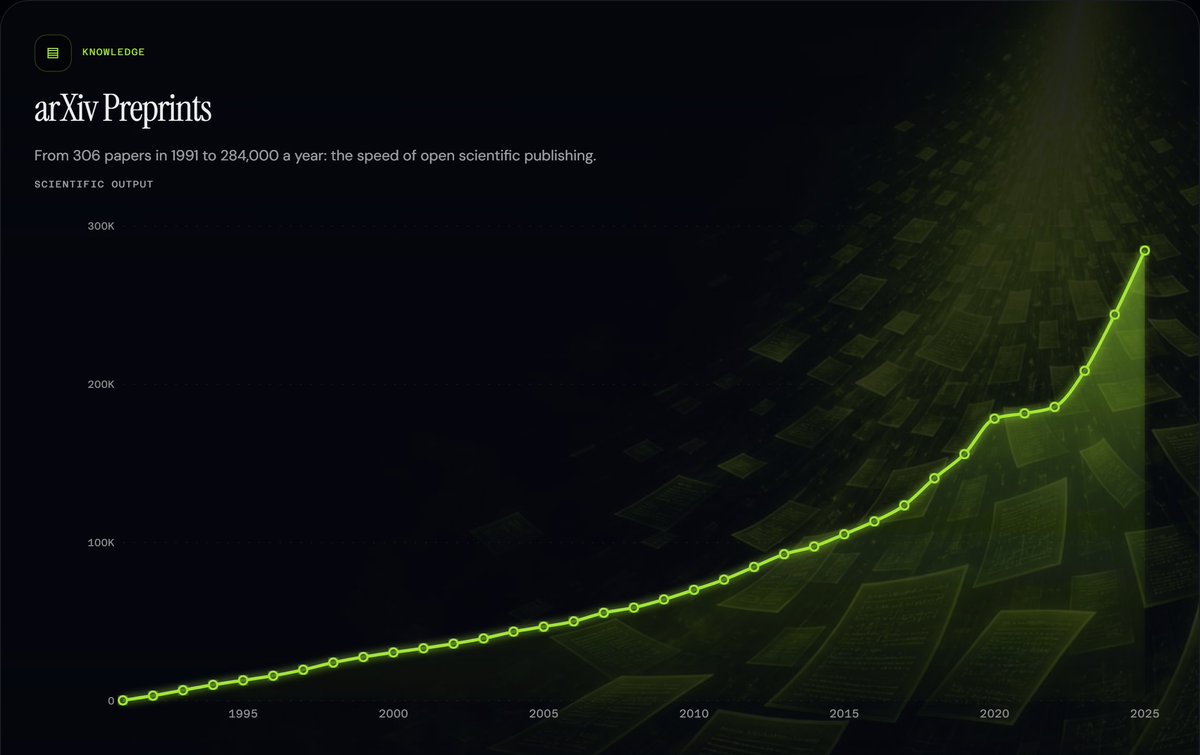
@kimmonismus You can see it in the raw submission numbers too. arXiv grew 5-14% every year for two decades, stalled at 2% in 2021-22, then 12%, 17%, 17%. And 2026 is running about a third ahead of last year. Chart from my site: https://t.co/atmRdABNc3
@elonmusk@cradrrat Grok 4.7: Python
Grok 4.8: C with a little C++
Grok 4.9: hand-written PTX
Grok 5: writes its own microcode and asks why we needed compilers
@broudsov What radiator temperature, net heat flux, and system mass lead you to conclude “certainly not in our lifetimes”? Radiative heat rejection is an engineering constraint, not evidence of impossibility. What calculation actually supports that conclusion?
Data: https://t.co/KpeiaaRmtB, Rmax on the HPL benchmark for the list's number one (milestones, not every list). Log scale.
This curve and 57 more: https://t.co/atmRdABNc3
In 1993, the fastest machine on the TOP500 list did 60 billion calculations a second.
In 2026: 2.2 exaflops. That's 2,198,400,000,000,000,000 calculations every second.
A teraflop in 1997, a petaflop in 2008, an exaflop in 2022.
The pace has stretched: the top spot doubled about every year until 2013, every two over the past decade, about four since the first exaflop.
But that last doubling alone added 1.1 exaflops, more than twice the whole 2020 number one.
“As far as we know” makes this sound like an established scaling result. Which result are you referring to?
For a fixed workload, the main compute cost scales roughly linearly with active parameters. That doesn’t guarantee linear time, but where has an exponential relationship between parameter count and RL duration been demonstrated? Is this a measured result from a particular setup, or an assumption in your forecast?
It seems you and others equate "real AI" with general-purpose chatbots, overlooking how much more capable specialized AI systems already are in fields like semiconductors, EE, and optics. Judging AI's capabilities based solely on a general-purpose LLM misses a huge part of the picture. AI has already been revolutionizing parts of the semiconductor industry for years.
If you did this "benchmark" on humans you would get a very similar result. Ask people for a random number 1–10 and 30%+ pick 7 . Avoid edges, evens, and the middle. Models just amplify the most common human answer.
1–100 is similar. So same underlying pattern, just less collapsed. They’re mirroring human “random” choices, not generating uniform ones. Also it's obvious that the only one who got the benchmark right here is Grok.
In 1300, a million lumen-hours of candlelight cost almost £30,000 (in 2000 prices).
By 2023: £2.15.
Under candles the price halved once every 280 years. With gas, every 19. Electricity made it 45x cheaper from 1920 to 1970.
Then it stalled. Half a century on, it's only 39% lower.
And since 2017, light has got 19% more expensive: power prices are rising faster than lamps improve.
@0xEronn “MIT just published” — May 2025. And where exactly is this “hard mathematical ceiling” proved? The paper models one source of representation loss, not a limit on LLM capabilities. The linked video makes the same unsupported leap. Did either of you actually read the paper?
At the end of 1960 there were 5 active satellites in orbit.
Today: 16,897.
It took 55 years to reach 1,443. Then @SpaceX launched Starlink in 2019, and since 2020 the count has doubled every ~2.4 years.
2 in 3 active satellites now belong to one company.