FULL INTERVIEW: @dylan522p on Jensen's resignation and its downstream implications for AI:
2:50 Jensen's role as the central bank of AI
6:40 All the ways NVIDIA can fall behind without Jensen
10:00 Successors
15:20 How Chinese AI labs are reacting
17:50 What's next for US chip export restrictions?
20:00 Revisiting AI 2027 predictions
22:20 Alice Huang wasn't a spy in the colloquial sense
24:35 Jensen's next moves
Nvidia and the World Without Jensen
Is NVIDIA Over? Export Controls, RASA,
Open Source Implications, Supply Chain Implications, Affair, US Still Dependent On China
https://t.co/MXgpW6HBER
Persistent Agents are the next unlock of AI usage
Our spend on AI is now 45% persistent agents
Unfortunately for Anthropic, Claude Tags sucks
OpenAI's Slack agent is even worse
We primarily use Perplexity Computer, which uses a lot of different models
Perplexity's Harness mogs
Today we’re releasing GDPx, a benchmark for measuring agentic capabilities across the most valuable domains.
GDPx is a true frontier-level benchmark: even the best model scores just 12% (1/7)🧵
Today we’re releasing GDPx, a benchmark for measuring agentic capabilities across the most valuable domains.
GDPx is a true frontier-level benchmark: even the best model scores just 12% (1/7)🧵
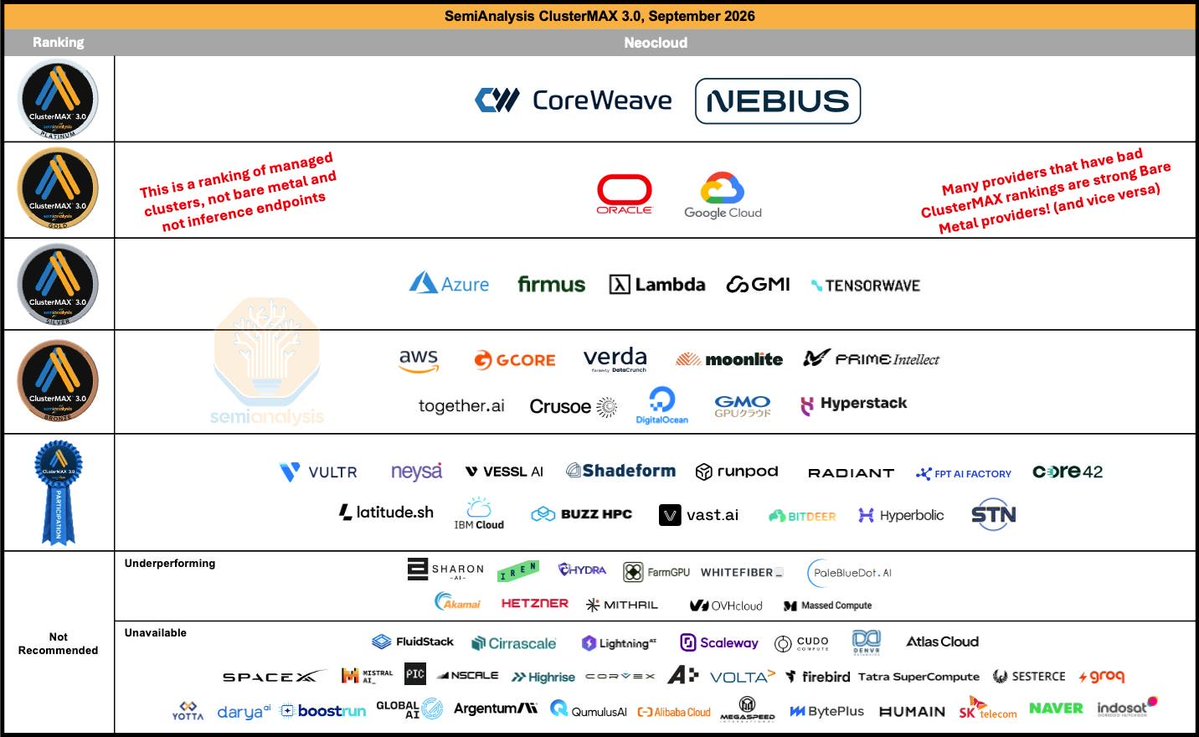
ClusterMAX 3.0 is here!
ClusterMAX 3.0 debuts with a comprehensive review of the neocloud industry, covering 77 providers.
We increase our market view to cover 323 providers, up from 209 in ClusterMAX 2.0, 169 in ClusterMAX 1.0, and 124 in the original AI Neocloud Playbook and Anatomy article.
We have now interviewed well over 200 end users of neoclouds as part of this research.
We update our itemized list of criteria across 10 categories, and update our direct descriptions of our expectations for Slurm, Kubernetes, Standalone Machines, Monitoring Dashboards, and Health Checks. All of this content is live on our website. We encourage providers to use these lists when developing their offerings. We still consider these lists as an amalgamation of our experience interviewing end users, making them representative of the features that end users expect from their cloud providers.
Nebius joins CoreWeave in the Platinum tier. While CoreWeave still sets the technical bar for others to follow, Nebius is now established as a provider that consistently commands a premium pricing over others. Strong business decisions by Nebius have put them in a position to serve an entire class of neolabs at seller’s prices.
Google Cloud joins Oracle in the Gold tier. Azure moves to Silver, Fluidstack moves to Unavailable, and Crusoe drops to Bronze. Lambda, Firmus and TensorWave remain in Silver, while GMI moves up to Silver from Bronze.
Many companies drop from Silver (or Gold) to Bronze or lower. We raise the bar this round as only 19 neoclouds globally achieve a Medallion rating.
We establish a tier between Bronze and Underperforming: the Participation Ribbon tier. 15 providers join this rating, which more accurately describes our opinion that they do the bare minimum to get by.
ClusterMAX 3.0: The Industry Standard GPU Cloud Rating System Returns
In gory detail: reliability, performance, support, pricing
—and, of course, security—
in our most thorough analysis of GPU cloud providers globally
https://t.co/PYQ5uFpvor
I sat down with @dylan522p and spoke with over a dozen people about his information machine.
"I don't think anyone who has a traditional equity research background would even try to figure out where $3T in [the AI labs' combined] ARR comes from."
Slack private messaging limits, finding CoWoS volume, and the industry they're looking at next - I wrote about SemiAnalysis here: https://t.co/0FVDIJNaGe