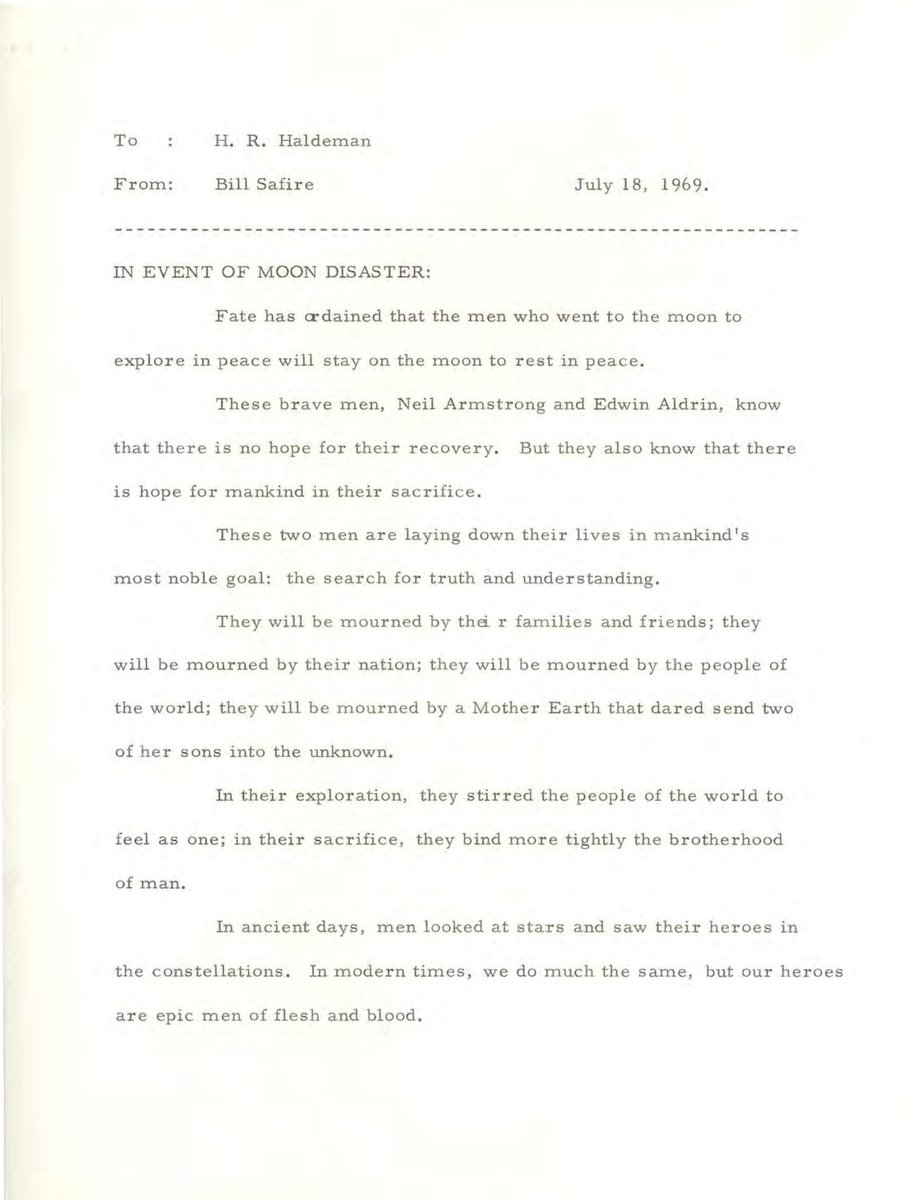
There was a secret speech prepared for Nixon in case the Apollo 11 astronauts died on the moon.
It was never read publicly, but for Memorial Day I used @ElevenLabs to generate a Nixon-read broadcast of the declassified transcript:
https://t.co/P2BUWCCzxO
Very important lesson for Blue Cities here: Every change Lurie has made has been opposed by screaming, bullying activists -- ignoring them has been the path to policy success and extremely high popularity. @skaushik100
https://t.co/sWctBukXM8
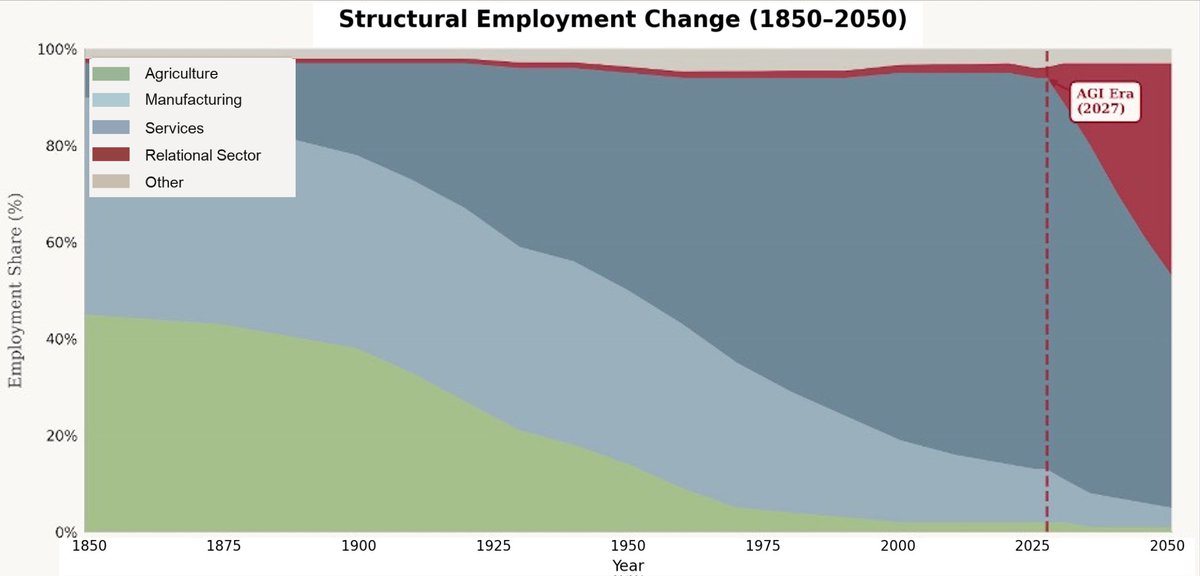
New essay on the economics of structural change and the post-commodity future of work.
1. Almost any question about the impact of advanced AI on the economy needs to start at the same place: what is still scarce? Answer that, and the analysis becomes pretty straightforward. This essay explores what becomes scarce if AI really can replicate most of what humans do in production, and what this mean for the future of jobs.
2. My conjecture, working through the economics: labor reallocates across sectors, and the sector it reallocates to has properties that keep labor a meaningful share of the economy. Ultimately this is about the structure of demand itself. For this, we have to go back to Girard, Augustine and Rousseau: once people's base needs are met, their preferences shift to comparative motives (e.g., status, exclusivity, social desirability). This motive is inherently non-satiated.
4. The key paper is Comin, Lashkari, and Mestieri (Econometrica 2021). As people get richer, they don't buy proportionally more of everything. They shift spending toward sectors with higher income elasticity. They estimate income effects account for 75%+ of observed structural change.
5. The ironic consequence: the sector that gets automated becomes a smaller share of the economy, not a larger one. Agriculture got massively more productive and its share of employment collapsed. Manufacturing too. The "stagnant" sectors absorb the spending and the jobs.
6. So the question is: which sectors have high income elasticity in a post-AGI world? I argue it's what I call the relational sector. Categories where the human isn't just an input into production, it is part of the value.
7. Why does the relational sector have high income elasticity? Because human desire has a mimetic, relational dimension. We don't just want things for their intrinsic properties. We want what others want, and we want it more when others can't have it. Girard, Rousseau, Augustine, and Hobbes all saw this.
8. In work with Kristóf Madarász, we showed this experimentally: WTP roughly doubles when a random subset of others is excluded from the good. And in new work with Graelin Mandel, AI involvement kills the premium. Human-made art gains 44% from exclusivity; AI-made art only 21%.
9. This all comes together for the core argument. The sector that absorbs spending as AI makes commodity production cheap is one where human provenance is part of the value, and demand for it grows faster than income. Exactly the profile that keeps labor meaningful.
10. To be clear about the claim: I'm NOT saying aggregate labor share must rise. It may fall. The claim is about sectoral composition, i.e., where expenditure and employment go once commodities get cheap, and the fact that the sector that will absorb reallocated labor maps to a substantial component of human preferences and desire.
11. If you're interested in the formal model, a linked companion technical note works out all the economics.
Read the essay here: https://t.co/NcjVgn2o8g
I'm a Democrat because I know all the good government can do. But we need to get California back to being California, and it starts by making sure no one's priced out of progress. Check out our new ad:
Democratic candidate for CA Governor Matt Mahan says he won't raise taxes if elected, will audit programs every 90 days.
He says results would be posted to be held accountable by public, "not by highly organized interests that ...sit in Sacramento ghost-writing legislation."
In 2022, LA shut down a former hotel to convert it into permanently supportive housing for the homeless. Four years and $20 million later, the 32 units are still empty.
This is the homeless industrial complex in action.
https://t.co/jHpb6ZzUPL
Thanks to the Bay Area Council for standing up against the regressive California mandate to convert gas-powered water heaters and furnaces to electric. Our grid is already unstable, with half a million experiencing a "Public Safety Power Shutoffs" in 2025.
https://t.co/CeB64pfcmq
@chamath It's more than just energy—and it's annoying how "tone deaf" the tech community can be. One data center in Oregon is literally 30 miles from the most bucolic, pristine, biodynamically farmed vineyards in North America. Why go there?
https://t.co/UU4gwjYhyE