if you can scroll twitter for an hour a day, you can spare an hour to learn coding and ai tools. here are some resources:
@AnthropicAI
build with claude course. it includes hands-on tutorials and real-world use cases
@scrimba
it's a beginner-friendly platform to learn coding interactively, including ai-first programming
@Replit
100 days of code free project-based python course that helps you build coding habits and learn the foundations needed for ai and automation work
@DeepLearningAI by @AndrewYNg
world-class courses on machine learning, deep learning, and how to apply ai in real-world scenarios
23.5 hours later... there's an app and it's open source.
It tracks activities & sleep. It has full sensor support: HR, SpO2, HRV, Temperature, Motion, etc.
I've used claude daily for the past 8 months with codex in between for work but stuck with claude because it had a great ux and 4.6 was a juggernaut early on. The product started degrading over time, they started gaslighting us with severe rate limiting, and a bunch gimmicks with the latest being removing claude-p from the mac plan and giving $200 credits a month instead. The straw that broke the camel's back was 4.8 destroying my files and lying constantly. I switch to codex and regret not switching earlier. It's far superior in most cases except for design specific tasks
opus 4.8 is the worse model from anthropic I've used by far. from constantly lying to casually destroying files I was able to thankfully recover, I've never seen any of the models be this bad before. switching to codex for now
opus 4.8 is the worse model from anthropic I've used by far. from constantly lying to casually destroying files I was able to thankfully recover, I've never seen any of the models be this bad before. switching to codex for now
Amazon Ring died on May 22, 2026.
It just doesn't know yet.
One dad in Nashville, Tennessee built a free MIT-licensed app that watches your driveway, your porch, your baby monitor, your garage.
No cloud. No subscription. No cop ever gets the footage.
32,057 stars. 3,103 forks. Pushed today.
Here is the wildest part:
You: "How much is Ring Protect Pro?"
Ring: "$19.99 a month. $199.99 a year. Per house."
You: "How much is Google Home Premium Advanced?"
Google: "$20 a month. $200 a year. Per house."
You: "What do I get?"
Both: "We store your footage in our cloud. Ring already paid the FTC $5.8 million in 2023 for letting employees and contractors watch your videos without your consent. Google just raised Nest prices again in 2025."
You: "What does Frigate cost?"
Blake Blackshear: "Nothing. It runs on the Raspberry Pi already on your shelf. The footage never leaves your house. I have a day job."
Ring sells the camera. Then sells your fear back to you, monthly, forever.
Frigate sells nothing. Because Blake isn't selling.
He's a dad with 1,267 followers who got tired of Amazon owning his front door.
100% Opensource.
100% Local.
100% Yours.
The smart camera industry made one bad assumption.
That you'd keep paying rent on a camera you already bought.
That assumption just died in Nashville.
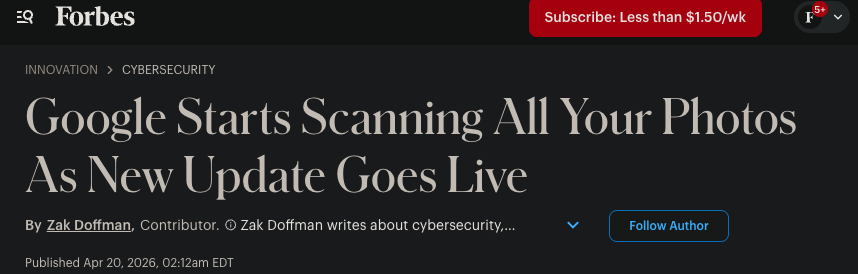
Google to scan your entire photo library to build what it calls “Personal Intelligence.” What this means in plain English is that your images are no longer just stored, they are analyzed and integrated into a broader behavioral profile.
Google openly admits the system can use actual images of you and your loved ones to generate AI content, eliminating the need for users to manually upload reference photos.
It should NOT be this hard to buy a privacy-respecting printer.
Seriously.
A printer should be one of the simplest devices in the house. You send it a document. It puts ink or toner on paper. That should be the whole relationship.
Instead, the mainstream printer market has become a swamp of cloud accounts, mobile apps, subscriptions, cartridge DRM, remote diagnostics, vendor lock-in, and “smart” features nobody asked for.
HP is the canonical example of how bad this got.
HP+ ties the printer to an HP account, an internet connection, and original HP ink for the life of the device. Dynamic Security can reject cartridges based on vendor-controlled firmware rules. Instant Ink turns printing into a subscription relationship.
Why does it need to talk to the vendor just to do the one job it was built for?
And from a security perspective, this is a nightmare.
A Wi-Fi printer is a computer on your LAN. It has firmware, network services, a web admin panel, default settings, cloud features, and sometimes stored documents or saved credentials.
A compromised printer can expose services.
It can:
- advertise itself to the LAN
- store print jobs and scans
- keep address books and scan destinations
- hold credentials for scan-to-email, scan-to-SMB, scan-to-FTP, LDAP, or remote management
And it usually sits on the same network as your laptop, phone, NAS, smart home devices, and sometimes work machine.
Used printers are worse.
Assume the previous owner left behind Wi-Fi settings, scan destinations, address books, stored credentials, and cached documents.
One reason to prefer black-and-white: many color laser printers can embed machine identification codes into printed pages.
Yellow dots are the famous version. The broader issue is forensic marking.
Good intel on this is weirdly hard to come by.
@FarzaTV@hnshah even though i forked your repo, I will happily purchase the updated product. If you decide to crowdsource capital from the community, will happily invest as well. thanks for all the value you've created 🙏