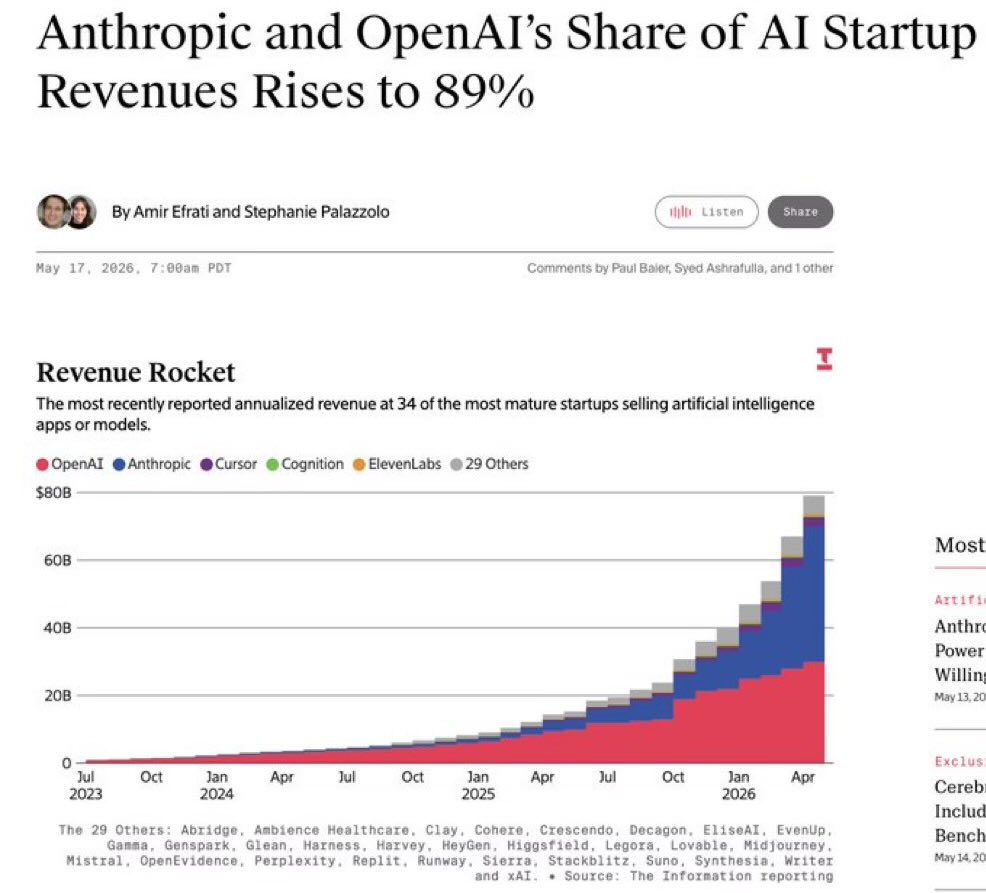
Today I'm publishing a new essay, Policy on the AI Exponential. AI is progressing extremely fast—much faster than the policy process was built to handle. The essay lays out where I think the technology is now, and the action needed to close the gap: https://t.co/Lh6PWae178
Two math olympiad champions wrote a training manual in 1993 on two old Macintosh computers, and every American kid who has won a major math competition in the last decade learned to think from it.
Their names are Sandor Lehoczky and Richard Rusczyk. The book is called The Art of Problem Solving. Most people in math know it as AoPS.
Since 2015, every single member of the US International Math Olympiad team has been an AoPS student. Not most of them. Every one.
That statistic sounds impossible until you understand what the book actually does.
Lehoczky and Rusczyk were not professors. They were competitors. Lehoczky earned the sole perfect AIME score in 1990 and led the national first place team. Rusczyk was a USA Mathematical Olympiad winner and a perfect AIME scorer in 1989. They had both survived the same brutal selection process the book was designed to train students for.
And the first thing they decided was that almost every existing math textbook was teaching the wrong thing.
School math gives you formulas. You memorize them. You apply them. You pass the test. Then you sit down in front of a real competition problem and the formula does not apply, and you have nothing underneath it.
That is the gap. The gap is not knowledge. It is thinking.
The entire premise of AoPS is that problem-solving is a transferable skill, not a bag of memorized tricks. A student who genuinely understands why a technique works can adapt it, combine it with something else, and deploy it in a context they have never seen before. A student who only memorized the technique freezes the moment the problem looks different.
The book teaches the difference between a formula and a method.
A formula tells you what to compute. A method tells you how to see. The students who win olympiads are not the ones who know more formulas. They are the ones who have trained themselves to look at an unfamiliar problem and recognize its structure. To see that this problem is secretly asking the same question as a problem they solved three weeks ago, just dressed differently.
Rusczyk calls this "learning to read the problem." Not reading the words. Reading what the problem is actually asking underneath the words.
The second thing they built into the book is tolerance for being stuck.
Most students treat confusion as a signal to stop. The book treats confusion as the starting point. Every chapter pushes students past the point where the obvious approach runs out. That moment of running out is not failure. That is where the actual thinking begins.
Lehoczky once described it this way. If you can solve a problem quickly, you are not learning. You are performing. Learning only happens when you are past the edge of what you already know.
The book was written on old Macintosh computers in 1993. Rusczyk launched the AoPS website in 2003. Today the community has over one million users. Thousands of students enroll in AoPS online courses every year. Most winners of every major American math competition are AoPS alumni.
A platform built by two kids who were good at math competitions has become the infrastructure that produces the next generation of mathematicians, engineers, and scientists who are good at thinking.
The formulas you memorized in school will eventually be obsolete.
The thinking you trained will not.
What is one problem in your life right now that you have been avoiding because you do not yet know the right formula to solve it?
El #001 "La Última Pregunta" está disponible gratis ahora.
Lee el cómic completo → https://t.co/i6VneePqZj
¿Cuál de las 5 lecciones de Asimov aplica más directamente a tu práctica profesional hoy?
#BIM#SketchUp#ArqDigital#Arquitectura#IA
En la era de la #InteligenciaArtificial, en la que la dignidad humana corre el riesgo de verse eclipsada por nuevas formas de deshumanización, tenemos el deber urgente de permanecer profundamente humanos, custodiando con amor esa magnífica humanidad que se nos ha dado y revelado en plenitud en Cristo, y que ninguna máquina podrá jamás sustituir en su esplendor. #MagnificaHumanitas
https://t.co/Ple93kfbB8
The suit-up alone would finish most people off.
Zhang Shupeng getting dressed on a narrow ledge at Tianmen Mountain before BASE jumping at 180 km/h.
No room for error at any point.
Nerdeyse Oksijenin bile olmadığı 7620 metre yükseklikten paraşütsüz atlayan Luke Aikins, 30x30 metrede kurulan ağ düzeneğine paraşütü olmadan iniş yapıyor.
Tarihte hiç bir uçuş ekipmanı olmadan bir uçaktan atlayıp, yine ekipmansız inebilen tek kişi…
Japanese neuroscientists spent years working out how to put a crying baby to sleep. They wired 21 babies to heart monitors, tested different ways of being held, and landed on a 13-minute routine. The grandma in this video has been doing it for three generations.
Three labs working independently arrived at the same answer from different angles. The first piece came from a pediatrician named Harvey Karp who published it in 2002 after years of studying how parents around the world calm their babies. Babies are born with a built-in calming switch in their brain. The switch flips on whenever something mimics the womb: warmth, snug pressure, gentle movement, a steady whooshing sound. Once it flips, fussing stops and sleep takes over. Karp called it the calming reflex. Every parent has set it off dozens of times without knowing it has a name.
The second piece comes from a sleep lab in Geneva. In 2019, researchers there put adults on a bed that rocked gently, about one sway every four seconds, and watched their brains all night. People fell asleep faster. They also dropped into deeper sleep, the kind where the brain locks in memories from the day. The part of your inner ear that senses motion is wired directly into the parts of your brain that handle sleep. Rocking syncs your brain waves.
The third piece is the most direct. A 2022 study put tiny heart monitors on 28 babies at home and watched how their bodies reacted to different kinds of touch. Only four kinds of touch worked: rocking, patting, bouncing, and stroking. Each one triggered the calming response within seconds. Heart rate dropped. The body shifted into rest mode.
The 13 minutes came from a team at RIKEN, one of Japan's biggest research institutes. They tracked how different ways of holding babies affected their heart rates and figured out the exact recipe. Walk around with the baby in your arms for five minutes. Then sit, still holding them, for another five to eight minutes. Only then put them down. The wait was the surprise finding. Put the baby down too early and they wake up. Give them eight full minutes of held sleep first, and they stay asleep.
All of this lived inside grandmothers' arms for thousands of years before anyone hooked a baby up to a sensor. Passed quietly from mother to daughter to granddaughter. The neuroscience just caught up.
What you're watching is roughly the same protocol a Japanese lab might publish in 2026. Grandma already knew. The citations are optional.
If you are running a consulting business and you are deploying Anthropic or OpenAI directly into your organization (I’m looking at you PwC and Accenture) you are letting the fox into the hen house.
OpenAI and Anthropic are openly funding and starting competitors to you while also using your usage to drive more success for them.
This is not a failure on their part but a failure on your part.
Consulting businesses that understand this are adopting a control plane that allows them to arbitrate where tokens go and who generates tokens for them.
Controlling the tokens is controlling the spice (Dune).
This was a key pillar of 8090’s global partnership with EY and they key feature of our Software Factory. We control token generation and can direct them to any model provider.
We are close to another global partnership and will announce it soon.
These organizations refuse to accept the disruption standing still or, even worse, by adopting and accelerating the companies who want to disrupt them.
In an early meeting at Facebook (c. 2007), when I was describing the goals of Facebook Platform (an area I oversaw) Bill Gates yelled at me/us.
His quote has stuck with me to this day:
“This isn’t a platform. A platform is where the collective sum of revenues of the participants exceeds those of the platform itself.”
Ladies and gentlemen, I present to you the tokenmaxxing circle jerk.
-“Que no llore el niño”, oraban los indígenas de Guerrero escondidos entre la maleza mientras veían aterrorizados como criminales del Cártel de Los Ardillos, incendiaban sus humildes viviendas.
Su llanto les daría de inmediato la ubicación de dónde estaban escondidos. De sus ojos brotaron lágrimas de miedo, de un terror que los hacía escuchar el latido de sus propios corazones. Los criminales incendiaron todo. Se llevaron sus pocas pertenencias y sus animalitos y los indígenas supieron que aquella promesa de “primero los pobres” fue en realidad, dejarlos solos a merced de los sanguinarios narcos que hoy están sembrando droga en sus tierras.
Escuchar el relato de este hombre duele profundamente. Quedarnos pasmados o indiferentes nos condena como sociedad.
✍️ Vanina Hache Villegas (Abogada litigante) 👇
🚨 *CIDH ACTIVA ALARMA INTERNACIONAL CONTRA REFORMA JUDICIAL DE MÉXICO* 🚨
🇲🇽 *Nuestro reconocimiento ciudadano y agradecimiento a los 65 jueces y magistrados*(con casi 30 años de carrera cada uno) que lograron algo histórico: que la *CIDH (Comisión Interamericana de Derechos Humanos) * priorice su queja y *le exija al Estado mexicano responder en 4 meses.*
📌 ¿Qué significa esto?
México bloqueó todos los mecanismos internos para cuestionar la reforma judicial. La vía interamericana es la única que quedó.
La CIDH activó el principio de no regresividad: no puedes desmantelar un sistema judicial profesionalizado y sustituirlo por uno de elección popular sin violar tratados internacionales firmados por México en 1981.
⚠️ *Lo que viene puede ser HISTÓRICO: * Si la Comisión concluye que hay violaciones a la Convención Americana, el caso sube a la Corte IDH. Y ahí las sentencias SON VINCULANTES. *México tendría que reformar su reforma. *
🛑 *El fondo del asunto es brutal y nos beneficiará a todos los mexicanos: * No se trata de jueces defendiendo su cargo. Se trata de algo más incómodo: ¿qué pasa cuando quien decide tu libertad, tu patrimonio o tu familia empieza a depender de la lógica política?
Un juez que tiene que mirar al poder antes de dictar sentencia deja de ser juez. Y en ese momento, la justicia deja de ser justicia.
📢 Este caso puede marcar un antes y un después: *No hay democracia posible sin jueces independientes*. Cuando la justicia se politiza, no gana *el pueblo… pierde. * Y pierde en lo más importante: en *la posibilidad real de defenderse frente al poder.*
📢‼️¡COMPARTE! Que esta información llegue lejos.
Attempted to write a Steam Engine hype at the era of Industrial Revolution as if it was the age of AI —
The steam engine breakthrough is insane right now.
Watt’s separate condenser + new GRPO optimization just dropped the 405 hp-class engine. We went from 7 hp → 70 hp → 405 hp+ in basically three years. One machine now does the work of 50+ men or water wheels — nonstop, rain or shine, anywhere.
Textile mills, ironworks, everything scaling 5-10x overnight. Productivity exploding.
This isn’t incremental. It’s automating physical labor at massive scale. Jobs shifting forever. Society about to look unrecognizable.
The Industrial Revolution isn’t coming. It’s here and accelerating faster than anyone predicted.
Terrified. Excited. Both.
What a time to be alive. 🚂💨
The last time an El Niño this strong hit, it killed 50 million people. That was 3 to 4% of the entire world population. Scale that to today and you're looking at 250 million equivalent.
The 1877 Super El Niño triggered simultaneous droughts across India, China, Brazil, and East Africa. Crops failed on four continents at the same time. The famine lasted three years. Researchers have called it "arguably the worst environmental disaster to ever befall humanity."
NOAA's latest update gives a two-in-three chance this one reaches strong or very strong by fall. European models are even more aggressive. Sea surface temperatures need to exceed 2°C above normal to qualify as "super." The trajectory is pointing directly at that threshold.
Here's what makes 2026 structurally different from every previous Super El Niño: there are two independent supply shocks converging on the same crop cycle.
The Iran war has shut down roughly a third of the world's seaborne fertilizer trade through the Strait of Hormuz. US fertilizer supply was at 75% of normal in mid-March, right when the Corn Belt needed it most. Fertilizer prices hit their highest level since 2022. That input shortage is already baked into the 2026 growing season.
The El Niño yield shock operates on a 6 to 12 month lag. India is forecasting below-normal monsoons for the first time in three years. Indonesia and Malaysia carry 90% of global palm oil, and El Niño production declines in those countries take 6 to 24 months to peak. Every strong El Niño in the past 55 years has reduced global cocoa production.
So the fertilizer shortage weakens the crops El Niño is about to stress, and the El Niño yield collapse hits in 2027 on fields that were already under-fertilized in 2026. Two shocks with nearly identical lag structures, converging on the same harvest window.
The difference between 1877 and 2026: we can see this one coming six months out. The commodity futures curve is barely pricing either shock. Whether that's rational discounting or willful denial depends entirely on what the Pacific Ocean does between now and October.
Demis Hassabis says he can cure every disease in 10 years.
Most people roll their eyes when they hear this, but I don't.
Demis is the guy who just won the Nobel Prize for solving protein folding with AI (a problem biologists had been stuck on for 50 years).
But that was just one milestone in his much grander plan.
In 2010, he founded DeepMind with a 2-part mission: "solve intelligence, then use it to solve everything else."
Step 1: make AI good enough to do real science.
Step 2: point that AI at humanity's biggest problems.
Step one was AlphaFold.
He used AI to figure out the 3D shape of every protein in nature (which is basically what every drug attaches to).
Demis said it would have taken "a billion years of PhD time" to do by hand.
Step two is curing all disease.
And as of today, step two is fully funded.
Isomorphic Labs (his AI drug discovery company inside Google) just raised $2.1B led by Thrive Capital.
Here's where the money goes and what Demis thinks happens next:
> Drug discovery currently takes 5-10 years and costs billions per drug. That math is why most diseases don't have good treatments today.
> AI fixes the math. Their drug design engine compresses development from years to months. Maybe weeks.
> Isomorphic's first AI-designed cancer drug enters human trials this year.
> Their pipeline expands beyond the current 17 programs across cancer, immune diseases, and heart disease into more health domains.
> The endgame is personalized medicine: drugs designed overnight for your specific biology and your specific disease.
That last one is the whole point.
Today's drugs are mass-produced for an "average" patient who doesn't really exist.
So most existing treatments work inconsistently from person to person, and most rare diseases never get a treatment at all (no market = no drug).
When drug design gets fast and cheap, that whole calculus flips.
Cancer variants get drugs designed for that specific variant, rare diseases get treatments because economics stop mattering, and drug-resistant infections get new drugs faster than they can evolve.
That's what curing every disease actually looks like.
Now imagine what your life looks like in 2036.
A doctor draws your blood, sequences your genome, sends your disease profile to an AI.
By morning the AI has designed a custom drug for your specific biology.
Side effects, dosage, drug interactions all worked out before you take the first pill.
You and your kids never see a cancer ward.
That's what $2.1B is buying today.
Demis was right about AlphaFold.
If you consider the possibility that he's right again, every disease alive today is on borrowed time.