Take on grand-challenges with alacrity. My cryptononymous account, stay apolitical otherwise--politics is a side-show compared to meta-gamechangers....
We Protected Our Children By Homeschooling During COVID, And The Science Proves We Were Right
I’ve had it with the gaslighting.
For years, those of us who chose to homeschool during the pandemic were labeled paranoid. Overprotective. Helicopter parents overreacting to what everyone insisted was “a cold” for kids.
Now the studies have come in. And guess what? We were right all along.
The data is brutal and vindicating. Children who catch COVID more than once face double the risk of long COVID. Their chance of myocarditis jumps 3.6 times higher than kids with just one infection. They’re developing kidney damage, brain issues, and symptoms in practically every organ system researchers have bothered to check.
This is exactly why we pulled our kids from school
We saw what was happening while everyone else played pretend. Schools became giant COVID incubators with their crowded classrooms, inadequate ventilation, and policies that seemed designed to maximize infection.
Large Study
The RECOVER study followed 465,000 children. After a second infection, kids faced more than double the risk of long COVID diagnosis. Their myocarditis risk skyrocketed. They became nearly twice as likely to develop kidney injury, electrolyte problems, and a whole host of other serious conditions.
And yet people had the nerve to tell us we were overreacting.
When we mentioned long COVID, they’d roll their eyes. When we talked about potential long-term organ damage, they’d dismiss us with “kids are resilient.” When we pointed to emerging research, they’d say or bring up with some opinion about “learning loss” or “socialization.”
What about the “learning loss” that comes with brain impairment from repeated infections? What about the “socialization” challenges for kids dealing with chronic fatigue or pain?
The JAMA study followed kids for up to two years. Some risks eventually returned to baseline, but others never did. Cognitive problems, dementia-like symptoms, psychotic disorders, and epilepsy showed elevated risk throughout the entire study period.
That risk never came back down.
This wasn’t just a temporary inconvenience we were protecting our children from. This was potentially permanent damage from repeated infections. And homeschooling was our lifeboat in a sea of denial.
Yes, it was hard. Yes, it required sacrifice. Yes, we had to completely reorganize our lives. But we kept our kids from being subjected to wave after wave of infections in environments that made zero serious attempts to reduce transmission.
The Lancet study of over a million children painted the same grim picture. During the omicron era, when reinfections became the norm in schools, risk increased across almost every measure they tracked.
Meanwhile, our homeschooled kids weren’t part of that statistic. They weren’t catching it three, four, five times like their peers in traditional school settings.
What makes me furious is that protecting kids from repeated infections was entirely possible. Masks work. Air filtration works. We know exactly how schools could have been made safer.
But society decided it wasn’t worth the inconvenience.
They chose “normal” over healthy. They pretended the pandemic ended because they got bored with it. They abandoned children to wave after wave of infections because adults couldn’t be bothered anymore.
We refused to play along with that game, and now the research vindicates our choice.
I don’t expect an apology from the people who called us paranoid. I don’t expect acknowledgment from the officials who failed to protect children in their care. I don’t expect schools to suddenly implement the safety measures they should have had all along.
But I do want other parents to know: you weren’t crazy for homeschooling. You weren’t overreacting. You were seeing clearly what others refused to see.
The studies aren’t ambiguous. The data isn’t unclear. The risks are real. The consequences are serious and potentially lifelong.
We protected our children while institutions failed. We stepped up when schools wouldn’t. We made the hard choice that the evidence now shows was absolutely the right one.
Homeschooling during COVID wasn’t paranoia. It was the sanest option on the table.
And I’d do it again in a heartbeat.
@1goodtern Sounds just like my city in Canada. Our population is about 150,000. I live on a main road near our only hospital. I can always tell when we're swinging up again simply by the massive increase in ambulances going by each day. So, so many. After 4 years, it's glaringly obvious.
As crazy as it may sound, Global sea surface temperatures have now been at all-time record warm levels for an entire year.
This is perhaps one of the most absurd and alarming graphs I have ever plotted.
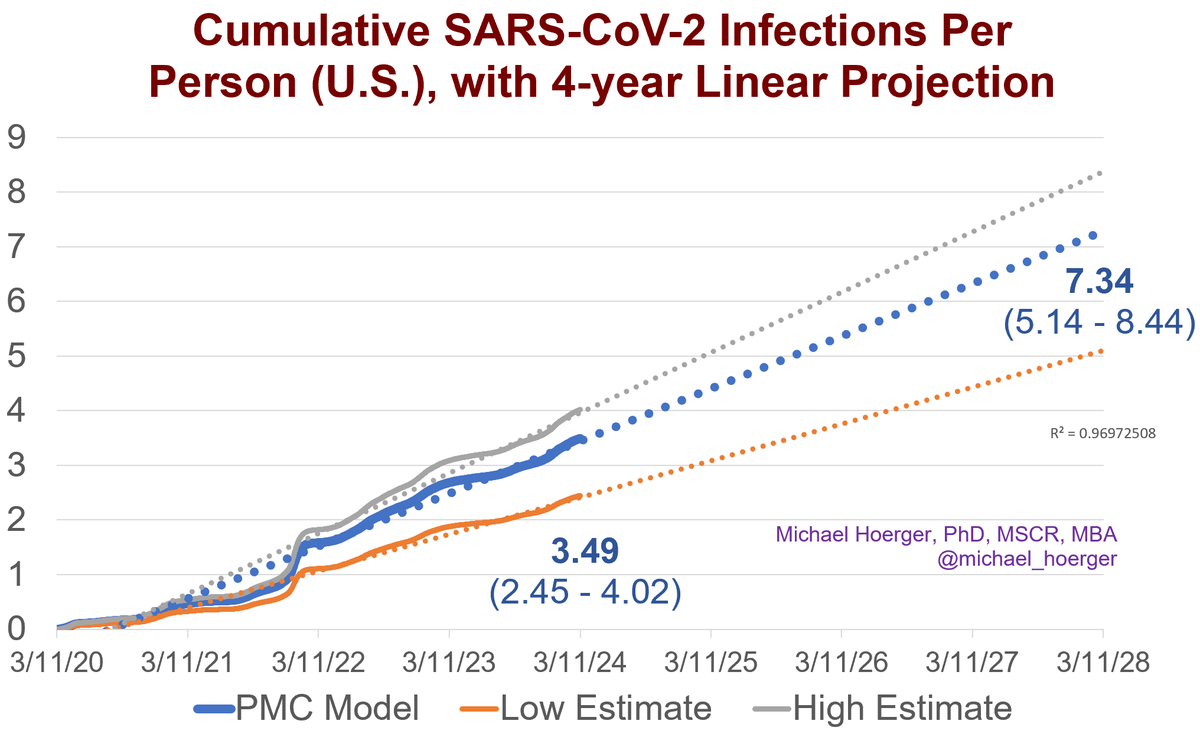
PMC COVID-19 Forecast, March 11, 2024
🧵1 of 3
🔹3.5 cumulative infections per person on average in the U.S. so far
🔹7.3 cumulative infections per person on average in the U.S. in four years, IF transmission continues according to the status quo of the linear trend
🔹Many caveats noted below
Four Years Into the Pandemic: Looking Back, Looking Forward
At the 4-year anniversary of the WHO Pandemic Declaration, the U.S. has seen an average of 3.5 cumulative infections per person (bold blue line), with a credible interval of 2.5 to 4.0 cumulative infections per person on average (other bold lines). A linear projection suggests that IF infections continue at the current rate, in 4 years the U.S. will reach an average of 7.3 cumulative infections per person, with a credible interval of 5.1 to 8.4 cumulative infections (dotted lines).
Individual Variation
Averages do not characterize individual variation in number of infections, which is likely substantial. These are averages, meaning that nearly half of people have had less than 3, and a little over half have likely had more than 3 infections. For each person that has had 2 infections, about as many people have had 5 infections (these are broad strokes). Moreover, individuals using multilayered mitigation are often on a much more gradual slope than individuals who are less cautious. Many people likely underestimate their number of infections due to a reduced emphasis on testing, false negatives, and asymptomatic cases. In publications on reinfections, serious long-term outcomes often start to escalate around the 3rd infection.
Mitigation Works
Note that from 2020-21, transmission was much slower (bold lines) than the overall trend (dotted lines). It took a long time to reach an average of 1 cumulative infection per person. Then, mitigation dwindled, with reduced emphasis on masking, testing, and isolation. Since the original omicron BA.1. surge, cumulative infections have increased at a relatively steady clip as public health has downplayed mitigation.
Linearity Does Not Mean Fatalism - The Slope Matters
It would be a mistake to take this graph for a fatalistic interpretation that we can do nothing on COVID. It shows that transmission was low when mitigation was in place (gradual slope). Now, transmission is much higher (steeper slope). The vertical access is cumulative infections, which can only increase, not decrease. Indeed, time accounts very well (R^2=.97) for the cumulative number of infections since the cumulative total only increases. That means that 97% of the variability in cumulative infections in our world as it exists can be explained by time passing. However, that statistic could just as easily be the case under a low-transmission graph (gradual slope) as in this high transmission graph.
Unconditional Long-term Forecasts are Uncertain, But a Conditional Forecast Can Provide a Useful Starting Point
The PMC has long cautioned never to take projections beyond two months as having a high degree of certainty. New subvariants make forecasting challenging beyond that time frame. Over the long-term, the potential for new vaccines and treatments creates substantial uncertainty. However, a “conditional forecast,” can be used to model what the world would be like, if one assumes X, Y, and Z to be true. This is much less useful as a forecasting tool. It’s a bit like a sports pundit saying, “The Warriors will win if Steph Curry scores 50 points.” What people want is the unconditional prediction, the forecast for the game outcome without qualifying it based on obvious stats. We cannot make unconditional and accurate long-term forecasts. The conditional forecast merely tells you what we would expect IF transmission proceeded according to the status quo.
How the Next 4 Years Could Be Different
The next 4 years could be much different from this linear projection. On the one hand, the CDC recently reduced the isolation period to 1 day, when most people remain highly infectious. Many people are not keeping up with vaccines. This could lead to a steeper slope and worse situation 4 years from now. However, improvements in vaccines could cause a more gradual slope or even a non-linear increase in cases such that cumulative infections increase at a slower and slower rate. As the long-term outcomes of repeat infections become more known, there could also be a reimplementation of other types of mitigation.
Where are the Waves?
Some might wonder how to reconcile this graph with those of daily transmission showing 8 pandemic waves. How is it so linear? Consider a large bowl of ice cream with 7 scoops. If the 8th scoop is big or small, it’s not affecting the cumulative total as much. One might not even discern the relative change. Same for cumulative reinfections. Since BA.1, infections have accumulated at a steady relatively linear fit. You can see waves and surges at the areas where the bold lines are higher than the dotted lines and times of lower transmission the reverse. The nature of a cumulative total, however, is that it obscures a lot of the month-to-month variation.
Enduring Immunity Against Infection?
Finally, this graph suggests that there is not credibly evidence of enduring immunity against COVID infections. If transmission were slowing, we would see a non-linear trend where the cumulative total increases more slowly and slowly. That does not seem to be the case. It could be that marginal gains in enduring immunity are being obscured by the reduction in public health mitigation, but such a hypothesis is not obviously supported in these data.
Thank you @EricTopol for illustrating the incorrect CDC policy on isolation.
In his next tweet, he addresses tests.
Regarding the CDC moving away from tests, a couple quick observations.
1. In the COVID Cautious Community, there has been a recent surge in people pushing the
We do need some general understanding of this, but currently there is none, no real research or investigation at all.
Certainly not the massive interdisciplinary research that would be necessary, to simply scope the situation.
25/
I'm not even going to attempt here, to forecast future scenarios, only to make people aware, that we are totally flying blind.
I'm pretty sure most people assume someone is studying this, when they're not.
21/
It's utterly bizarre, that in a world of political madness, increasingly crazy politicians, sabre-rattling, power play, and outright science denial, with crumbling societies, that governments will suddenly all come together to cooperate. Unrealistic is a total understatement.
20/
The last thing the rich and powerful want the public to know and understand, is that they have no idea what they are talking about, and that all the things they are promising the public about the future, are false. So they'd far rather not know.
16/
I have been practicing as a dr for nearly 3 decades. I have never seen so many young adults with autoimmune diseases diagnosed left right centre and on strong medications.
I have never seen so many new heart conditions.
People perpetually falling sick.
It is the Covid.
@singingsox Secondhand smoke carries fewer risks than COVID infection, yet there was enough consensus to ban smoking indoors.
It really shouldn't be hard to grasp the necessity of clean, safe air.
@singingsox Secondhand smoke carries fewer risks than COVID infection, yet there was enough consensus to ban smoking indoors.
It really shouldn't be hard to grasp the necessity of clean, safe air.